Laser diffuse reflection sensors are widely used in industrial automation, object detection, and distance measurement due to their reliability and non-contact operation. Understanding their working principles is essential for selecting and applying these devices effectively. This article explains the fundamental concepts, components, and operational mechanisms of laser diffuse reflection sensors in a clear, technical manner.
At its core, a laser diffuse reflection sensor operates by emitting a focused laser beam toward a target object. Unlike specular reflection, where light reflects at a defined angle (like a mirror), diffuse reflection occurs when the target surface is rough or matte, scattering the light in many directions. The sensor contains a laser diode that generates a coherent, monochromatic light beam, typically in the visible red or infrared spectrum. This beam is directed through an optical lens system, which focuses it into a precise spot on the target. When the beam strikes the object, the surface texture causes the light to scatter diffusely. A portion of this scattered light returns to the sensor, where a receiver element—usually a photodiode or position-sensitive detector (PSD)—captures it. The receiver converts the light intensity into an electrical signal, which is then processed by internal circuitry to determine the presence, absence, or distance of the object.
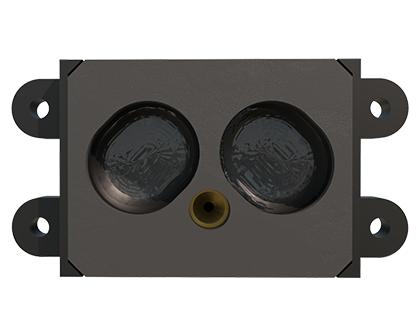
Key components include the laser emitter, optical system, receiver, and signal processing unit. The laser emitter provides a stable, high-intensity light source with low divergence, ensuring accurate targeting over distances. Optical lenses collimate and focus the beam to minimize spot size and enhance resolution. The receiver is often positioned adjacent to the emitter in a compact housing, designed to detect the weak, scattered return light while filtering out ambient interference using spectral filters or modulation techniques. Signal processing involves comparing the received light intensity to a threshold or analyzing the triangulation geometry for distance measurement. In triangulation-based diffuse reflection sensors, the receiver is offset from the emitter at a known angle. By measuring the position where the reflected light strikes the receiver, the sensor calculates the distance to the target using trigonometric principles. This method allows for precise measurements even on non-uniform surfaces.
Applications of laser diffuse reflection sensors span various industries. In manufacturing, they detect objects on conveyor belts, monitor fill levels in containers, or ensure proper positioning in assembly lines. Their ability to work on diverse surfaces—from glossy metals to opaque plastics—makes them versatile. Environmental factors like dust, humidity, or ambient light can affect performance, so modern sensors incorporate features such as background suppression, which ignores reflections beyond a set distance, or temperature compensation to maintain accuracy. Calibration is crucial; users often adjust sensitivity thresholds or teach-in reference points based on specific target materials and conditions.
Advantages include fast response times, high precision, and minimal maintenance due to the absence of moving parts. However, limitations exist: extremely dark or absorbent surfaces may reflect insufficient light, reducing detection range, while highly reflective surfaces can cause false signals. Choosing the right sensor involves considering factors like sensing distance, spot size, response time, and environmental robustness. Recent advancements include integrated smart functions like IO-Link communication for real-time diagnostics and adaptive algorithms that compensate for surface variations.

In summary, laser diffuse reflection sensors rely on the scattering of laser light from target surfaces to enable non-contact detection and measurement. Their design combines optics, electronics, and signal processing to deliver reliable performance in challenging industrial settings. By grasping these principles, engineers and technicians can optimize sensor selection and implementation for enhanced automation efficiency.