In industrial automation and control systems, proximity sensors play a critical role in detecting the presence or absence of objects without physical contact. A fundamental aspect of their functionality revolves around voltage, which governs their operation, performance, and integration into broader circuits. This article delves into the intricacies of voltage in proximity sensor applications, covering key principles, typical voltage ranges, and practical considerations for engineers.
Proximity sensors, including inductive, capacitive, and photoelectric types, rely on electrical signals to sense objects. Voltage serves as the primary energy source that powers these sensors, enabling them to generate electromagnetic fields, capacitive changes, or light beams. For instance, inductive proximity sensors use a coil energized by a direct current (DC) voltage to produce an oscillating magnetic field. When a metallic object enters this field, eddy currents are induced, altering the oscillation amplitude and triggering a switch output. The operating voltage directly influences the sensor's sensing range, response time, and stability. Most industrial proximity sensors operate within DC voltage ranges of 10-30V DC or alternating current (AC) voltages of 90-250V AC, with 12V DC and 24V DC being common standards due to their compatibility with programmable logic controllers (PLCs) and safety regulations.
Voltage requirements vary by sensor type and design. Inductive sensors typically function at lower voltages (e.g., 5-24V DC) for precise detection of metals, while capacitive sensors may handle wider ranges (e.g., 10-65V DC) to sense non-metallic materials like plastics or liquids. Photoelectric sensors, which use light emitters and receivers, often operate at 12-24V DC to balance power consumption and detection accuracy. Engineers must adhere to manufacturer-specified voltage ratings to prevent malfunctions. Undervoltage can lead to insufficient signal strength, causing false negatives or reduced sensing distances, whereas overvoltage may damage internal components, such as transistors or integrated circuits, shortening the sensor's lifespan.
In circuit design, voltage drop and supply stability are crucial factors. Proximity sensors are often connected in series or parallel within control panels, and voltage drops across long cables or due to high current loads can impair performance. Using proper wire gauges and regulated power supplies minimizes these issues. Additionally, sensors with voltage protection features, like surge suppression or reverse polarity protection, enhance reliability in harsh environments with electrical noise or fluctuations.
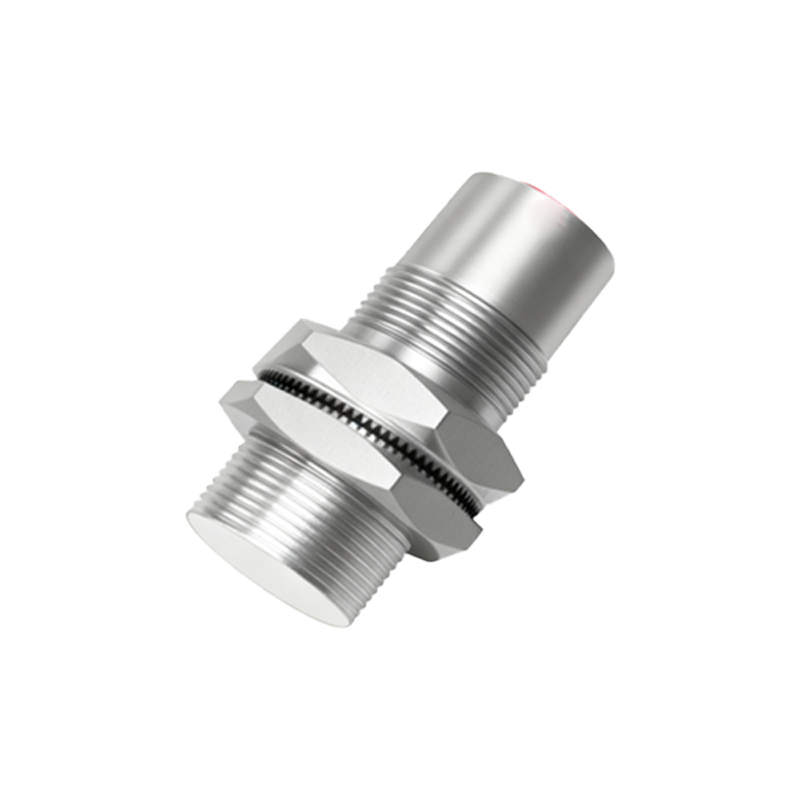
Output voltage levels also define sensor interfaces. Many proximity sensors provide digital outputs, such as NPN (sinking) or PNP (sourcing) transistor switches, which operate at the supply voltage. For example, a 24V DC sensor might output a signal at 24V when activated, interfacing seamlessly with PLCs or relays. Analog output sensors, conversely, produce a voltage proportional to the detected distance (e.g., 0-10V DC), enabling continuous monitoring in applications like positioning systems. Understanding these output characteristics ensures correct integration with downstream equipment.
Maintenance and troubleshooting often involve voltage measurements. Using a multimeter, technicians can verify supply voltage, output signals, and grounding to diagnose issues like sensor failure or wiring faults. Regular checks for voltage consistency help preempt downtime in automated lines. In summary, voltage is not merely a power parameter but a core element that dictates the efficacy of proximity sensors. By selecting appropriate voltage levels and ensuring stable electrical conditions, engineers can optimize sensor performance for diverse industrial tasks, from assembly robots to safety barriers.