Inductive proximity sensors are stalwarts of industrial automation, offering non-contact detection of metallic objects with remarkable reliability. Operating on the principle of electromagnetic induction, these sensors generate an oscillating electromagnetic field from a coil wound around a ferrite core. When a metallic target enters this field, eddy currents are induced on the target's surface. This causes a change in the oscillation amplitude within the sensor's coil, which is detected by a threshold circuit, subsequently triggering a solid-state output signal. This fundamental operating principle makes them exceptionally robust, immune to environmental factors like dust, oil, and moisture that often plague mechanical switches or optical sensors.
The core advantages of inductive sensors are numerous. Their non-contact nature eliminates mechanical wear, granting an exceptionally long operational life. They are capable of high-speed switching, with response frequencies often reaching several kilohertz, making them ideal for counting or high-speed production lines. Furthermore, they are inherently self-contained, requiring no separate receiver or reflector. A critical specification is the nominal sensing distance (Sn), typically ranging from a few millimeters to about 60mm for standard cylindrical models. It is vital to note that this rated distance is defined for a standard target of mild steel. For other metals, a correction factor must be applied; for instance, stainless steel may reduce the effective range to about 0.7-0.9 times Sn, while copper or aluminum can reduce it to 0.3-0.5 times Sn.
Several key design variations exist to suit diverse applications. Shielded (flush-mountable) sensors allow for side-by-side installation without mutual interference, as their magnetic field is concentrated in front of the sensing face. Unshielded (non-flush) sensors offer a longer sensing range but require clearance around the sides. The output configuration is another major differentiator, with NPN (sinking) and PNP (sourcing) transistor outputs being the most common, alongside Normally Open (NO) and Normally Closed (NC) switching logic. Two-wire AC/DC, three-wire DC, and four-wire (with both NO and NC outputs) models provide further flexibility for integration into various control systems, such as PLCs (Programmable Logic Controllers).
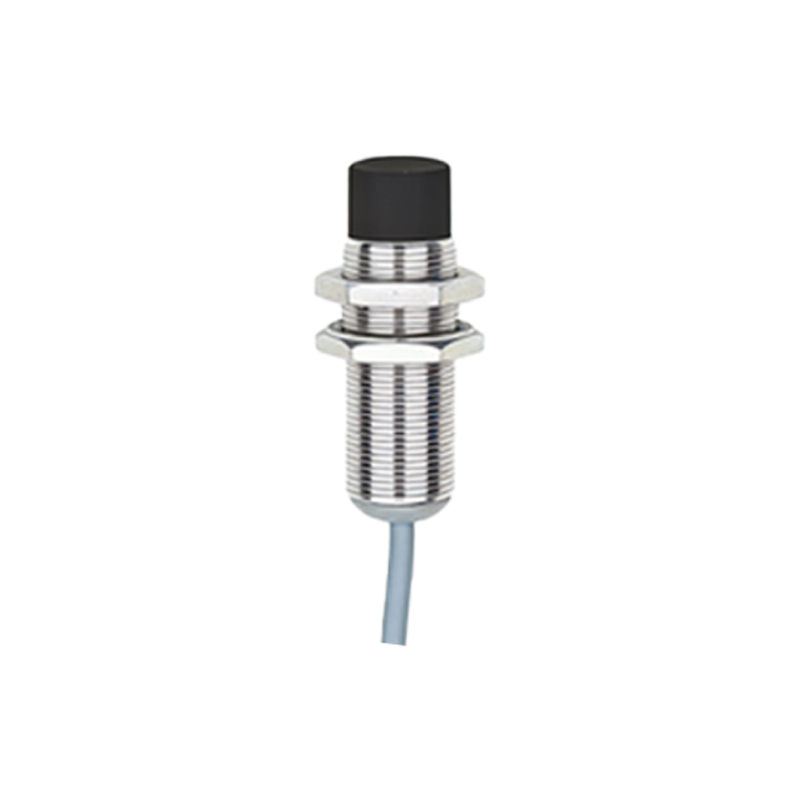
Application scenarios are vast across manufacturing, packaging, material handling, and automotive industries. Common uses include position verification of machine parts (e.g., cylinder end-position detection), detection of metallic objects on conveyors, counting of metal products, and monitoring of rotational speed via a gear tooth or key on a shaft. In robotic cells, they ensure precise tool positioning or pallet presence. Their durability makes them perfect for harsh environments like metal stamping or machining centers where coolant and metal chips are prevalent.
Selecting the right inductive sensor requires careful consideration of several parameters. First, identify the target material and required sensing distance, applying the necessary correction factor. The sensor's housing material (e.g., nickel-plated brass, stainless steel, or PBT plastic) must withstand the chemical and physical conditions of the environment, including temperature extremes and potential washdowns. The electrical requirements—operating voltage (commonly 10-30V DC or 20-250V AC), output type (NPN/PNP), and current rating—must match the control system. Physical size and mounting style (threaded barrel, rectangular, or slot style) are dictated by space constraints. For advanced needs, factors like switching frequency, hysteresis, and availability of IO-Link for digital communication and parameterization should be evaluated.
Installation and wiring are straightforward but demand attention to detail. Ensure the sensor is mounted securely without misalignment to the target's approach path. Maintain the specified mounting clearances, especially for unshielded types, to prevent false triggering. For DC models, correct polarity must be observed, and the load (e.g., a PLC input) should be connected in series. In electrically noisy environments, using shielded cables and proper grounding is recommended. Regular maintenance is minimal but should involve periodic cleaning of the sensing face to remove accumulated metallic debris or grime that could marginally affect performance.
In conclusion, inductive proximity sensors are indispensable, high-performance components in modern industrial control. Their simple yet effective operating principle translates into ruggedness, speed, and longevity. By meticulously matching sensor specifications—including type, sensing distance, output, housing, and electrical characteristics—to the specific application requirements, engineers can build more reliable, efficient, and maintenance-friendly automated systems. As Industry 4.0 progresses, the integration of smart features like IO-Link is further enhancing their diagnostic capabilities and value within connected factories.