Welding wire laser sensors represent a significant advancement in industrial automation and welding technology, offering unparalleled precision, reliability, and efficiency. These sensors utilize laser-based measurement principles to monitor and control the feeding and positioning of welding wire in real-time, ensuring optimal weld quality and consistency across various applications, from automotive manufacturing to heavy machinery production.
At the core of welding wire laser sensors is the use of laser triangulation or time-of-flight measurement techniques. In laser triangulation, a laser diode projects a focused beam onto the welding wire surface. The reflected light is captured by a high-resolution CMOS or CCD sensor at a specific angle. By analyzing the displacement of the laser spot on the sensor, the system calculates the exact position, diameter, and feed rate of the wire with micron-level accuracy. Time-of-flight sensors, on the other hand, measure the round-trip time of laser pulses to determine distance, providing robust performance even in challenging environments with spatter, fumes, or varying ambient light.
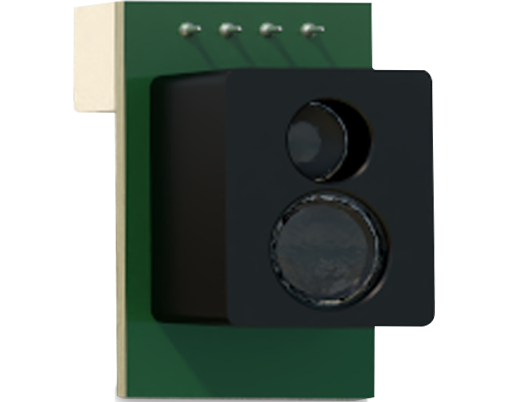
The integration of these sensors into welding systems—such as MIG (Metal Inert Gas), TIG (Tungsten Inert Gas), and robotic welding cells—brings multiple benefits. First, they enable precise wire feed control, preventing issues like birdnesting (tangling) or inconsistent wire extension, which can lead to defects such as porosity, incomplete fusion, or excessive spatter. By maintaining a constant contact tip-to-work distance (CTWD), the sensors ensure stable arc characteristics and uniform bead geometry, directly enhancing weld strength and appearance.
Second, welding wire laser sensors contribute to process optimization and cost reduction. Real-time monitoring allows for immediate adjustments, minimizing material waste from overfeeding or underfeeding wire. For instance, in high-volume production lines, even a minor deviation in wire diameter can accumulate significant scrap over time. Laser sensors detect such variations instantly, triggering corrective actions or alerts. This proactive approach reduces downtime for manual inspections and rework, boosting overall equipment effectiveness (OEE).
Moreover, these sensors support adaptive welding in applications with complex joint geometries or varying gaps. In pipeline welding or shipbuilding, where workpiece alignment may not be perfect, laser sensors scan the joint profile and adjust welding parameters dynamically. This includes modulating wire feed speed, voltage, and travel speed to fill gaps uniformly, ensuring compliance with stringent industry standards like AWS (American Welding Society) or ISO (International Organization for Standardization).
The robustness of modern welding wire laser sensors is another key advantage. Designed to withstand harsh industrial conditions, they feature IP67-rated enclosures that resist dust, moisture, and mechanical shocks. Advanced models incorporate anti-spatter coatings and air-purge systems to maintain lens clarity in high-spatter environments like submerged arc welding. Additionally, integration with industrial networks (e.g., Ethernet/IP, PROFINET) allows seamless data exchange with PLCs (Programmable Logic Controllers) or SCADA (Supervisory Control and Data Acquisition) systems, enabling predictive maintenance and data analytics for continuous process improvement.
In practice, implementing welding wire laser sensors involves careful calibration and alignment. The sensor must be mounted at an optimal angle and distance from the wire, typically within 50-200 mm, depending on the laser class and measurement range. Calibration routines using certified reference wires ensure accuracy, while user-friendly software interfaces simplify setup and diagnostics. For robotic welding, sensors are often integrated into the torch or mounted on auxiliary axes, providing real-time feedback to the robot controller for path correction.
Looking ahead, trends like Industry 4.0 and smart manufacturing are driving further innovations. Welding wire laser sensors are evolving to incorporate AI (Artificial Intelligence) algorithms for defect prediction and quality classification. By analyzing historical data, these smart sensors can identify patterns indicative of impending failures, such as liner wear or drive roll slippage, enabling preemptive maintenance. Furthermore, the miniaturization of laser components is making sensors more compact and affordable, expanding their use in small-scale or portable welding equipment.
In conclusion, welding wire laser sensors are indispensable tools for achieving high-quality, efficient, and automated welding processes. Their ability to deliver precise, real-time measurements transforms traditional welding into a data-driven operation, reducing errors, enhancing productivity, and lowering operational costs. As welding technology advances toward greater automation and connectivity, these sensors will continue to play a pivotal role in shaping the future of industrial fabrication.