In modern industrial automation, maintaining precise tension control in material handling systems is critical for product quality and operational efficiency. Rubber bands, often used in packaging, textile, and assembly lines, require consistent tension to prevent slippage, breakage, or deformation. Traditional methods like mechanical tensioners or manual adjustments are prone to inaccuracies and wear. Laser sensors offer a non-contact, high-precision solution for real-time rubber band tension monitoring, revolutionizing this aspect of industrial processes.
Laser sensors operate by emitting a focused beam of light onto the target surface—here, the rubber band. As the band stretches or relaxes under tension, its surface reflects the laser light differently. Advanced sensors, such as laser triangulation or time-of-flight models, detect minute changes in distance or position with micron-level accuracy. For instance, a laser displacement sensor can measure the exact elongation of a rubber band as it moves along a conveyor. By correlating elongation with known material properties (like elasticity modulus), engineers can calculate tension force dynamically without physical contact. This eliminates friction-induced errors and reduces maintenance needs compared to tactile sensors.
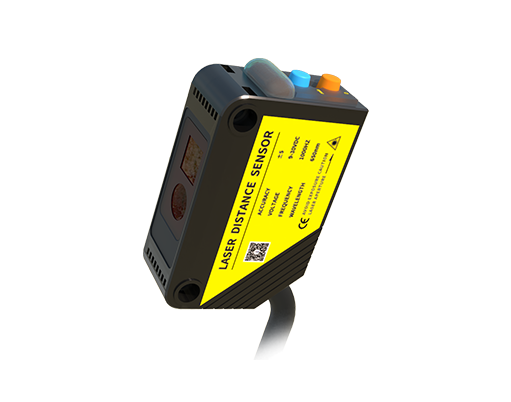
The integration of laser sensors into rubber band systems involves several key components. A typical setup includes a laser emitter-receiver unit, a data acquisition module, and control software. The sensor continuously scans the band's surface, capturing data points on its thickness or displacement. This data is processed using algorithms that account for factors like ambient vibration, temperature fluctuations, and band material variations. In high-speed packaging lines, for example, laser sensors can detect tension drops that might cause misalignment of products, triggering automatic adjustments via servo motors. This ensures uniform wrapping and reduces waste. Moreover, laser systems are adaptable to different band types—synthetic, natural rubber, or silicone—by calibrating to specific reflective properties.
Benefits of using laser sensors for rubber band tension monitoring are substantial. First, non-contact measurement preserves band integrity, avoiding wear from mechanical probes. Second, real-time feedback enables predictive maintenance; sensors can alert operators to gradual tension loss before failure occurs, minimizing downtime. In industries like pharmaceuticals, where sterile packaging is vital, laser sensors maintain hygiene by eliminating contamination risks from touching components. Additionally, these sensors enhance energy efficiency by optimizing tension to the minimum required level, reducing motor strain and power consumption. Case studies from automotive assembly lines show that laser-based tension control cut rubber band-related stoppages by over 30%, boosting throughput.
However, challenges exist in implementation. Laser sensors require clear line-of-sight, which can be obstructed by dust or debris in industrial environments. Regular cleaning and protective housings are necessary. Calibration must be precise, as incorrect alignment may lead to false readings. For elastic bands with high stretchability, sensors need high sampling rates to track rapid changes. Advances in infrared laser technology and machine learning integration are addressing these issues, allowing for adaptive calibration and noise filtering. Future trends include wireless laser sensor networks for large-scale monitoring and IoT connectivity for remote diagnostics.
In conclusion, laser sensors provide a robust, accurate method for monitoring rubber band tension in industrial settings. By enabling non-contact, real-time measurements, they improve product consistency, reduce operational costs, and support automation goals. As industries evolve toward smarter manufacturing, adopting laser-based solutions for seemingly simple components like rubber bands exemplifies how precision engineering drives overall system reliability. Engineers should consider factors like environmental conditions and band specifications when selecting sensors, ensuring seamless integration into existing workflows for long-term benefits.