In the realm of industrial automation, where reliability, precision, and durability are paramount, inductive proximity sensors stand as a cornerstone technology. These non-contact sensing devices are ubiquitous on factory floors, silently performing critical tasks in machine control, positioning, and safety systems. Their fundamental operating principle is elegantly simple yet robust, based on the laws of electromagnetic induction.
At the heart of an inductive proximity sensor lies a coil wound around a ferrite core, which, when energized by an oscillator circuit, generates a high-frequency alternating electromagnetic field at its active face. This field extends into the surrounding space. When a metallic object—the "target"—enters this field, eddy currents are induced on the surface of the target. These eddy currents, in accordance with Lenz's Law, create their own opposing magnetic field, which absorbs energy from the sensor's oscillating circuit. This energy loss causes a change in the oscillation amplitude. A subsequent evaluation circuit within the sensor detects this change and triggers a switching action, typically opening or closing a solid-state output (PNP or NPN). The target is detected without any physical contact, eliminating mechanical wear and enabling high-speed operation.
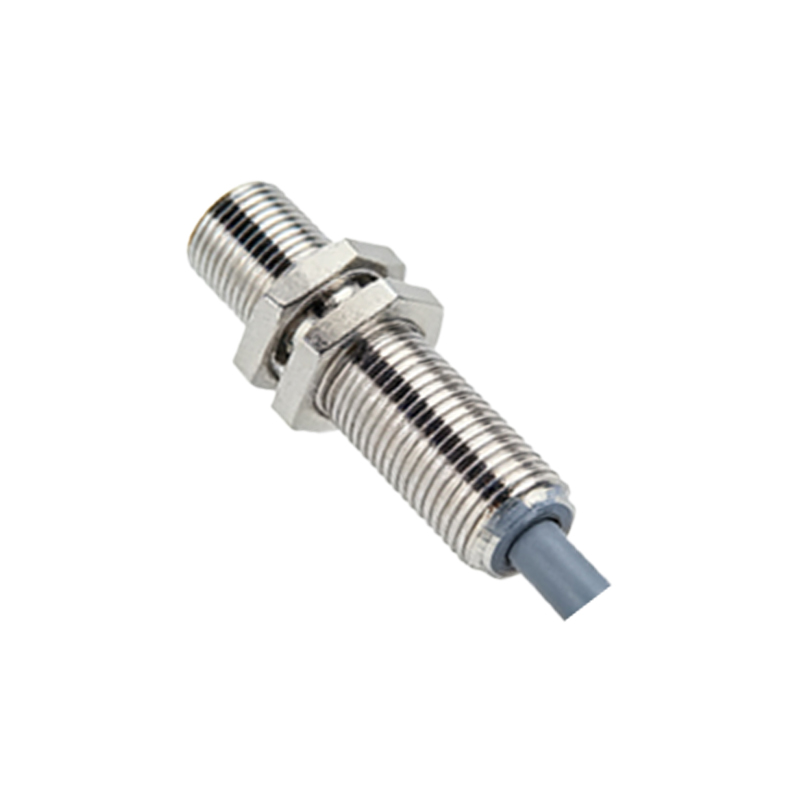
A key characteristic of inductive sensors is their sensitivity to conductive metals, primarily ferrous metals like steel and iron. The sensing distance, or "switching distance," is standardized as the nominal operating distance (Sn). It is important to note that this nominal distance is defined for a standard target of mild steel (Fe360) with a thickness of 1mm and a side length equal to the sensor's diameter or three times the nominal distance. For other metals, a correction factor must be applied. For instance, stainless steel (austenitic) typically reduces the effective sensing range to about 0.7-0.9 times Sn, while aluminum and copper reduce it significantly further to approximately 0.3-0.4 times Sn and 0.2-0.3 times Sn, respectively. This metal dependency is a critical consideration during sensor selection.
The advantages of inductive proximity sensors are numerous and explain their widespread adoption. They are exceptionally robust, featuring housings typically made of nickel-plated brass, stainless steel, or PBT plastic, offering high resistance to shock, vibration, and harsh industrial environments including coolants, oils, and dust (many conform to IP67 or IP69K ratings). They offer very fast switching frequencies, often exceeding several kilohertz, making them suitable for high-speed counting and positioning applications. With no moving parts, they boast a virtually infinite mechanical lifespan, limited only by the electronic components. Furthermore, they are immune to ambient light, unlike optical sensors, and are generally unaffected by non-metallic substances like dirt, wood, or liquids, ensuring stable operation.
Applications are vast and varied across all industrial sectors. Common uses include position detection of machine parts (e.g., cylinder end positions, presence of a metal workpiece on a conveyor), high-speed counting of metal objects (bottlecaps, cans), rotational speed monitoring via a gear tooth or keyway, and as part of safety interlocks on machine guards. Specialized variants include analog output sensors for distance measurement, factor-1 sensors that offer the same sensing distance for all metals, and weld-field immune sensors designed to function reliably in the intense electromagnetic noise of resistance welding equipment.
Selecting the right inductive sensor requires careful analysis of several parameters. First, define the application: the target material, size, and required sensing distance. Choose the housing style (cylindrical, rectangular, ring-shaped) and size to fit the mechanical constraints. The electrical specifications are crucial: operating voltage (commonly 10-30V DC or 20-250V AC), output type (PNP normally open/closed, NPN normally open/closed), and output current rating. Environmental factors such as temperature range, required ingress protection (IP rating), and potential chemical exposure must be considered. For challenging environments, look for features like extended temperature ranges, PTFE coatings for chemical resistance, or flush-mounted designs that allow installation flush in a metal bracket without loss of sensing range.
Installation and wiring also demand attention. Maintain the specified mounting clearances from surrounding metal to prevent false triggering. Use shielded cables in electrically noisy environments and ensure proper grounding. Always refer to the manufacturer's datasheet for precise specifications, connection diagrams, and installation guidelines.
In conclusion, inductive proximity sensors are a mature, reliable, and versatile solution for metallic object detection. Their non-contact nature, rugged construction, and high performance make them an indispensable component in modern automated systems. A thorough understanding of their operating principles, characteristics, and selection criteria empowers engineers and technicians to deploy them effectively, ensuring optimal machine performance, enhanced safety, and reduced maintenance costs across countless industrial applications.