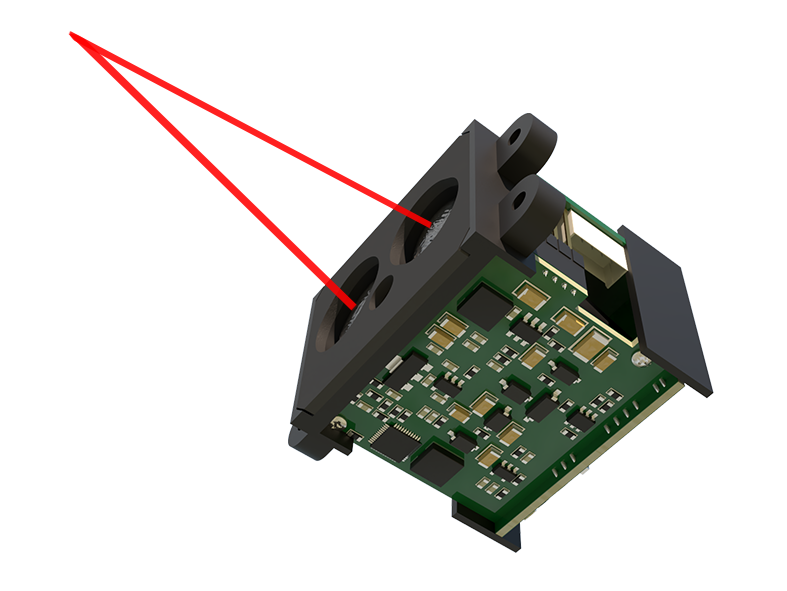
Single-shot laser sensors represent a pivotal advancement in non-contact measurement technology, enabling high-precision detection and positioning across diverse industrial applications. These sensors operate by emitting a focused laser pulse toward a target object and analyzing the reflected light to calculate distance, displacement, or presence with exceptional accuracy. Unlike continuous-wave lasers, single-shot variants deliver discrete, rapid measurements per trigger, making them ideal for dynamic environments where objects are in motion or where intermittent monitoring is required.
The core mechanism relies on time-of-flight (ToF) or triangulation principles. In ToF-based sensors, the time taken for the laser pulse to travel to the target and back is measured, with distance derived from the speed of light. This method excels in long-range applications, such as warehouse logistics for pallet positioning or construction site monitoring. Triangulation-based sensors, conversely, use a receiver at a known angle to the emitter; the position of the reflected spot on a detector array determines distance through geometric calculations. This approach offers micron-level resolution, suited for precision manufacturing tasks like semiconductor wafer alignment or automotive component inspection.
Key advantages of single-shot laser sensors include their immunity to ambient light interference, thanks to narrow-band optical filters and synchronized detection circuits. They maintain reliability in harsh conditions—such as dust, vibration, or temperature fluctuations—common in factories or outdoor settings. Additionally, their fast response times, often in the microsecond range, facilitate real-time control in automated assembly lines, robotics, and quality assurance systems. For instance, in packaging industries, these sensors verify fill levels without physical contact, preventing contamination while boosting throughput.
Integration with industrial networks (e.g., IO-Link, Ethernet/IP) allows for seamless data communication, enabling predictive maintenance and adaptive process adjustments. Modern sensors incorporate smart features like background suppression, which ignores irrelevant surfaces, and programmable logic for multi-threshold detection. However, challenges persist, including sensitivity to highly reflective or absorptive materials, which may require calibration or complementary sensor fusion.

Looking ahead, trends like miniaturization and AI-enhanced signal processing are expanding applications into fields like autonomous vehicles for obstacle detection and medical devices for non-invasive diagnostics. As Industry 4.0 evolves, single-shot laser sensors will continue to drive efficiency, reducing downtime and enhancing safety. Engineers must consider factors like beam divergence, sampling rate, and environmental certifications (e.g., IP67) when selecting sensors to ensure optimal performance. Ultimately, these devices epitomize the convergence of optics, electronics, and software, offering robust solutions for tomorrow’s smart industries.