In today's rapidly evolving industrial landscape, the demand for precision, reliability, and seamless integration is paramount. Standard proximity sensors often fall short when faced with unique spatial constraints, specific material detection challenges, or harsh environmental conditions. This is where the power of custom circular proximity sensors comes into play, offering engineered solutions that bridge the gap between off-the-shelf components and perfect application fit.
The core advantage of a circular form factor lies in its versatility and mounting simplicity. Unlike rectangular or complex-shaped housings, a circular sensor can be easily integrated into drilled holes, providing a clean, flush installation. This is critical in applications with limited space or where a low-profile design is necessary to avoid interference with moving parts. Customization begins with this fundamental shape, allowing engineers to specify exact diameter, length, and thread patterns to match existing panel cutouts or design new, optimized layouts.
Material compatibility is a primary driver for customization. While standard inductive sensors are excellent for detecting metals, many applications involve non-ferrous metals, plastics, glass, or liquids. Custom circular proximity sensors can be calibrated to specific sensing distances and tuned to the target material's electrical properties. For instance, a sensor can be designed with a higher frequency oscillation to reliably detect aluminum, or capacitive variants can be engineered to sense non-metallic materials through barriers. The sensing range itself is not a fixed value; it can be extended or reduced based on the coil design and electronics within the same circular housing.
Environmental resilience is another critical dimension. Off-the-shelf sensors might offer basic IP67 ratings, but extreme conditions demand more. Customization allows for the specification of housings made from stainless steel, nickel-plated brass, or specialized polymers to resist corrosion from chemicals, salts, or frequent washdowns. The internal electronics can be potted with high-grade epoxy to withstand severe vibration, shock, and wide temperature fluctuations from -40°C to 100°C and beyond. Connectors and cabling can also be tailored, from rugged M12 connectors to extended-length cables with specific jacket materials for oil resistance or flexibility.
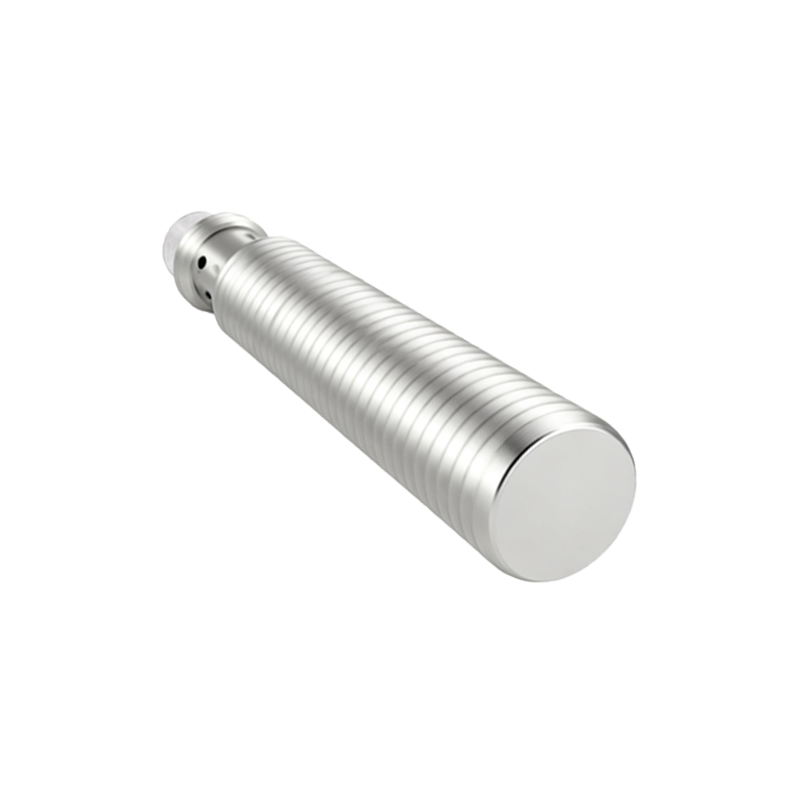
Electrical output and interface requirements are equally customizable. Whether a project needs a simple Normally Open (NO) or Normally Closed (NC) PNP/NPN output, a push-pull configuration, or an analog output (4-20mA or 0-10V) for distance proportionality, the sensor's circuitry can be designed accordingly. Integration with modern industrial networks is also possible, with options for IO-Link functionality embedded within the compact circular housing. IO-Link enables digital parameter setting, real-time diagnostics, and condition monitoring, transforming a simple sensor into a smart data point on the network.
The development process for a custom circular proximity sensor is a collaborative partnership. It typically starts with a detailed application review: the target object material, required sensing distance, operating environment, power supply, output signal, and mounting constraints. Prototypes are then developed and tested under real or simulated conditions to validate performance. This iterative process ensures the final product delivers consistent, reliable detection in the specific use case, whether it's for precise positioning in semiconductor manufacturing, bottle cap detection in food packaging, or tire presence verification in automotive assembly.
Ultimately, investing in custom circular proximity sensors is an investment in system efficiency, longevity, and reduced total cost of ownership. It eliminates compromises, reduces installation headaches caused by adapters or brackets, and minimizes downtime due to sensor failure. By tailoring the sensor to the environment instead of forcing the application to accommodate a standard sensor, engineers achieve higher levels of automation reliability and precision. For OEMs and system integrators, this customization provides a competitive edge, enabling the design of more compact, robust, and intelligent machinery.