In the realm of industrial automation, proximity sensors are indispensable for non-contact object detection. However, a persistent challenge arises when the target material is aluminum. Unlike ferrous metals, aluminum is non-magnetic and possesses unique electrical properties that can confound standard inductive proximity sensors. This article delves into the technical intricacies of detecting aluminum with proximity sensors, explores suitable sensor technologies, and provides practical application guidance.
Standard inductive proximity sensors operate on the principle of electromagnetic induction. They generate a high-frequency oscillating electromagnetic field. When a ferrous metal (like steel or iron) enters this field, eddy currents are induced on the metal's surface. These eddy currents draw energy from the sensor's oscillator, causing a detectable amplitude drop that triggers the sensor's output. Aluminum, being a conductive but non-ferrous metal, also induces eddy currents. The core issue is the "skin effect." The depth at which eddy currents flow is inversely proportional to the frequency and the material's conductivity and permeability. Aluminum has high conductivity and very low permeability (approximately 1, similar to air). This results in a much shallower skin depth compared to steel for the same frequency. Consequently, the energy loss in the oscillator circuit is less pronounced, leading to a significantly reduced sensing range—often only 30% to 50% of the rated sensing distance for steel.
To reliably detect aluminum, specific sensor technologies and configurations are employed:
1. Factor-1 Sensors: These are specialized inductive sensors designed for non-ferrous metals. They operate at a higher frequency, which improves sensitivity to good conductors like aluminum, copper, and brass. The "Factor-1" designation means their sensing range for a given size is approximately equivalent for both steel and aluminum. They are the most direct solution.
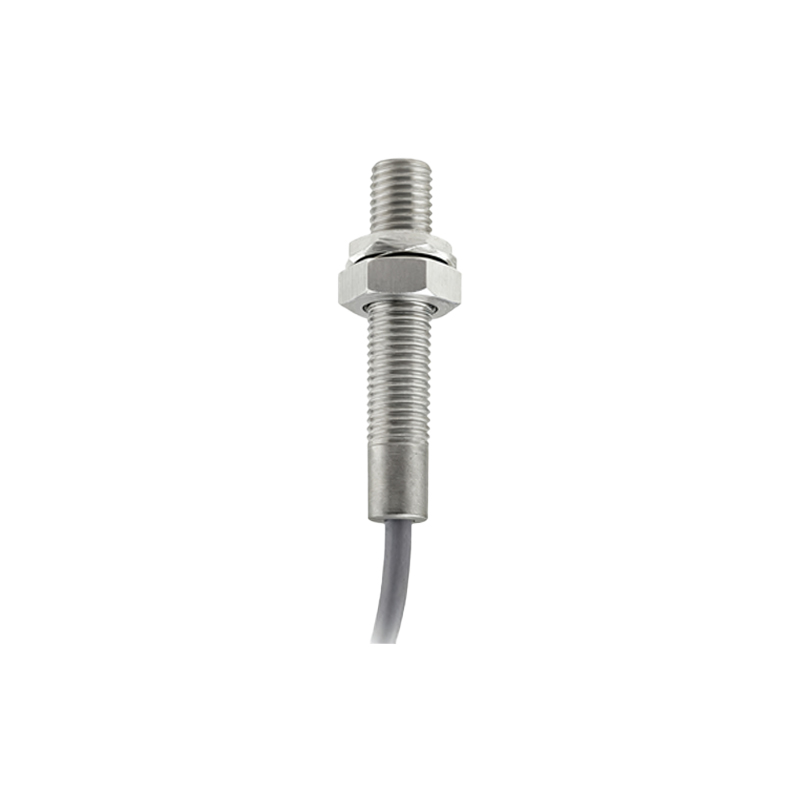
2. All-Metal Sensors (Factor-1 Type): Often marketed as "all-metal" or "non-ferrous metal" sensors, these are essentially optimized Factor-1 sensors. Their internal circuitry is tuned to respond to the specific eddy current pattern generated in materials with low permeability and high conductivity.
3. Capacitive Proximity Sensors: For non-metallic targets or where the aluminum target is very thin or anodized, capacitive sensors offer an alternative. They detect changes in capacitance caused by any material that alters the dielectric constant near their sensing face. They can detect aluminum regardless of its alloy or surface treatment, but are also sensitive to moisture, dust, and other environmental factors.
4. Ultrasonic Sensors: These measure the time-of-flight of sound waves and are completely material-agnostic. They are excellent for detecting aluminum parts at longer ranges or with complex shapes, though they may be slower and more susceptible to temperature variations and acoustic noise.
Key Application Considerations:
Sensing Distance: Always refer to the sensor's technical data sheet for the exact reduction factor (e.g., Sn/Al = 0.4) for aluminum. Never assume the nominal steel sensing distance applies.
Aluminum Alloy & Surface Condition: The exact composition (e.g., 6061 vs. 1100) affects conductivity. Anodized coatings are non-conductive and will prevent detection by inductive sensors unless the coating is very thin; capacitive or ultrasonic sensors may be required.
Target Size: The target should be at least equal to the sensor's sensing face diameter for reliable switching. For small aluminum parts, a sensor with a smaller face may be necessary.
Mounting & Environment: Ensure flush mounting in metal is avoided unless the sensor is specifically rated as "non-flush mountable." Consider environmental factors like coolant, metal chips, and vibration.
Best Practices for System Integration:
1. Test with the Actual Part: Before finalizing a design, prototype with the exact aluminum alloy, size, and expected surface finish.
2. Adjust Sensitivity: Many modern sensors feature a potentiometer or teach-in function. Use this to fine-tune the sensing point for your specific aluminum target, maximizing reliability.
3. Maintain Consistency: In high-speed counting or positioning applications, ensure the aluminum parts have consistent geometry and presentation to the sensor to avoid false triggers or missed detections.
4. Consider Shielding: In electrically noisy environments, use shielded cables and proper grounding to prevent electromagnetic interference from affecting the sensitive detection circuit.
In conclusion, detecting aluminum is not a limitation but a specific application requirement. By selecting the appropriate sensor technology—primarily Factor-1 inductive sensors—and carefully applying the considerations outlined above, engineers can achieve robust, reliable detection of aluminum components. This ensures seamless automation processes in industries ranging from automotive machining and aerospace assembly to packaging and robotic handling, where aluminum's lightweight properties are increasingly favored.