In the realm of industrial automation and precision metrology, the demand for accurate, reliable, and high-speed non-contact measurement has never been greater. Among the various technologies available, blue laser displacement sensors have emerged as a superior solution for a wide range of challenging applications. Unlike their traditional red laser counterparts, which typically operate at wavelengths around 650 nm, blue laser sensors utilize a shorter wavelength, generally around 405 nm. This fundamental difference in light source technology unlocks significant performance advantages.
The core principle of operation for a triangulation-based blue laser displacement sensor remains similar to other laser sensors. A focused blue laser beam is projected onto the target surface. The diffusely reflected light from this point is then captured by a high-resolution CMOS or CCD receiver lens at a specific angle. The position of the reflected light spot on the receiver shifts proportionally to the distance of the target. Sophisticated internal processors analyze this shift to calculate the precise displacement, height, or thickness with exceptional accuracy. However, the shorter wavelength of blue light is the key to its enhanced capabilities.

One of the most critical advantages of the blue laser is its interaction with various materials. Many industrial materials, including metals like copper, brass, and gold, transparent objects such as glass and clear plastics, and low-reflectivity surfaces like black rubber or carbon fiber, pose significant challenges for red lasers. These materials often absorb or transmit red wavelengths, resulting in weak or noisy return signals. Blue light, with its higher photon energy, is more readily scattered and reflected by these problematic surfaces. This leads to a stronger, more stable signal, enabling reliable measurement on surfaces previously considered difficult or impossible to measure with standard sensors. This capability drastically reduces measurement errors and expands the sensor's application scope.
Furthermore, the shorter wavelength allows for a more finely focused laser spot. This results in significantly higher resolution and repeatability. The smaller spot size minimizes the impact of surface texture, allowing the sensor to measure intricate details, sharp edges, and fine patterns with greater fidelity. For applications involving thin wires, micro-components, or precise step height measurements, this focused beam is indispensable. The high linearity of blue laser sensors ensures that measurements are consistent across the entire sensing range, a vital requirement for quality control in manufacturing.
The operational benefits extend to environmental robustness as well. Ambient light, particularly from standard factory lighting which often contains red spectrum, can interfere with red laser sensors, necessitating protective housings or filters. Blue laser sensors are inherently less susceptible to this type of interference, improving stability in typical industrial settings. Additionally, many blue laser sensors are designed with IP67 or higher ratings, making them resistant to dust, oil, and water ingress, suitable for harsh environments like machining centers or automotive assembly lines.
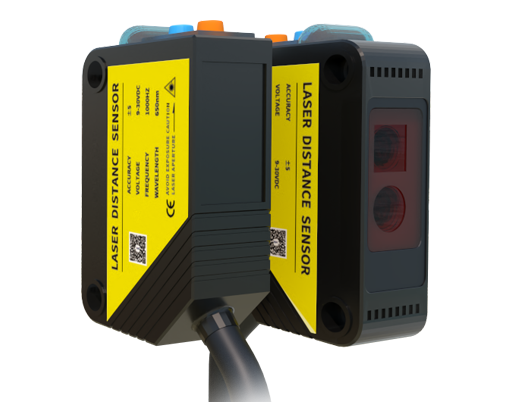
Typical applications for blue laser displacement sensors are diverse and critical. In the electronics industry, they are used for coplanarity inspection of IC leads, solder paste height measurement, and wafer warpage analysis. Automotive manufacturers employ them for precise gap and flush measurement between body panels, brake disc thickness monitoring, and rubber seal profiling. In precision machining, they verify the dimensions of machined parts, control tool wear, and measure the thickness of transparent coatings on metals. The ability to measure hot targets, such as freshly forged metals, is another area where specific blue laser models excel, as the shorter wavelength can better penetrate the thermal radiation plume.
When selecting a blue laser displacement sensor, engineers must consider several key specifications beyond just the wavelength. The measuring range, spot size, sampling speed, and linearity are paramount. High-speed models capable of tens of thousands of measurements per second are essential for dynamic processes or moving production lines. The interface options, such as Ethernet/IP, PROFINET, or analog outputs, must integrate seamlessly with existing PLC or data acquisition systems. Finally, built-in intelligent functions like multi-point measurement, peak-hold for transparent materials, and programmable logic can simplify system design and enhance functionality.
In conclusion, blue laser displacement sensors represent a significant technological advancement in non-contact metrology. By leveraging the unique properties of short-wavelength blue light, they overcome the limitations associated with measuring challenging materials and achieve unparalleled levels of precision and stability. As industries continue to push the boundaries of miniaturization, material science, and quality standards, the adoption of blue laser sensor technology is poised to become the benchmark for demanding displacement measurement tasks, driving improvements in productivity, yield, and product quality across the manufacturing landscape.