Capacitive proximity sensors are versatile devices widely used in industrial automation for non-contact detection of various objects. Unlike inductive sensors that only detect metals, capacitive sensors can sense a broader range of materials by measuring changes in capacitance. The sensing principle relies on the formation of an electrostatic field between the sensor's active surface and the target object. When an object enters this field, it alters the dielectric constant, causing a measurable change in capacitance that triggers the sensor's output.
The effectiveness of a capacitive sensor heavily depends on the dielectric properties of the target material. Materials with high dielectric constants are more easily detected because they cause a significant disturbance in the electrostatic field. Common industrial materials are often categorized by their detectability. Conductive materials, such as metals and water-based liquids, are the easiest to detect due to their high conductivity, which strongly influences the capacitance. For instance, metals like steel, aluminum, and copper can be sensed at greater distances, often up to the sensor's nominal range.
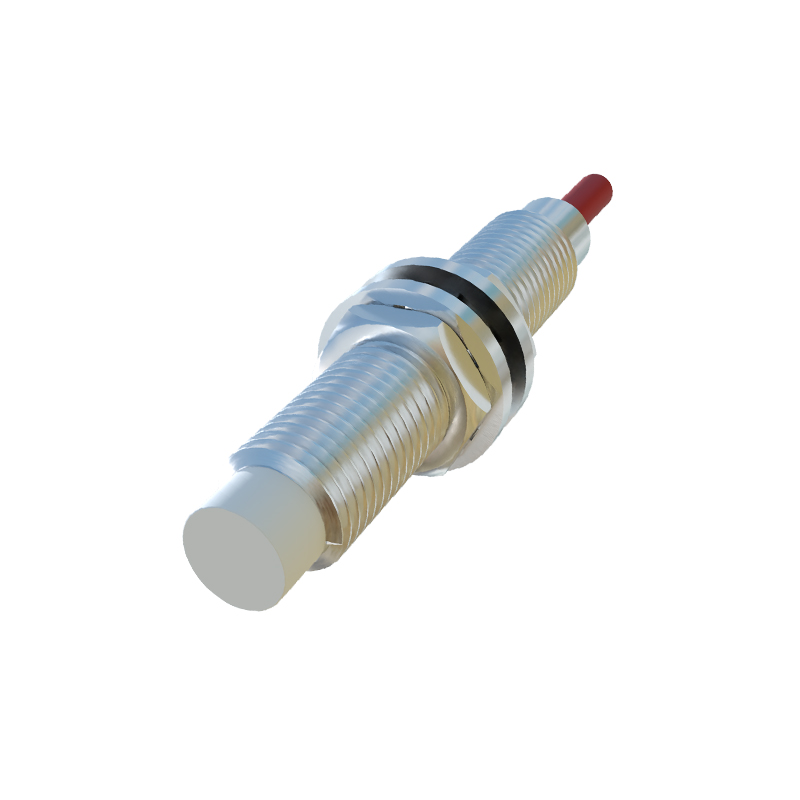
Non-conductive materials, also known as dielectrics, present a more varied challenge. Their detectability is directly proportional to their dielectric constant (εr). Materials with a high εr, such as plastics containing water (e.g., wet wood, paper, or certain ceramics), are relatively easy to sense. For example, water has a very high dielectric constant (approximately 80 at room temperature), making water-filled containers or moist substances reliable targets. Conversely, materials with a low dielectric constant, like dry plastics (e.g., polyethylene, polypropylene with εr around 2-3), dry wood, or glass, are more difficult to detect. These materials require sensors to be set at higher sensitivity levels and often necessitate a shorter sensing distance.
A critical application is level detection for liquids, granules, and powders. Capacitive sensors excel here, as they can detect substances through non-metallic container walls, enabling contactless level control. For powders and granular materials (e.g., flour, grains, plastic pellets), the sensor's performance can be affected by material density, moisture content, and particle size. Hygroscopic materials that absorb moisture become easier to detect over time.
Several factors influence sensing performance beyond the material itself. The sensor's design, including the size and shape of the active electrode, the oscillation frequency, and the presence of shielding, plays a crucial role. Shielded sensors have a focused field, making them suitable for flush mounting in metal and for detecting high-dielectric materials. Unshielded sensors have a larger, more extended field, which can be advantageous for sensing low-dielectric materials or materials behind thin barriers, but they are more susceptible to interference.
Environmental conditions must also be considered. Temperature fluctuations, humidity, and the presence of dust or contaminants can affect the dielectric constant of both the target and the surrounding medium, potentially leading to false triggers or reduced sensing distance. Modern capacitive sensors often feature adjustable sensitivity potentiometers or teach-in functions to compensate for these variables and fine-tune the sensor for a specific material and application.
In practical installation, proper calibration is paramount. Engineers must account for the target material's properties, the required sensing distance, and the installation environment. For challenging low-dielectric materials, techniques such as using a larger sensor face, reducing the nominal sensing distance, or attaching a metal foil to the target can improve reliability. Understanding the material's behavior is the first step in ensuring robust and fail-safe operation in systems ranging from packaging machinery and fill-level control to material handling and touch interfaces.
Ultimately, the compatibility between a capacitive proximity sensor and a sensing material is a function of dielectric permittivity. By carefully selecting and configuring the sensor based on the target's electrical properties, engineers can achieve highly reliable detection across a vast spectrum of conductive and non-conductive substances, enhancing automation system flexibility and intelligence.