In the realm of industrial automation and machine control, proximity switch sensors are indispensable components, acting as the silent sentinels that detect the presence or absence of objects without physical contact. While technical datasheets provide the essential specifications, examining proximity switch sensor machine images offers a practical, visual understanding of their integration, application nuances, and physical characteristics. These images serve as a crucial bridge between theoretical knowledge and real-world implementation for engineers, technicians, and procurement specialists.
A close analysis of typical machine images reveals several key aspects. Firstly, the physical form factor is immediately apparent. Images showcase the diverse housing materials, such as nickel-plated brass, stainless steel (particularly V4A/AISI 316L for corrosive environments), or PBT plastic. The cylindrical M8, M12, M18, and M30 threaded barrels are most common, but rectangular and ring-shaped designs are also visible for specific applications. The IP (Ingress Protection) rating, often stamped on the housing, is visually confirmed—whether it's IP67 for resistance to temporary immersion or IP69K for high-pressure, high-temperature washdowns in food and beverage processing.
Secondly, installation context is paramount. Machine pictures rarely show a sensor in isolation. Instead, they depict the sensor mounted on a machine frame, a robotic arm end-effector, or within a conveyor system. These images highlight critical installation details: the necessary sensing distance (sn) clearance from the target, the importance of avoiding metal-to-metal side mounting which can cause interference, and the use of mounting brackets or locknuts. For inductive sensors (detecting metals), images might show the optimal positioning relative to a gear tooth or a piston rod. For capacitive sensors (detecting liquids, plastics, etc.), images often illustrate their use in level detection within non-metallic tanks.
The third element illuminated by machine imagery is the indication of status. Most modern proximity sensors incorporate an LED indicator, usually visible in photos. A solid or blinking LED (often yellow or green) provides immediate visual feedback on the sensor's operational state—power on, target detected, or error condition. This feature is invaluable for quick troubleshooting during machine setup or maintenance.
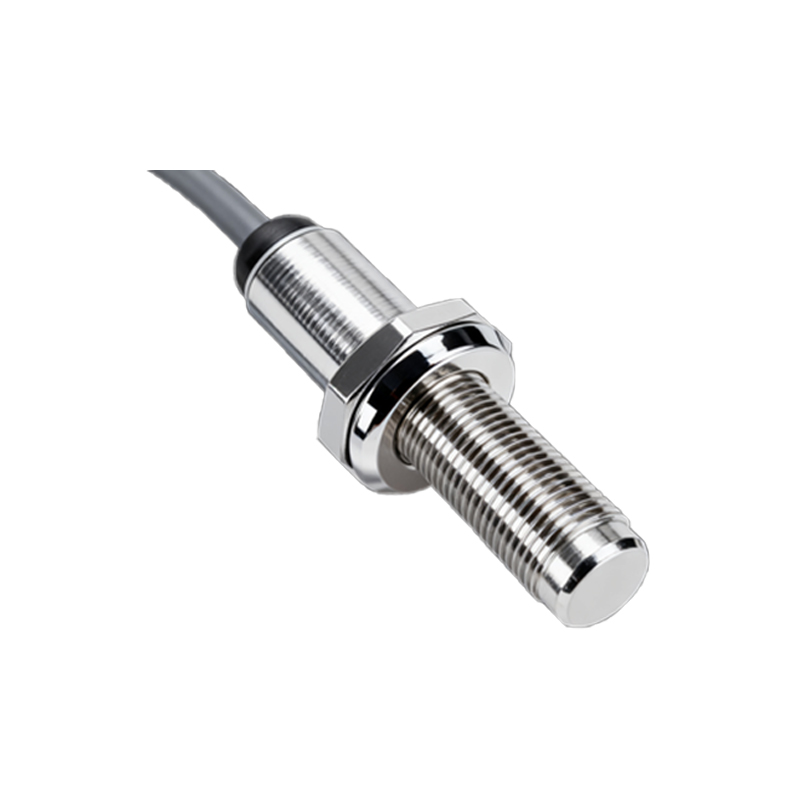
Furthermore, the electrical connection interface is clearly displayed. Images detail whether the sensor has a pre-wired cable (with PUR or PVC sheathing for flexibility and oil resistance) or a quick-disconnect (QD) connector, typically conforming to the M12 or M8 standard. The number of wires (3-wire DC PNP/NPN or 2-wire AC/DC) can sometimes be inferred, emphasizing the wiring configuration crucial for correct integration with PLC (Programmable Logic Controller) input modules.
Specialized applications are also vividly captured. Pictures might show analog-output sensors used for distance measurement, with graphs illustrating the linear voltage or current output relative to target distance. Images of high-temperature sensors show their unique design, often with extended front caps to protect the sensing face from extreme heat near furnaces or welding equipment. Contrastingly, images of weld-field immune sensors demonstrate their robust shielding, allowing them to function reliably in the electrically noisy environment of spot welding robots.
In conclusion, proximity switch sensor machine images are far more than simple illustrations. They are dense with practical engineering information. By studying these images, professionals can better select the correct sensor type (inductive, capacitive, magnetic, or ultrasonic), verify its physical suitability for the installation environment, anticipate potential mounting challenges, and understand the visual diagnostics available. In a field where precision and reliability are non-negotiable, these visual references complement technical data, ensuring optimal sensor selection and deployment for seamless, efficient, and safe machine operation.