In the realm of industrial automation and control systems, proximity sensors play a pivotal role in enabling non-contact detection of objects. Among the various configurations available, the 4-wire proximity sensor stands out for its unique capabilities and widespread adoption in demanding environments. This article delves into the operational principles, key advantages, typical wiring configurations, and common application scenarios of 4-wire proximity sensors.
A proximity sensor, fundamentally, is a device that detects the presence or absence of an object within its sensing range without physical contact. The 4-wire variant is distinguished by its four distinct electrical connections. These typically comprise two wires for the power supply (often labeled as V+ or Brown for positive and 0V or Blue for negative/neutral) and two wires for the output signal. The output section is where the critical differentiation lies: one wire is for the switched output signal (e.g., Black), and the other is a dedicated common or reference line (e.g., White). This architecture allows 4-wire sensors to provide a fully isolated or independent output circuit. They are commonly available in two primary output types: NPN (sinking) and PNP (sourcing), and can switch either alternating current (AC) or direct current (DC) loads. The dedicated common wire provides a clear return path for the output current, separating it from the sensor's internal logic power supply.
The core technology behind these sensors is often based on electromagnetic induction (for inductive sensors detecting metals) or capacitance (for capacitive sensors detecting both metallic and non-metallic materials). An inductive 4-wire proximity sensor contains an oscillator circuit that generates a high-frequency electromagnetic field at its sensing face. When a metallic target enters this field, it induces eddy currents within the target, which dampens the oscillator's amplitude. This change is detected by a threshold circuit, which subsequently triggers the solid-state output switch (like a transistor) to change state—turning ON or OFF. The 4-wire design ensures that the power for this switching output is drawn from the separate output supply lines, not from the sensor's own logic circuitry.
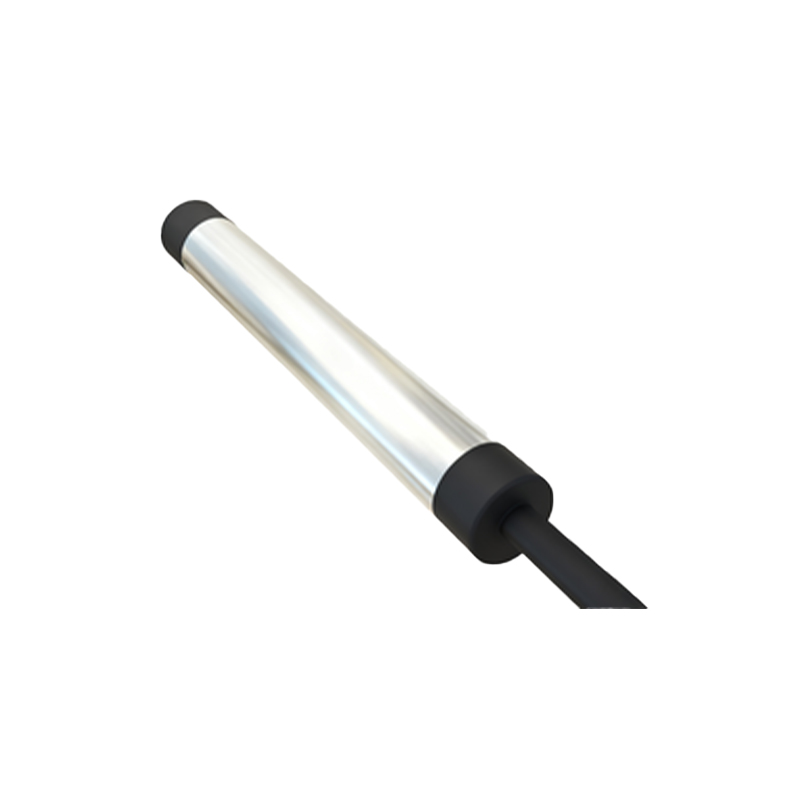
The advantages of using a 4-wire proximity sensor are significant. Firstly, the isolated output offers superior noise immunity. Electrical noise from the load (such as a relay, solenoid, or contactor coil) is less likely to interfere with the sensor's sensitive internal electronics, leading to more reliable and stable operation. Secondly, this isolation provides greater flexibility in system design. The output can be connected to a different voltage level than the sensor's supply voltage, within the device's specifications. For instance, a sensor might be powered by 24V DC, but its output could switch a 12V DC or 120V AC load (for AC models). Thirdly, troubleshooting is often simpler because the power and output circuits are distinct. A fault in the load circuit is less likely to damage the sensor's core sensing components.

Wiring a 4-wire sensor requires careful attention to the manufacturer's datasheet. For a DC-powered PNP sensor (sourcing): The Brown wire connects to the positive DC supply, the Blue wire to the negative/0V. The Black wire (output) is connected to the load, and the other side of the load is connected to the negative/0V supply. The White wire (common) is also connected to the negative/0V. For an NPN sensor (sinking): The Brown and Blue wires are connected similarly. The Black output wire connects to the load, and the other side of the load connects to the positive supply. The White common wire connects to the positive supply. For AC models, wiring involves Line and Neutral for power, with the output switching the load in series with the AC line.
These sensors find extensive applications across industries. In material handling, they are used for precise positioning, counting, and end-of-travel detection on conveyors. In machine tools, they serve as limit switches to prevent over-travel of moving parts. In automotive assembly lines, they verify the presence of components like pistons or bearings. Packaging machinery utilizes them to detect foil, liquid levels in bottles (using capacitive types), or to control filling operations. Their robustness, with typical ingress protection ratings like IP67, makes them suitable for harsh environments with dust, moisture, or vibration.
In conclusion, the 4-wire proximity sensor is a versatile and robust solution for industrial sensing needs. Its design, featuring separate power and isolated output circuits, delivers enhanced reliability, noise resistance, and wiring flexibility compared to 2-wire or some 3-wire counterparts. When selecting a 4-wire sensor, engineers must consider factors such as sensing distance, target material, output type (NPN/PNP, AC/DC), environmental conditions, and electrical specifications to ensure optimal integration and performance within