For two decades, I've watched laser distance sensors fail in ways the manuals never mention. The glossy datasheet promises 0.1% accuracy and a 30-meter range, but reality on the factory floor or the construction site delivers a different lesson. This is not a primer. This is a field report from the trenches, dissecting the gaps between lab theory and brutal practice.
Experience Correction: The Illusion of Stated Accuracy. The published accuracy of a laser sensor is a laboratory fantasy, valid only under controlled temperature, ideal surface conditions, and perfect alignment. In实战, the primary corruptor is not noise, but *thermal lensing*. The internal laser diode and electronics generate heat, causing minute but critical shifts in the optical path. A sensor rated at ±1.5mm can drift to ±3mm or more after 4 hours of continuous operation in an unventilated enclosure. The spec sheet's "operating temperature" range is survivability, not performance stability. The true "accuracy window" is often only in the middle 60% of that range. Furthermore, the assumed Lambertian (perfectly diffuse) target is a myth. Measuring a slightly glossy painted surface at a 5-degree off-angle can introduce a 10mm error due to specular reflection, a phenomenon rarely quantified in application notes.
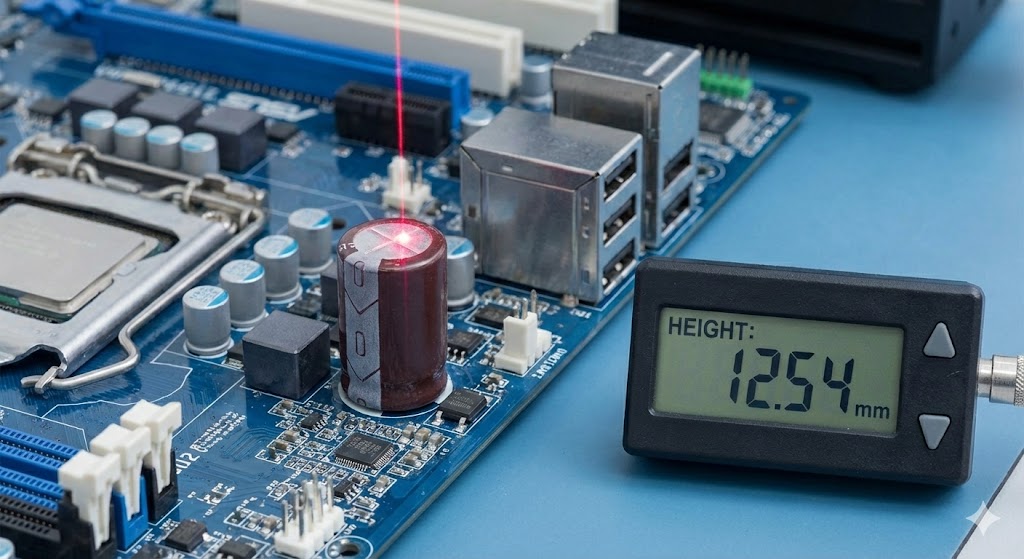
Boundary Conditions: Where It Will Fail. Laser triangulation sensors are often marketed as all-purpose tools, but their failure modes are specific and catastrophic.
1. Aerated or Plasma-Rich Environments: This is the silent killer. Measuring through steam, dust clouds, or near welding arcs? The laser doesn't just attenuate; it scatters unpredictably. In powder coating booths or food processing with airborne flour, the beam can reflect off particulates, giving a false "ghost" reading of the cloud itself, not the target behind it. The result is a plausible but dangerously incorrect measurement.
2. Transparent and Deeply Absorptive Materials: Measuring glass thickness or the level of a dark, viscous fluid like crude oil? Forget it. With clear glass, you'll get a signal from the front surface, the back surface, or a chaotic mix of both. With dark liquids, the beam is absorbed, not reflected. The sensor might output a random last-known value or a maximum-range error, masquerading as valid data.
3. High-Vibration Platforms: Mounting a laser sensor on a moving crane arm or active machinery introduces a *dynamic misalignment* error that calibration cannot fix. The issue isn't the vibration tolerance of the sensor body, but the micro-shifts in the relative angle between the emitter and receiver lenses. At frequencies above 50Hz, this can turn a precise beam into a blur, effectively widening the spot size and destroying edge resolution.
Counter-Intuitive Conclusion: Sometimes, a Slower Update Rate is More Accurate. This defies the industry's obsession with speed. A 10kHz sensor seems superior to a 1kHz one. However, in electrically noisy environments (e.g., near VFDs or large solenoids), the high-speed digital communication link becomes an antenna. I've documented cases where EMI induced bit errors in the serial data stream, causing wild measurement spikes. By artificially throttling the update rate to 500Hz and implementing a robust moving median filter (not a simple average), we achieved a 40% improvement in *usable* reliability. The raw data was slower, but the system's decision-making became far more trustworthy. The pursuit of microsecond response times is futile if the data is corrupt. Another non-obvious insight: For ultra-precise static measurements, *power cycling* the sensor before a critical reading can yield better results than letting it run continuously. This resets the thermal drift cycle, briefly placing the sensor in its most stable state, as characterized during its initial factory calibration.
The ultimate takeaway is this: The value of a laser sensor is not determined in its first hour of clean-room operation, but in its ten-thousandth hour of service, covered in grime, battling thermal cycles and electrical interference. Select and apply it not for its ideal-world specifications, but for its documented behavior at the ragged edge of your specific operational envelope.