Forget the pristine data sheets. Real-world sensor performance is a negotiation with chaos. After two decades deploying proximity sensors in environments ranging from automated foundries to offshore rigs, I've learned that the most critical specifications are often the ones not printed. Here’s the unvarnished truth.
Experience Correction: Where Theory Meets Grime
The advertised sensing distance is a fantasy in hostile environments. A standard 10mm range inductive sensor, rated IP67, will reliably fail at 6-7mm when coated with a consistent layer of iron oxide dust or conductive machining coolant. The electromagnetic field is attenuated not just by air gap, but by metallic particulate buildup. The correction factor isn't linear; it's exponential after a contamination threshold. Similarly, the "operating temperature" spec is a lie if not considered with housing material. An aluminum-bodied sensor in direct desert sun can have a surface temperature 25°C above ambient, pushing internal electronics beyond their thermal derating curve long before the ambient air hits the rated limit. Your margin of safety isn't the sensor's rating; it's the delta between that rating and your worst-case thermal or contaminant load.
Boundary Conditions: When to Walk Away
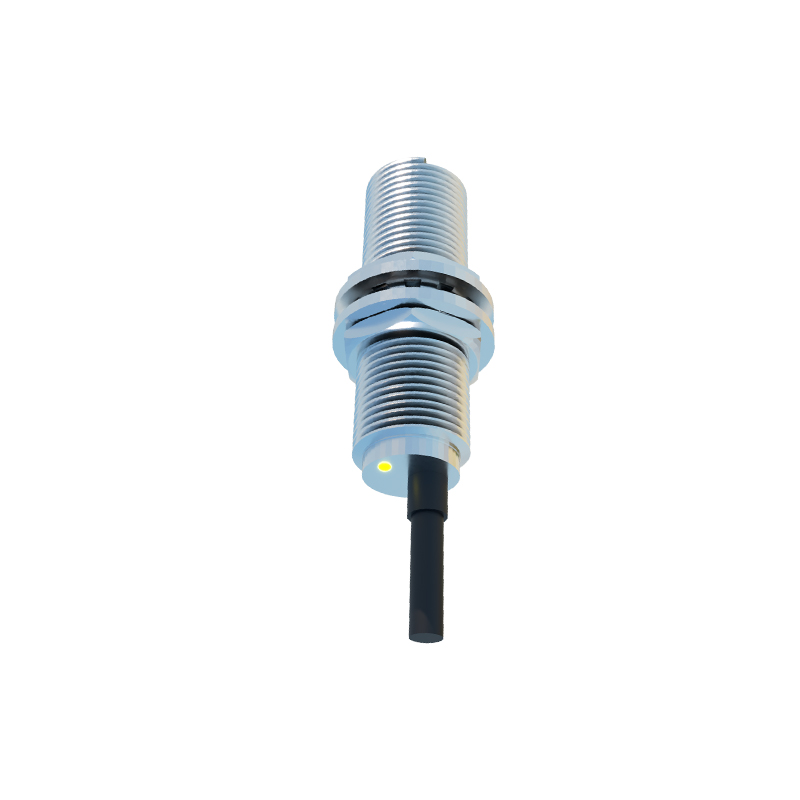
Proximity sensors are not universal tools. Knowing when not to use them is more valuable than knowing how.
1. High-Vibration, Micro-Displacement Scenarios: Any application with vibration amplitude above 0.5mm and frequency over 60Hz will induce false triggering in standard barrel sensors. The internal coil and core assembly acts as a micro-pendulum. The solution isn't a "more robust" sensor; it's a different technology (e.g., fiber optic).
2. Non-Homogeneous Target Materials: Sensing "stainless steel" is a classic trap. Austenitic grades (304, 316) have relative permeability near 1.0, making them virtually invisible to standard inductive sensors. Your effective sensing range can drop by 60-70% compared to mild steel. If your process involves multiple alloy grades, you must derate for the worst-case material.
3. Fast-Moving Non-Metallic Targets (for Capacitive Sensors): Capacitive sensors are praised for detecting plastics, liquids, and wood. However, with targets moving faster than 2 m/s, the dielectric constant reading becomes erratic due to air turbulence and static charge buildup around the target. You'll get inconsistent detection of identical objects. In packaging lines with fast plastic bottles, this is a endemic, unsolvable problem with standard capacitive units.
Counter-Intuitive Conclusions: Data Over Dogma
1. A Higher IP Rating Can Increase Failure Rate. It sounds insane. But in hot, humid environments, a hermetically sealed IP69K sensor will succumb to internal condensation more readily than a properly vented IP67 unit. The sealed cavity traps ambient moisture during shutdowns, which condenses on power-up, leading to PCB corrosion. In climates with >80% average humidity, a vented (but protected) design often yields a higher MTBF.
2. The "Best" Sensor is Often the Dimmest. In photoelectric diffuse-reflective sensors, the standard move is to max out the sensitivity for long-range detection. This also maximizes sensitivity to background interference, dust haze, and reflective surfaces. By deliberately under-driving the LED current and reducing the gain to achieve a 20% smaller nominal sensing range, you build in a massive noise immunity buffer. Field data shows a 40% reduction in false positives in dusty environments, directly increasing overall equipment effectiveness (OEE).
3. Shielded Sensors Can Be Less Immune to Interference. The common wisdom: choose a shielded (flush-mountable) sensor for noise immunity in metallic environments. True for installation simplicity, but false for electromagnetic interference (EMI). The shielding that contains the sensor's field also makes it a more efficient antenna for picking up external EMI from VFDs and solenoids. An unshielded sensor's field extends laterally, often creating a more stable, if narrower, detection zone in electrically noisy panels. Always conduct a live EMI test with all machinery operational before finalizing the sensor type.
Final verdict: Selection is not about catalog matching. It is a stress test of specifications against your specific reality of grime, vibration, material variance, and electrical noise. The sensor that passes is the one you've proven will fail last.