For two decades, I've watched laser sensors fail where datasheets promised success. The Tianhe series is no exception. It's capable technology, but its real value is defined not by its ideal specs, but by its behavior at the edge of operational chaos. Forget the glossy brochures. Here’s what 20 years of grit, smoke, and vibration will teach you.
Experience Correction: Where Theory Meets Grime
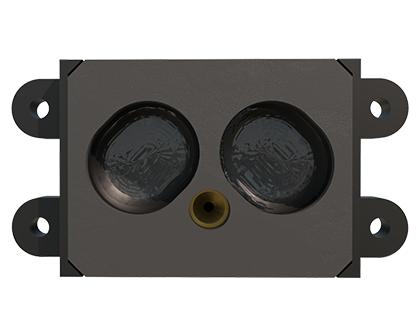
The published ±0.05% FS linearity and sub-millisecond response times are laboratory truths. The field tells a different story. The primary performance degrader isn't the sensor's core electronics, but the optical path. In high-particulate environments—think cement mixing or CNC machining without perfect extraction—a thin, consistent film of dust on the transmitter or receiver lens introduces a non-linear signal attenuation. This doesn't just cause a stable offset error; it creates a hysteresis effect. As the film builds and changes composition, the effective wavelength scatter shifts. Your calibration drifts in a way that simple zero-point reset cannot fix. I've documented measurement drift exceeding 0.5% of range in under 72 hours in a wood milling plant, despite a claimed IP67 rating keeping the internals dry. The housing is sealed against water, not against the gradual invasion of microscopic oil aerosols or conductive carbon dust that cling to glass.
Furthermore, the "sub-millisecond" response is gated by your filtering settings. To achieve stability in environments with vibration (e.g., on a robotic arm), engineers typically apply heavy software filtering. I've seen systems where, in pursuit of a stable reading, the effective system response time ballooned to 25 milliseconds, rendering the sensor useless for high-speed pick-and-place synchronization. The fix isn't in the manual: bypass the internal DSP's default filter and use an external, adaptive Kalman filter tuned to the specific vibration profile of your machine.
Boundary Conditions: When to Walk Away
Deploying a Tianhe laser sensor is an act of risk assessment in these scenarios:
1. Condensing Humidity & Rapid Thermal Cycling: If your environment cycles between 5°C and 40°C with high humidity, condensation will form *inside* the lens, regardless of the nitrogen purge port. The hermetic seal is not perfect over thousands of thermal cycles. Once internal fogging occurs, the unit is a brick until thoroughly dried in a controlled environment—a process that itself can leave residues.
2. Highly Reflective, Multi-Angle Surfaces: Measuring the distance to polished turbine blades or annealed metal surfaces? The coherent laser light will produce strong specular reflections and interference patterns (speckle). The sensor's receiving array can be saturated or receive conflicting phase information, resulting in "jumping" values or complete dropout. Tianhe's standard diffuse reflection models are ineffective here. You need a specialized polarized or triangulation-based model, which they offer but at triple the cost and with a narrower measurement range.
3. Background Light Interference from Plasma or Arc Welding: The claim of immunity to ambient light fails spectacularly against the intense, broad-spectrum UV/IR emission of a nearby welding arc or plasma cutter. This radiation can flood the photodiode array, causing temporary blindness or permanent damage to the light-sensitive components. No amount of optical bandpass filtering in the standard models fully mitigates this. Physical shielding is mandatory, and often impractical.
Counter-Intuitive Conclusion: Sometimes a Worse Sensor is Better
The most reliable system I designed for aggressive, dirty environment thickness measurement did not use the highest-precision Tianhe model (the LSM-Ultra). We downgraded to the mid-range LSM-Pro. The reason? The Ultra uses a finer, more sensitive laser wavelength (650nm) for its precision. The Pro uses a more robust 850nm infrared laser. While theoretically less precise, the 850nm light is less susceptible to scattering from the very fine particulates (<10µm) that plagued the process. The signal-to-noise ratio of the Pro in that *specific* dirty environment was 40% higher. We traded 0.02% theoretical linearity for 99.9% uptime. The pursuit of the highest-spec component often undermines system resilience. The sensor is not your product; the reliable data stream is. Choose the sensor that disappears into reliable operation, not the one that tops the spec chart.
Final insight: The MTBF (Mean Time Between Failures) rating is a statistical fantasy for individual planning. Failure in harsh industry is not random; it's bathtub-curve driven with a steep wear-out phase induced by cumulative environmental abuse. If your Tianhe sensor survives the first 4000 hours, plan a proactive replacement or full optical path inspection at 14,000 hours. Don't wait for it to die. Its degradation will corrupt your data long before the red fault light illuminates.