Forget the pristine lab data and glossy marketing brochures. Two decades of deploying laser sensors in environments ranging from steel mills to offshore platforms have taught me one brutal truth: survival trumps specification. The real value of a sensor isn't measured in its datasheet's micron-level precision, but in its operational resilience. Let's cut through the noise.
Experience Correction: The Gritty Reality vs. Theoretical Precision
Theoretical resolution and repeatability are seductive numbers. In practice, they are the first casualties. Take a high-precision triangulation sensor rated for ±5µm. In a controlled environment, it performs flawlessly. Introduce a common industrial antagonist: airborne particulate—metal dust, oil mist, flour. The laser beam scatters, not uniformly, but in unpredictable patterns based on particle size and concentration. I've documented measurement drift exceeding 50µm in a machining cell within hours, not due to sensor failure, but due to the changing optical density of the air. The advertised "high-speed" response is another pitfall. A 10kHz sampling rate is useless if the internal filtering algorithm, a black box in most products, introduces a 5ms latency to smooth out noise. For dynamic vibration measurement on a rolling mill, this lag renders the data a historical artifact, not a real-time diagnostic tool. The fix? Never specify a sensor without first testing it in the *dirtiest* possible simulation of your actual environment. A 650nm red laser might be standard, but in applications with hot objects (above 500°C), shifting to a 1550nm infrared laser can drastically reduce interference from incandescent glow, a nuance rarely highlighted in catalogs.
Boundary Conditions: When to Walk Away
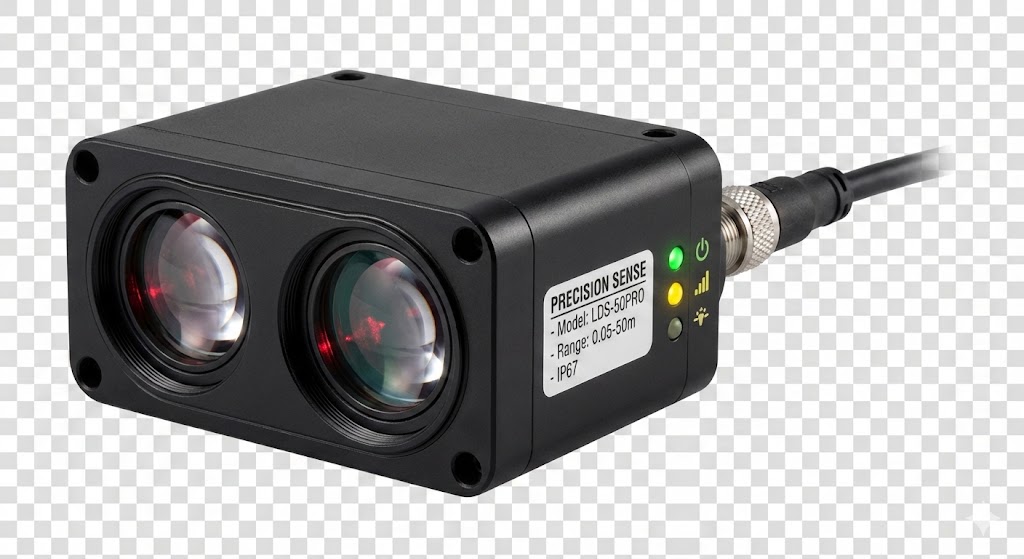
Laser sensors are not universal solutions. Their failure points are specific and catastrophic. First, total optical occlusion. Any application where the target can be completely covered—by paste, thick grease, or debris—is a hard no. The sensor won't "recover"; it will output garbage data, often a default maximum or minimum range, leading to catastrophic process failure. Second, highly specular (mirror-like) surfaces at acute angles. The textbook says "use a diffuser." In practice, on continuously moving, polished metal sheets, maintaining a perfect diffuse condition is impossible. The reflection angle can shift dramatically, sending the laser spot completely off the receiver, resulting in a total signal loss. Third, rapidly changing mediums. Measuring liquid level through a sight glass seems ideal until chemical fogging or condensation forms on the glass interior. The laser measures the condensation layer, not the liquid. Similarly, measuring through turbulent steam or dense, non-homogeneous smoke guarantees meaningless data. In these scenarios, non-optical technologies like radar or guided-wave radar often present a far more robust, if less precise, alternative.
Counter-Intuitive Conclusion: Sometimes, "Worse" is Better
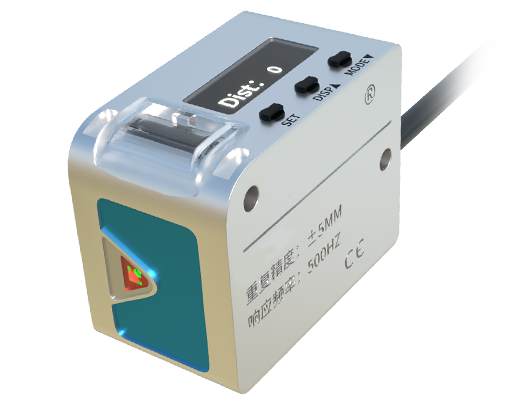
Here’s the heresy: In many harsh industrial settings, a laser sensor with a slightly *larger* spot size and *lower* stated resolution outperforms its high-precision counterpart. Why? Robustness. A 3mm spot size integrates surface imperfections—scratches, minor debris, grain structure—averaging them into a stable reading. A 50µm spot laser will chase every microscopic flaw, producing a noisy, unstable signal that requires heavy filtering, defeating the purpose of high resolution. Furthermore, the relentless pursuit of miniaturization can be an enemy. A ultra-compact sensor has less thermal mass and is more susceptible to thermal drift in environments with large ambient temperature swings. A larger, "industrial-grade" housing acts as a heat sink, stabilizing internal electronics. Finally, the most reliable "sensor" is often a redundant pair. Deploying two lower-cost lasers in a voting scheme provides higher system availability and fault detection than a single, expensive "gold-standard" unit. The data supports this: Mean Time Between Failures (MTBF) calculations often show a dual-redundant system of mid-tier sensors offers an order of magnitude improvement in system uptime over a single premium sensor, at a comparable total cost. The goal isn't perfect data from one point; it's trustworthy, actionable data for the system's lifetime.