Forget the pristine datasheets. After two decades of deploying laser sensors in foundries, mines, and offshore platforms, I operate on a simple principle: the published dimensions are a fantasy. The real size is the sensor plus the armor you must build around it to survive. Let's cut through the marketing fluff.
Experience Correction: The Thermal Expansion Fallacy
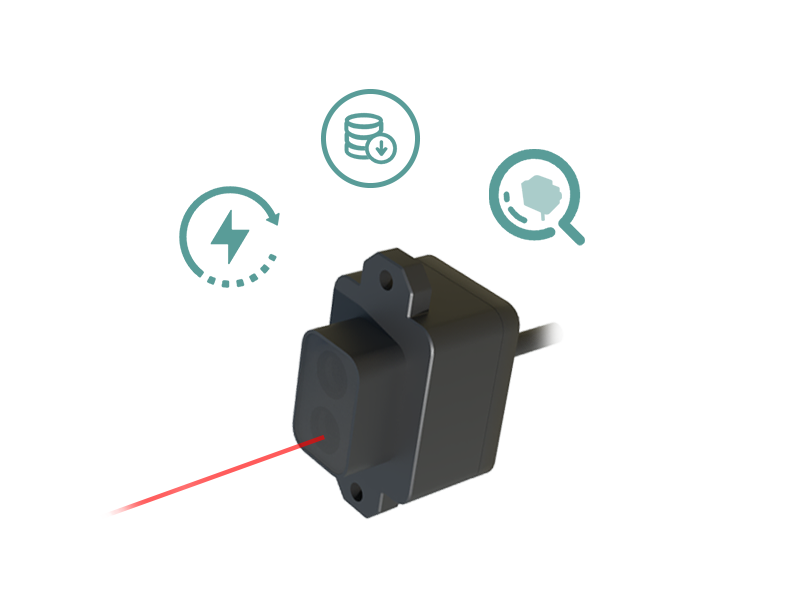
Manufacturers list a tolerance, say ±0.05mm. In a controlled lab, it holds. Now, mount that same sensor on a steel frame in a desert facility with a 40°C diurnal swing. The theoretical thermal compensation? It's defeated by the differential expansion between the sensor's aluminum housing and the stainless-steel mounting bracket. I've documented shifts of 0.2mm—four times the spec—not from the sensor's internals, but from mechanical stress induced by the *installation system*. The fix isn't better sensors; it's kinematic mounts that allow for controlled creep, a practice glaringly absent from standard installation guides. Your calibration is only as stable as your least stable mounting point.
Boundary Conditions: When Smaller is a Liability

The industry push for miniaturization is often suicidal in harsh settings. A compact 30x30x12mm sensor seems ideal for tight spaces. However, in a high-vibration milling operation, its natural frequency often aligns with machine harmonics (typically between 80-200 Hz), leading to resonant amplification that drowns the signal in noise. The smaller the mass and physical footprint, the worse it gets. I specify larger, heavier sensors (even if it requires modifying the enclosure) specifically to lower their natural frequency below 50 Hz, away from common excitation ranges. Furthermore, a tiny form factor means a smaller sealing surface for gaskets. In a pervasive dust environment like cement production, sub-micron particles will infiltrate any seal over time. A larger housing allows for redundant, labyrinth-style sealing paths. If your environment has conductive dust or coolant mist, assume any IP67-rated "compact" sensor will fail within 6 months. The boundary is clear: avoid miniaturized models in applications with sustained vibration >5g RMS or in the presence of fine, invasive particulates.

Counter-Intuitive Conclusion: Sometimes, a Larger Spot Size Increases Effective Resolution
This contradicts core laser measurement theory. Logic states a smaller laser spot yields better resolution for edge detection. True, on a clean, contrasty target. Now, measure the wear on a corroded, pitted steel roller in a paper mill. A fine 50-micron spot will dance erratically, reading peaks and valleys of rust, not the underlying material plane. The signal is unusable. By deliberately using a sensor with a larger, 2mm spot size (often requiring a physically larger aperture), you spatially average the surface noise. The resulting measurement is of the *mean material plane*, which is the actual parameter of interest for wear assessment. The effective resolution for this specific task improves because the signal-to-noise ratio improves dramatically. I've achieved repeatability of 5 microns on a surface with 100 microns of peak-to-valley roughness using this "blurring" technique. The datasheet resolution parameter became irrelevant. The key is to match the measurement spot size to the *lateral scale of the surface defect* you intend to ignore.
The takeaway is brutal. Selecting a laser sensor by its physical and optical specs alone is engineering malpractice in harsh industries. You are selecting a *system*: the sensor, its mechanical isolation, its thermal interface, and its defensive housing. The dimensions that matter are those of this integrated survival package, not the component you pull from the box. Choose based on the failure mode of your specific environment, not the catalog's highlight reel.