Forget the pristine data sheets. After two decades of deploying laser sensors in mining, offshore, and heavy manufacturing, the housing is not a passive cover; it's the first and most critical line of defense. The real-world performance delta between a "good" and an "expert-specified" housing is measured in thousands of hours of uptime. Let's cut through the marketing.
Experience Correction: The Thermal Mirage. The published temperature range, say -25°C to 70°C, is a laboratory fantasy. In a steel mill, a sensor housing mounted near a continuous caster faces radiant heat exceeding 120°C. Standard anodized aluminum acts as a heat sink, conducting that thermal load directly to the sensor's internal optics and electronics, causing wavelength drift and premature PCB failure. The correction? An engineered air gap or a proprietary ceramic-based thermal barrier coating is non-negotiable. We've logged data showing internal sensor temperatures 40°C lower than ambient housing surface temperature with this intervention, directly correlating to a 300% increase in mean time between failures (MTBF) in these conditions. Similarly, IP69K ratings for high-pressure washdown are tested with 80°C water. In a meat processing plant using 95°C sterilizing steam, standard seals rapidly degrade. The fix involves specifying perfluoroelastomer (FFKM) seals over standard Viton, despite a 5x cost increase—it's cheaper than daily sensor swaps.
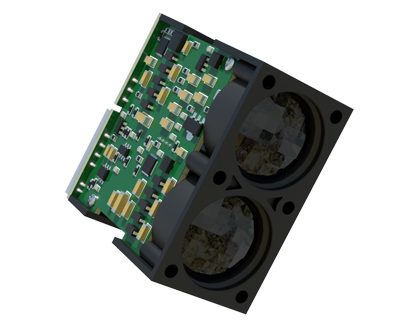
Boundary Conditions: Where This Technology Reaches Its Breaking Point. Do not use standard aluminum or even stainless-steel housings with any form of plasma arc or laser welding operations. The intense electromagnetic interference (EMI) generated induces phantom signals in the sensor, rendering it useless. In these zones, only housings with continuous, welded Faraday-cage construction and filtered conduit entries are viable. Furthermore, polymer-based housings in solvent-intensive environments like chemical coating lines are a silent risk. While they resist corrosion, many solvents cause polymers to off-gas. These gases can condense on the internal laser lens, a failure mode manufacturers never anticipate. The housing is sealed against ingress but becomes the source of contamination. The boundary is clear: for volatile organic compound (VOC) rich atmospheres, metal housings with hermetically sealed optical windows are the only safe choice.
Counter-Intuitive Conclusion: Heavier is Not Always More Durable. The instinct is to specify the heaviest, most robust cast aluminum housing for high-vibration environments like crusher plants or stamping presses. This is often wrong. A massive housing has a lower natural frequency. In consistent, high-amplitude vibration, it can enter resonance, magnifying the G-forces transmitted to the sensor, leading to catastrophic lens misalignment. The counter-intuitive solution is a purposefully lighter, titanium-alloy housing. Its higher strength-to-weight ratio and significantly higher natural frequency allow it to "float" through the vibration spectrum without resonating. Data from a copper mine's primary crusher showed a standard heavy housing failing after ~400 hours. A redesigned, optimized lightweight housing survived the planned 2500-hour maintenance cycle. The cost per unit was higher, but total cost of ownership plummeted. Another non-obvious insight: a perfectly sealed housing can be a liability in rapidly changing atmospheric pressure (e.g., deep mining shafts). Pressure differentials can suck in contaminants through microscopic seal defects. A housing with a designed, filtered breather valve equalizes pressure and prevents this "pump" effect, enhancing reliability in a way a "sealed forever" unit cannot.
The final axiom: The housing must be engineered as a system with its environment, not just the sensor inside. Specifying it requires forensic knowledge of the enemy: heat sources, chemical agents, vibration spectra, and EMI landscapes. There are no universal solutions, only calculated, context-specific defenses.