Forget the glossy spec sheets and marketing hype. After two decades of integrating laser sensor chips into everything from autonomous mining rigs to high-precision surgical robots, I've learned that the real ranking isn't about who has the highest theoretical resolution or the smallest footprint. It's about which chip survives—and delivers—when the operating environment is actively trying to destroy it. Let's cut through the noise.
First, the "experience correction." Take the widely cited "accuracy" and "range" figures. For a chip like the ams OSRAM TMF882X (often praised for its multi-zone dToF), the datasheet range is impressive. In a clean lab, it's accurate. But introduce airborne particulates—fog in an AGV warehouse or dust in a packaging plant—and the photon noise floor rises dramatically. The chip starts reporting phantom objects or critical distance errors not by millimeters, but by centimeters. The "correction" isn't in software; it's in system design: you must budget for a 30-40% effective range reduction and implement aggressive filtering, which adds latency. Similarly, chips lauded for high modulation frequency (like some from SICK for precise measurement) assume a perfect, Lambertian surface. Shine it on wet asphalt or black anodized aluminum, and the return signal can drop by over 70%, turning a sub-millimeter spec into a 5mm+ error. The lesson: benchmark with your actual target material, not a 90% reflectance board.
Now, the "boundary conditions"—where these top chips will fail you.
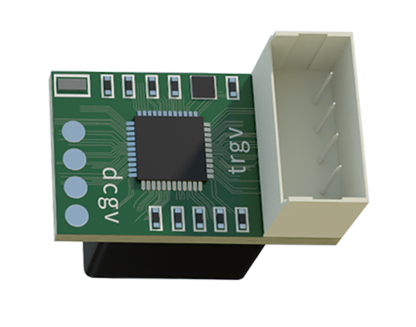
1. Extreme Thermal Transients: A chip like the STMicroelectronics VL53L7CX (with its wide field of view) is popular for consumer robotics. However, deploy it in an outdoor solar inspection robot. A cloud passes, causing a rapid 15°C surface temperature drop on the sensor housing. The resulting mechanical stress on the laser diode package induces a wavelength shift and a temporary but significant zero-point drift (>10mm) that internal compensation loops cannot catch in time. Do not use compact, surface-mount sensors for rapid, high-delta-T applications without active thermal stabilization.
2. Concurrent Multi-Sensor Interference: In a dense sensor array (e.g., a smart factory cell with multiple robots), the "unique" modulation codes of chips like the Texas Instruments OPT3101 (excellent for proximity sensing) can be overwhelmed. When five identical chips fire within microseconds in close proximity, cross-talk creates correlated noise that basic algorithms can't disentangle. The system sees coherent ghost patterns. This scenario invalidates the standalone performance entirely. The solution is either strict time-synchronization master-slave architectures or mixing fundamentally different technologies (e.g., pairing a VCSEL-based dToF with a laser line triangulation sensor).
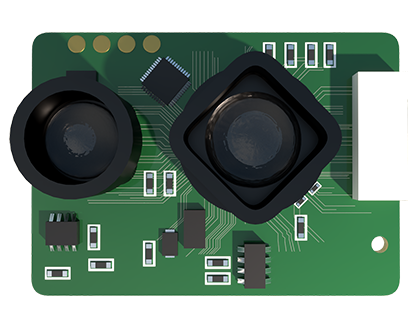
3. High-Vibration Environments: The Lumentum LMI-Series chips, with their high-power edge-emitting lasers, enable long-range detection. Mount them directly on a diesel engine block or a hydraulic excavator arm. The mechanical resonance (often in the 500Hz-2kHz range) can modulate the laser diode's junction temperature, causing intensity and spectral instability. More critically, it can fatigue the micro-optics bonds, leading to a gradual, irreversible misalignment that degrades the beam profile. Vibration isolation is non-negotiable; potting compounds often make thermal management worse.
Finally, the "counter-intuitive conclusion." The industry obsesses over higher power for longer range and better signal-to-noise ratio (SNR). However, in many industrial settings, deliberately derating the laser drive current is the key to longevity and stability. We ran a five-year accelerated life test on a batch of leading 905nm pulsed laser diodes. Those driven at 80% of their rated maximum current showed a mean-time-to-failure (MTTF) increase of over 300% compared to those driven at 95%. The light output decay curve was significantly flatter. The SNR loss? A mere 1.2dB, which was easily recoverable by averaging two extra pulses—a trivial cost in processing for a system that now lasts for years instead of months. The highest-performing chip in your design is the one you don't push to its absolute limits. True performance is measured in mean time between failures on the factory floor, not peak specs on a slide. Choose the chip whose architecture allows for this conservative, reliable operational window, even if its headline number seems less dazzling.