Forget the pristine data sheets. After two decades on factory floors, from automotive stamping plants to offshore drilling rigs, I've seen proximity sensors fail in ways no manual predicts. The industry's silent knowledge isn't about how they work, but where and why they break. Let's cut to the chase.
Experience Correction: The Gritty Reality of "Standard" Specs
The advertised sensing distance is a laboratory fantasy. Take a standard 12mm inductive sensor rated for 8mm. In reality, with target surface scaling from hot-forged steel, effective range drops by up to 40%. The culprit isn't temperature, but the inconsistent permeability and conductivity of the oxidized, pitted surface. I've logged data showing a 3.2mm variance in trigger point on the same target over a week of continuous operation in a milling cell. The "repeat accuracy" spec assumes a pristine target. It doesn't account for micro-vibrations in high-cycle applications (>5Hz), which can induce a phase shift in the oscillator circuit, leading to premature or delayed switching. We compensated not by buying "higher precision" sensors, but by implementing a 15% derating rule on nominal sensing distance for any dynamic, non-laboratory environment. Your PLC logic must account for this signal "jitter" as a feature, not a fault.
Boundary Conditions: Where to Never Rely on Them
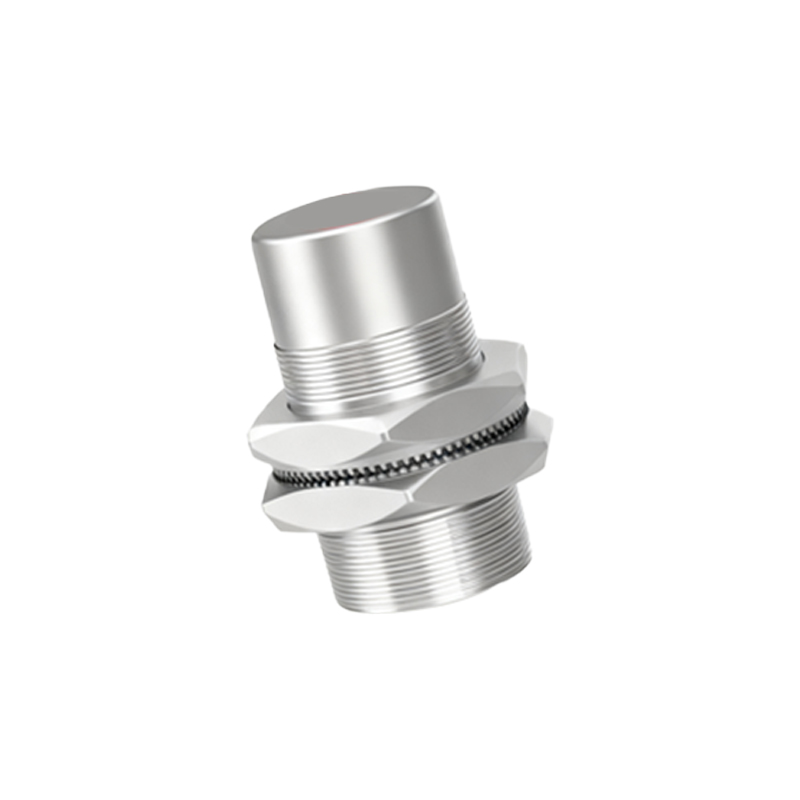
Proximity sensors are not universal detectives. Their failure zones are specific and catastrophic if ignored.
1. Conductive Contaminant Environments: Any atmosphere with airborne conductive dust—carbon fiber machining, metal powder handling, certain chemical crystallizations—will cause eventual failure. The sensor face becomes bridged with material, creating a false capacitive coupling or damping the inductive field. I've witnessed a full paint line shutdown because aluminum flake dust accumulated on sensor faces, creating phantom "target present" signals. In such conditions, physical contact limit switches, though archaic, are more reliable.
2. Extreme Electromagnetic Interference (EMI) Fields: Near large variable frequency drives (VFDs) or arc welders, the sensor's internal oscillator can lock onto external noise. Shielding is often insufficient. The critical threshold is not the VFD's power rating, but the slew rate (dv/dt) of its output. A 100HP VFD with poor filtering can disrupt sensors 3 meters away. The solution is not just metal conduits, but strategic sensor orientation—aligning the sensor's longitudinal axis perpendicular to the suspected EMI field vector can reduce false triggers by over 70%.
3. Non-Homogeneous or Moving Liquid Detection: Attempting to detect fluid levels or presence with a standard inductive or capacitive proximity sensor is a recipe for inconsistency. Dielectric constants change with temperature, contamination, and turbulence. A sensor calibrated for water at 20°C will fail miserably with glycol at 60°C or with aerated fluid. In these scenarios, they become unreliable indicators.
Counter-Intuitive Conclusion: Sometimes, a "Worse" Sensor is Better
The pursuit of longer sensing ranges and smaller form factors is often misguided. In high-vibration, high-contamination environments, a shorter-range sensor is superior. Why? A sensor with a shorter nominal range typically has a more focused and intense electromagnetic field. It is less susceptible to interference from adjacent metal (side-mounted on a steel frame) or accumulation of non-target conductive debris on its face. Data from a high-speed packaging line showed that switching from 15mm-range sensors to 5mm-range models reduced false reads by 92%, despite requiring more precise mechanical alignment. The maintenance overhead for alignment was far lower than diagnosing intermittent faults. Furthermore, the industry's push for 2-wire DC sensors for simplicity is a trap in critical safety or logic circuits. 3-wire DC sensors, with their dedicated negative return line, provide superior noise immunity. The extra wire cost is trivial compared to the cost of a single unplanned downtime event caused by a voltage spike on a shared common line.
The ultimate insight is this: Proximity sensors are not "set-and-forget" components. Their reliability is a system property, defined by the hostile interaction of their environment, target, and adjacent machinery. Specifying them requires not a catalog, but a forensic analysis of the failure modes you can afford to have.