For two decades, I've watched proximity sensors fail in ways the glossy brochures never mention. The industry sells you on repeatability, sensing distance, and IP ratings. Reality delivers a different curriculum. Let's cut through the noise.
Experience Correction: The Gaps Between Spec and Reality
The published sensing distance (Sn) is a laboratory fantasy. In practice, dielectric constant, target material, and temperature conspire against it. Take a standard 12mm inductive sensor rated for 4mm Sn on steel. Switch to 304 stainless steel, and you lose 10-15% range due to lower permeability. Now, add a consistent 85°C ambient temperature from a motor housing. The oscillator circuit drifts, coil resistance increases, and you can kiss another 5-8% of your effective range goodbye. The real-world Sn is often Sn 0.75. Mounting flush in metal? The datasheet warns of a reduction factor, but it never quantifies the 3D "null zone" that forms around the barrel. I've seen installations where a sensor, theoretically flush-mountable, required a 1.5mm standoff to detect a passing gear tooth reliably because of this asymmetric field distortion. Vibration is another silent killer. A 10g, 2kHz vibration doesn't just risk mechanical failure; it can modulate the sensor's LC tank circuit, causing intermittent output chatter on the edge of the detection threshold—a fault that disappears during static diagnostics.
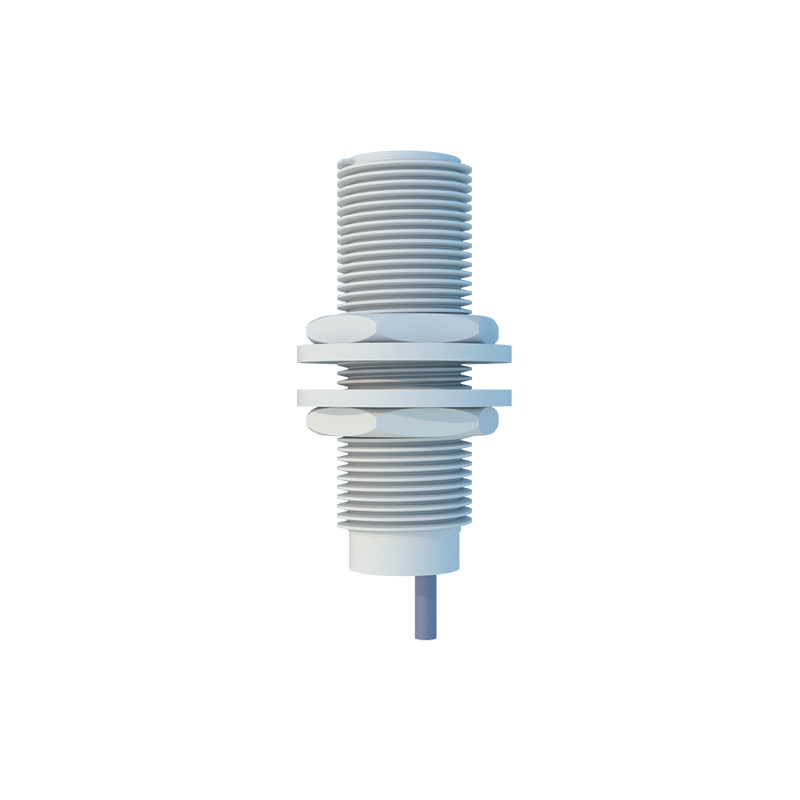
Boundary Conditions: When to Walk Away
Proximity sensors are not universal tools. Knowing their failure modes is critical.
1. Conductive Contaminants: Inductive sensors in machining centers with ferrous or aluminum swarf are a classic pitfall. Fine metallic dust can bridge the sensing face, creating a false "target present" signal or dampening the field. The solution isn't a higher IP69K rating; it's choosing a cylindrical form factor with a pronounced sensing face groove or switching to a pneumatic mechanical sensor.
2. Extreme Thermal Cycling: A sensor rated for -25°C to 70°C will survive constant heat. But cycling between a cold startup and operational heat daily causes condensation inside the housing. Eventually, this moisture freezes, expands, and fractures the epoxy potting, leading to internal corrosion. In such environments, sensors with internal conformal coating and a breather valve are mandatory, not optional.
3. High-Speed Non-Ferrous Detection: Need to count aluminum cans at 3000 units/minute? A standard capacitive sensor will struggle with consistency. The small mass and low dielectric constant result in a weak signal-to-noise ratio. In these cases, a specialized high-speed capacitive sensor with a focused field and advanced noise immunity algorithms is the only viable option. Using a standard sensor here guarantees drift and random miscounts by the second shift.
4. Strong Asymmetric Magnetic Fields: Placing an inductive sensor near a large DC motor or welding station is a common error. The external DC field can bias the sensor's ferrite core, effectively "latching" it in an on or off state until the external field is removed or the sensor is degaussed. Hall-effect or magnetostrictive sensors are equally vulnerable.
Counter-Intuitive Conclusions: Data-Driven Insights That Defy Common Sense
1. A Higher Frequency Sensor Can Be Less Accurate. Inductive sensors with higher switching frequencies (e.g., 5kHz vs 500Hz) offer faster response for high-speed applications. However, the higher frequency makes them exponentially more susceptible to noise from VFDs and switching power supplies. In an electrically noisy panel, the lower frequency sensor often provides more stable, jitter-free operation. Speed isn't always king; signal integrity is.
2. Shielding Can Reduce Sensing Range More Than Non-Shielding. It's logical to assume a shielded (flush-mountable) sensor is always better. However, in detecting small or low-mass targets (like a M3 screw head), the focused, shorter field of a shielded sensor can be too narrow. An unshielded sensor, with its larger, more diffuse magnetic field, often provides a more robust and forgiving detection envelope for such tricky targets, despite its sensitivity to surrounding metal.
3. The "Fail-Safe" Output is Often the Point of Failure. Many engineers specify Normally Closed (NC) outputs for "fail-safe" design, believing a wire break will de-energize the circuit. In proximity sensors, the output is typically a solid-state switch (PNP or NPN). The most common electronic failure mode is an internal short-circuit of this transistor, not an open circuit. A shorted "NO" output fails active (output on