After two decades on the factory floor, I've seen proximity sensors fail in ways no manual predicts. The square-bodied inductive or capacitive proximity switch, lauded for its robust housing and stable sensing, is no exception. Let's cut through the marketing fluff.
Experience Correction: The Myth of "Stable" Sensing Distance. The datasheet states a nominal sensing distance (Sn) for a standard target. In reality, this parameter is a fantasy in dirty environments. For inductive sensors detecting steel, a buildup of ferrous dust or swarf on the face can effectively extend the sensing distance by up to 30%. The sensor "sees" the conductive layer as part of the target, causing premature triggering. Conversely, a persistent layer of non-conductive grease or paint (over 0.5mm thick) on a capacitive sensor can attenuate its field, requiring a target 15-20% closer to actuate. The rated temperature coefficient? It assumes ambient heat. Mount a sensor on a vibrating machine frame experiencing cyclical friction heat, and the internal oscillator drift can cause a 5-10% shift in Sn at the extremes of its claimed range. Rely on the nominal Sn for critical positioning, and you'll invite timing faults.
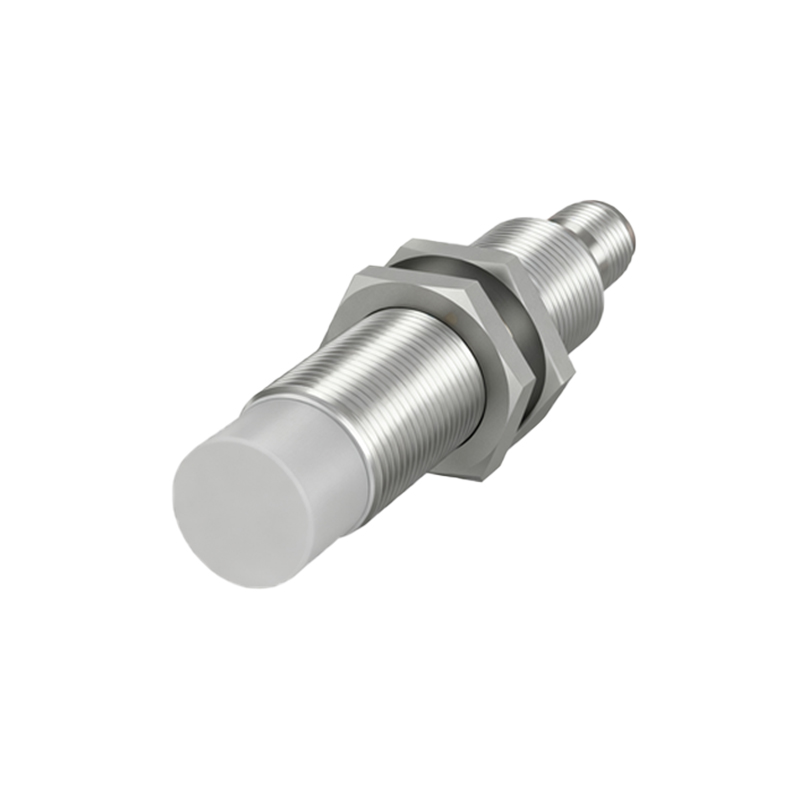
Boundary Conditions: Where This Square Peg Does Not Fit. The square shape promises easy mounting, but that's precisely its weakness in specific scenarios.
1. High-Pressure Washdown with Narrow Jets: The seam between the sensing face and the housing is a vulnerability. Directed, high-pressure jets (IP69K testing uses diffuse spray) can force conductive fluid into the housing via capillary action, leading to internal corrosion and failure within weeks, despite the IP rating. Do not specify these for direct, close-range high-pressure cleaning paths.
2. Heavy, Abrasive Particulate Flow: In mining or milling applications where sand or abrasive granules flow perpendicularly across the sensor face, the square edges create turbulent wear. The housing may survive, but the sensing face (often PBT or PTFE) will erode, changing its dielectric properties and killing capacitive models, while inductives suffer from material removal altering field geometry. A cylindrical sensor presents a smoother profile for such flows.
3. High-Frequency Vibration on Non-Rigid Structures: The flat mounting surface demands full contact. On sheet metal guards or panels that resonate, the broad mounting plane can turn the sensor into a perfect vibration transmitter, loosening mounting hardware and accelerating solder joint fatigue inside. In such cases, a cylindrical sensor with a locking nut and smaller footprint often dampens better.
Counter-Intuitive Conclusion: A "Worse" Spec Can Yield Higher Reliability. Here’s the hard truth: sometimes selecting a sensor with a shorter rated sensing distance improves system uptime. Why? Sensors are tuned for maximum Sn at the factory. This often means operating the oscillator at the edge of its stability envelope for inductive types, or at high sensitivity for capacitive. In electrically noisy environments (VFDs, welders), this high-gain state makes them prone to false triggering from EMI. By deliberately choosing a model with a 30% shorter Sn than theoretically needed, you are often selecting a unit that operates in a more electrically robust region of its circuit. The result? Fewer nuisance stops. Data from a automotive welding line retrofit showed a 70% reduction in sensor-related stoppages after swapping "max range" models for "medium range" equivalents, even though both were technically capable of the required 8mm detection. The trade-off was a slight adjustment in mounting position—a trivial cost for massive reliability gain. Furthermore, in capacitive sensing of non-metals, a sensor with a lower nominal sensitivity but equipped with a potentiometer you can manually de-tune on-site is infinitely more valuable than an auto-compensating "smart" sensor that can be fooled by ambient humidity shifts. Control, not automation, is key in edge-case applications.
The square proximity sensor is a tool, not a universal solution. Its value is unlocked not by its advertised specs, but by a ruthless understanding of its failure modes and strategic under-utilization of its performance ceiling.