In the world of precision measurement and industrial automation, laser displacement sensors have become indispensable tools. These devices offer non-contact, high-speed, and highly accurate measurement capabilities, enabling tasks that were once difficult or impossible with traditional contact methods. At their core, these sensors operate on a simple yet powerful principle: they project a laser beam onto a target surface and analyze the reflected light to determine the exact distance to that point.
The fundamental technology behind most laser displacement sensors is triangulation. A laser diode emits a focused beam of light onto the target. The light spot reflects off the surface and is captured by a receiving lens, which focuses it onto a position-sensitive detector, typically a CCD or CMOS linear array. The position of the light spot on this detector changes precisely with the distance to the target. By calculating this positional shift, the sensor's internal processor can determine the displacement with remarkable accuracy, often down to the sub-micron level. Alternative high-end methods, such as confocal or interferometric principles, are used for even more demanding applications requiring nanometer resolution.
The advantages of using laser displacement sensors are numerous. Their non-contact nature means there is no risk of damaging delicate or soft materials, and no wear on the sensor itself from physical touch. They provide extremely fast measurement rates, often in the kilohertz range, making them perfect for high-speed production lines. Furthermore, they can measure a wide variety of materials, including metals, plastics, glass, and even liquids, provided the surface can reflect sufficient laser light.

The applications for these sensors span virtually every manufacturing sector. In the automotive industry, they are used to measure critical component dimensions, inspect body panel gaps, and control robot positioning. In electronics manufacturing, they ensure the precise thickness of semiconductor wafers, the coplanarity of chip leads, and the height of solder paste. They play a crucial role in quality control, checking for warpage, vibration analysis, and online thickness monitoring of rolled materials like steel, paper, or film. Beyond traditional factories, they are used in research and development for material science experiments and even in civil engineering for monitoring structural deformations.
Selecting the right laser displacement sensor requires careful consideration of several key parameters. The first is measuring range, which defines the minimum and maximum distances over which the sensor can operate accurately. Related to this is the stand-off distance, the optimal working distance from the sensor head to the target. Resolution specifies the smallest detectable change in distance, while linearity indicates the accuracy of the measurement across the entire range. The spot size of the laser is critical for measuring small features or rough surfaces. Finally, factors like measurement speed, output interfaces (analog, digital, Ethernet), and environmental robustness (IP rating, temperature stability) must align with the specific application needs.
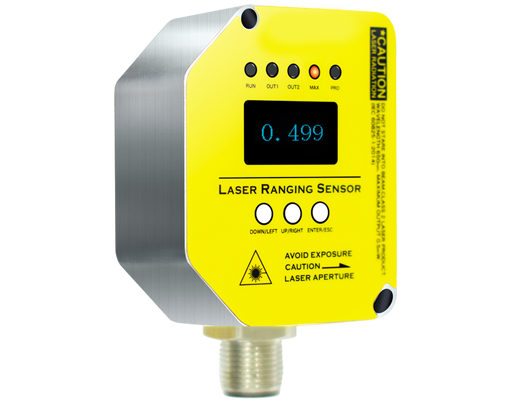
When integrating a laser sensor, practical considerations are paramount. The target surface's color, texture, and material significantly affect performance; a dark, matte surface absorbs more light than a shiny white one, potentially requiring a sensor with a more powerful laser or special calibration. Ambient light, particularly strong industrial lighting, can interfere with the sensor's receiver, often necessitating optical filters or protective housings. Proper mounting and alignment are essential to ensure the laser beam is perpendicular to the target surface for optimal accuracy. Regular calibration against known standards is also recommended to maintain long-term performance.

Looking ahead, the evolution of laser displacement sensors continues. Trends include miniaturization of sensor heads for integration into tighter spaces, the development of blue-violet lasers for better performance on organic materials, and enhanced connectivity for Industry 4.0 and IoT frameworks, allowing for predictive maintenance and big-data analytics. Multi-point and profile sensors, which use laser lines instead of single points, are expanding applications into 3D contour scanning.
In conclusion, laser displacement sensors are a cornerstone of modern precision measurement. By understanding their operating principles, vast application potential, and critical selection criteria, engineers and technicians can effectively harness their power to improve product quality, optimize processes, and drive innovation across countless industries. Their ability to deliver reliable, non-contact data at high speeds makes them an investment that continues to pay dividends in efficiency and control.