Introduction to Through-Beam Photoelectric Sensors
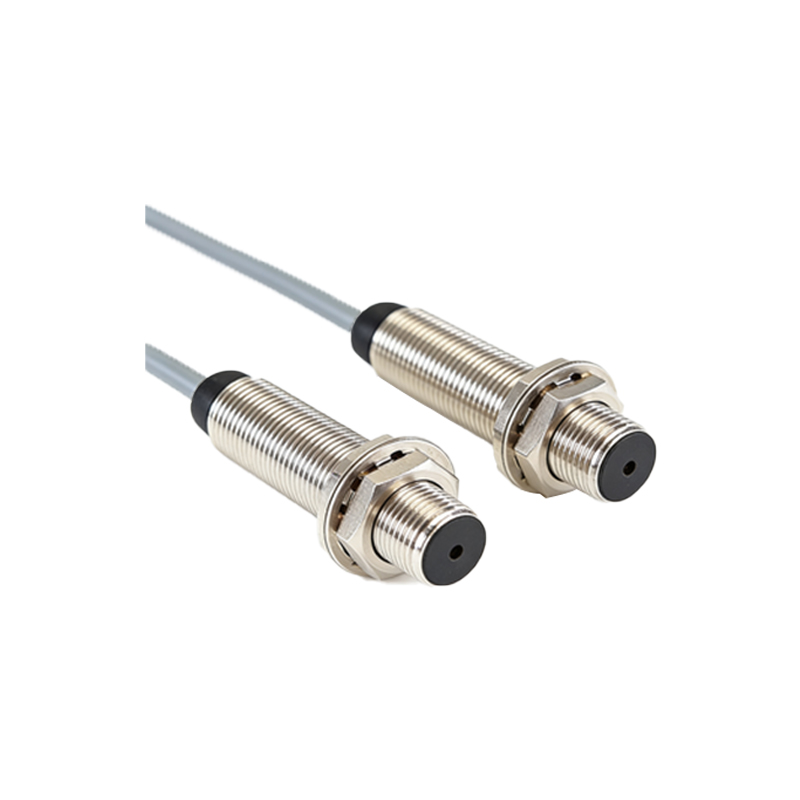
Through-beam photoelectric sensors consist of a separate emitter and receiver, operating in a break-beam mode. When the light beam between them is interrupted by an object, the receiver triggers a detection signal. The light source is a critical element that directly impacts sensor performance, including detection range, reliability, and immunity to environmental factors such as dust, vibration, and ambient light. In industrial settings, selecting the correct light source is essential for minimizing false triggers and ensuring high-speed, accurate detection.
Common Light Source Types: LED vs. Laser
The two primary light sources used in through-beam sensors are light-emitting diodes (LEDs) and laser diodes. LEDs are widely employed for general-purpose applications due to their long operational life, low cost, and broad beam divergence. However, LEDs produce a relatively wide beam, which can lead to reduced sensitivity in high-precision alignment. Laser sources, on the other hand, offer a highly collimated beam with minimal divergence, enabling detection over distances exceeding 100 meters. Lasers are ideal for applications requiring precise positioning, such as in automated assembly lines or warehouse logistics. However, lasers are more sensitive to environmental contaminants and require careful installation to maintain alignment.
Wavelength Considerations for Industrial Environments
The wavelength of the light source affects the sensor's ability to penetrate dust, fog, or mist. Infrared (IR) wavelengths, typically around 850 nm to 950 nm, are commonly used because they are less visible to the human eye and can pass through moderate amounts of airborne particles. Visible red light sources, usually at 650 nm, are easier to align visually, making them suitable for installations requiring manual setup. For harsh environments, such as woodworking or mining, selecting the appropriate wavelength can significantly reduce false detections caused by debris or humidity. Engineers must also consider ambient light interference; for example, sensors using modulated light sources with specific frequencies can filter out noise from sunlight or artificial lighting.
Beam Divergence and Alignment Challenges
Beam divergence defines how quickly the light beam spreads over distance. In through-beam sensors, a narrow divergence angle (e.g., 0.5°) is ideal for long-range detection, as it maintains a high energy density at the receiver. Conversely, wider beams (e.g., 3-5°) are easier to align but may cause decreased range and increased susceptibility to misalignment due to vibration or thermal expansion. For instance, in conveyor belt systems where the sensor mounts may shift over time, a slightly wider beam can provide a tolerance buffer. Engineers should evaluate the trade-off between alignment ease and detection distance when selecting the light source configuration.
Modulation and Signal Processing
Modern through-beam sensors employ modulated light sources—where the emitter pulses the light at a specific frequency—to distinguish the signal from background ambient light. The receiver’s electronics are tuned to detect only that frequency, enhancing immunity to interference. For high-speed applications, such as detecting small parts on a fast-moving production line, the modulation frequency must be high enough to avoid missing objects. However, higher modulation frequencies may reduce the effective detection range due to increased power consumption and signal attenuation. Engineers must balance these factors by considering the target object size, speed, and environmental conditions.
Environmental Factors and Maintenance
The light source’s performance can degrade over time due to factors like dust accumulation on optics, temperature fluctuations, and aging of the emitter. For example, LEDs may exhibit gradual lumen depreciation, while laser diodes can suffer from thermal runaway if not properly heat-sinked. Regular cleaning of the emitter and receiver windows is essential to maintain consistent performance. In outdoor or heavy-industry settings, selecting sensors with sealed, IP67-rated housings and automatic gain control can mitigate the effects of contamination. Additionally, using light sources with built-in diagnostics, such as power output monitoring, can alert operators to potential failures before they cause downtime.
Conclusion: Matching Light Source to Application
Selecting the optimal light source for a through-beam photoelectric sensor requires a systematic analysis of the application’s specific demands. For general-purpose tasks with moderate distances and clean environments, an infrared LED often provides the best cost-performance balance. For high-precision, long-range, or high-speed applications, a laser source with a narrow beam and modulation may be necessary. Engineers should always test prototypes under actual operating conditions, including worst-case dust, light, and temperature scenarios, to validate the sensor’s reliability. By understanding the interplay between wavelength, divergence, modulation, and environmental resilience, you can design a robust detection system that minimizes maintenance and maximizes uptime.