Through-Beam Sensors: High Reliability for Long-Distance Detection
Through-beam photoelectric sensors consist of a separate emitter and receiver placed opposite each other. The emitter sends a continuous beam of light directly to the receiver. When an object interrupts this beam, the sensor triggers an output. This design offers the highest detection accuracy among photoelectric sensors, as the light path is direct and unaffected by surface reflectivity. They are ideal for long-range applications, with typical ranges exceeding 30 meters. However, installation requires precise alignment of both components, and the sensor cannot detect objects smaller than the beam diameter. Common uses include conveyor belt monitoring, warehouse doorway detection, and automated guided vehicle (AGV) tracking.
Retro-Reflective Sensors: Balanced Performance for Medium-Range Tasks
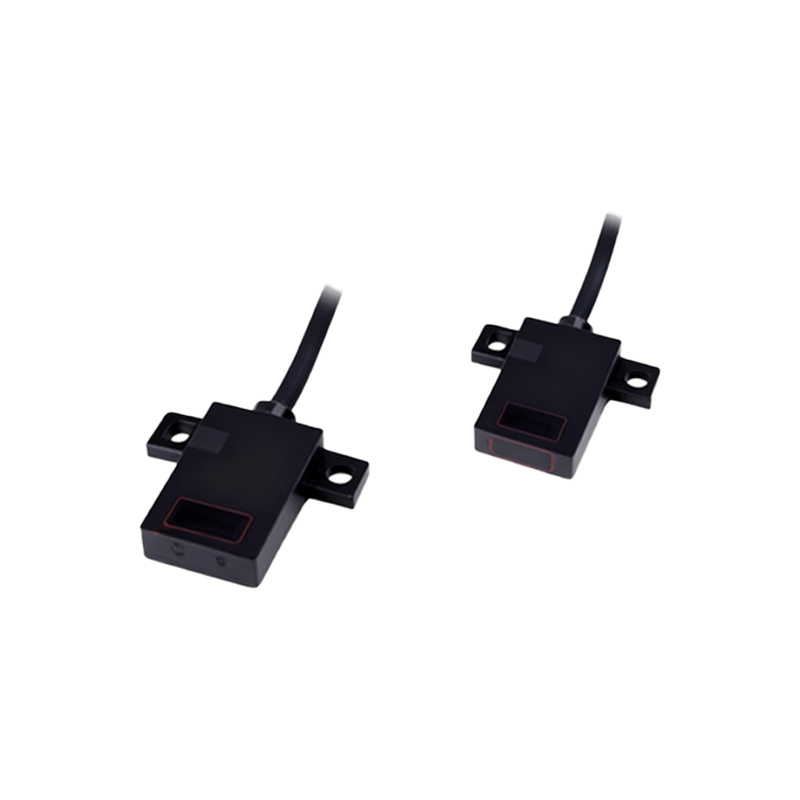
Retro-reflective sensors integrate the emitter and receiver in a single housing, with a reflector placed opposite the sensor. The emitted light bounces off the reflector and returns to the receiver. When an object blocks the light path, the sensor detects its presence. These sensors offer a good balance between range and ease of installation, typically covering distances up to 10 meters. They are more tolerant to misalignment than through-beam types but may struggle with highly reflective objects, which can cause false triggers. Using a polarizing filter can mitigate this issue. Typical applications include packaging line object detection, pallet positioning, and automated storage systems.
Diffuse Reflective Sensors: Compact Solutions for Short-Range Sensing
Diffuse reflective sensors, also known as proximity photoelectric sensors, have both emitter and receiver in one unit with no separate reflector. The emitter projects light toward a target, and the sensor detects the light reflected directly from the object's surface. This design allows for simple installation and minimal wiring, making it suitable for tight spaces. However, detection range is limited, typically under 2 meters, and depends heavily on the object's color, texture, and reflectivity. Dark or matte surfaces may reduce sensitivity. These sensors excel in applications like part presence verification, level detection in hoppers, and robotic end-effector positioning.
Each type of photoelectric sensor serves a distinct purpose in industrial automation. Through-beam sensors provide maximum reliability for long distances, retro-reflective sensors offer a versatile medium-range solution, and diffuse reflective sensors deliver compact, cost-effective short-range detection. Selecting the appropriate type depends on factors like detection distance, object characteristics, environmental conditions, and installation constraints. Understanding these differences ensures optimal system performance and reduces maintenance downtime.