Ultrasonic proximity sensors are a cornerstone technology in modern industrial automation and process control. Operating on principles distinct from inductive, capacitive, or photoelectric sensors, they offer unique advantages for solving complex detection and measurement challenges. At their core, these sensors function by emitting high-frequency sound waves, typically in the range of 40 kHz to 400 kHz, which are inaudible to the human ear. A transducer acts as both a speaker and a microphone: it emits a burst of ultrasonic pulses and then listens for the returning echo after these pulses reflect off a target object.
The fundamental working principle is based on the time-of-flight (ToF) measurement. The sensor's internal electronics precisely calculate the time interval between the emission of the sound pulse and the reception of its echo. Since the speed of sound in air is a known constant (approximately 343 meters per second at 20°C), this time measurement can be accurately converted into a distance value using the formula: Distance = (Speed of Sound × Time of Flight) / 2. The division by two accounts for the round-trip journey of the sound wave. This capability allows ultrasonic sensors to perform not just simple presence detection, but also precise distance measurement and continuous level monitoring.
Several key characteristics define their performance and application suitability. The sensing range varies significantly by model, from a few centimeters for precise positioning tasks to over 10 meters for large container level sensing. The beam angle, or dispersion pattern, is another critical factor. A wider beam can cover a larger area but may be prone to detecting unwanted background objects, while a narrow, focused beam is ideal for precise targeting. Modern sensors often feature adjustable sensing windows or teach-in functions, allowing engineers to set specific near and far limits within the overall range, effectively creating a "window" of detection.
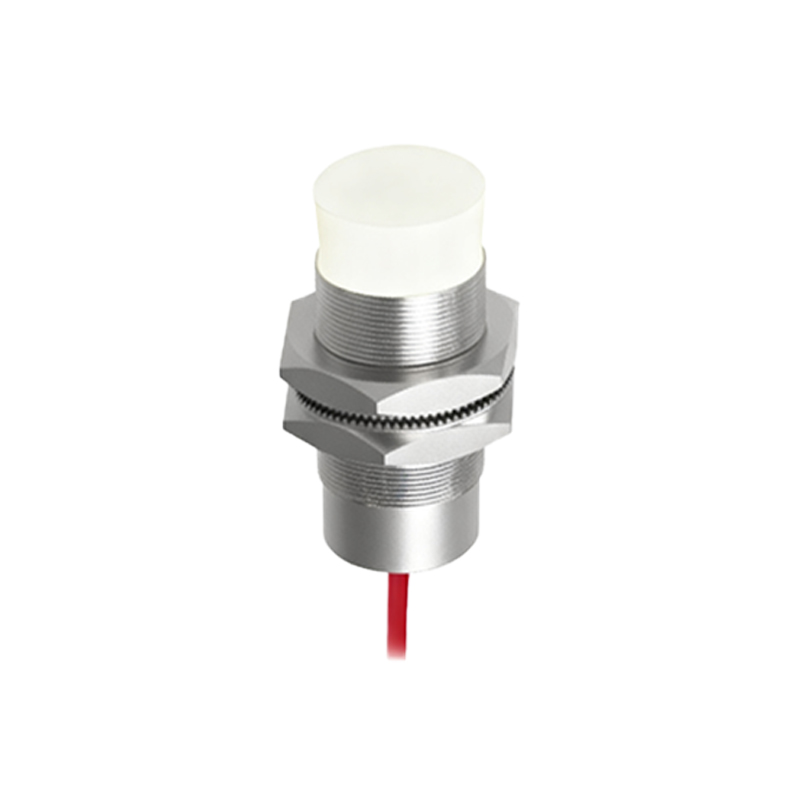
The material independence of ultrasonic sensors is one of their most significant advantages. Unlike inductive sensors that only detect metals, or capacitive sensors sensitive to material density, ultrasonic waves can reflect off virtually any solid or liquid surface—metal, plastic, wood, glass, granules, or liquids, regardless of color, transparency, or reflectivity to light. This makes them exceptionally versatile. Furthermore, they are largely immune to ambient light conditions, dust, smoke, and vapors that commonly plague photoelectric sensors, ensuring reliable operation in harsh industrial environments.
However, certain environmental factors must be considered for optimal performance. The speed of sound is temperature-dependent, changing by about 0.17% per degree Celsius. High-precision models incorporate temperature compensation circuits to correct for this variance. Extremely soft, sound-absorbing materials (like wool or foam) may not reflect sufficient energy for reliable detection. Turbulent air, strong air currents, or significant variations in air pressure can also deflect or dissipate the sound waves. The surface angle of the target is important as well; a smooth surface perpendicular to the sensor beam provides the strongest echo, while highly angled or irregular surfaces may scatter the signal.
In practical industrial applications, ultrasonic proximity sensors are deployed in a vast array of roles. In material handling and packaging, they are used for palletizing, box presence detection on conveyors, and controlling robotic gripper positioning. In the automotive industry, they assist in assembly line positioning and robot guidance. One of the most common applications is in bulk solid and liquid level monitoring in silos, tanks, and hoppers, providing continuous, non-contact measurement of materials like grains, powders, chemicals, and water. They are also found in collision avoidance systems for automated guided vehicles (AGVs) and crane systems.
When selecting an ultrasonic sensor for a specific task, engineers must evaluate several parameters beyond just range. The response time or switching frequency determines how quickly the sensor can update its output, crucial for high-speed production lines. Output options include analog (4-20 mA or 0-10 V), discrete (PNP/NPN switching), and digital interfaces (IO-Link), which not only provide switch signals but also enable advanced diagnostics and parameterization. The housing material, typically made of robust plastics like PBT or metals like stainless steel, must withstand the environmental conditions, including exposure to chemicals, washdowns, or extreme temperatures.
Installation and commissioning require careful attention. Sensors should be mounted securely to minimize vibration. It is essential to avoid placing them where acoustic noise from other machinery (like pneumatic valves or compressors) could interfere. The sensing path should be kept clear of obstructions and, if possible, away from highly reflective background surfaces that could cause multiple echoes. Many contemporary sensors feature built-in LED indicators and push-button programming, simplifying setup without the need for additional configuration tools.
In summary, ultrasonic proximity sensors provide a reliable, versatile, and material-independent solution for distance measurement and object detection where other sensing technologies fall short. Their ability to function effectively in dirty, dusty, or vaporous environments, coupled