In the realm of precision measurement and control within industrial automation, material testing, and advanced manufacturing, laser tension sensors have emerged as a pivotal technology. Unlike traditional contact-based load cells or strain gauges, these sensors employ non-contact laser measurement principles to determine tension or force, offering significant advantages in applications where direct contact is impractical, contaminating, or could alter the material properties being measured.
The core operating principle of most laser tension sensors is based on laser Doppler vibrometry or laser triangulation. In a common configuration for measuring tension in moving wires, filaments, or thin strips, the sensor projects a laser beam onto the target material. As the material vibrates or moves under tension, its natural frequency or deflection characteristics change. The sensor's sophisticated optical system detects these minute changes. The key relationship exploited is that the transverse vibration frequency of a tensioned string or web is proportional to the square root of the applied tension. By precisely measuring this frequency through laser-induced vibration analysis or by monitoring the material's position and sag via triangulation, the sensor's onboard processor calculates the exact tension value with high resolution.
The advantages of this non-contact methodology are substantial. Firstly, it eliminates issues of mechanical wear, slippage, and maintenance associated with contact rollers or wheels. This leads to higher long-term reliability and reduced downtime. Secondly, it does not impart any additional drag or force on the material, ensuring the measurement does not interfere with the process itself—a critical factor in the production of delicate optical fibers, fine wires, or sensitive films. Thirdly, laser sensors are immune to electromagnetic interference (EMI), making them ideal for use in environments with strong magnetic fields or near powerful motors, where traditional electronic sensors might falter.
Industrial applications for laser tension sensors are diverse and growing. In the wire and cable manufacturing industry, they are indispensable for controlling tension during drawing, stranding, and insulating processes, directly impacting product consistency and quality. In the printing and converting sector, they ensure uniform web tension for accurate registration and to prevent wrinkles or breaks in paper, foil, or plastic films. The textile industry utilizes them in fiber spinning and weaving to maintain optimal yarn tension. Furthermore, they are finding increased use in research and development laboratories for material characterization, testing the tensile properties of novel composites, fibers, and biological tissues without introducing contact stress concentrations.
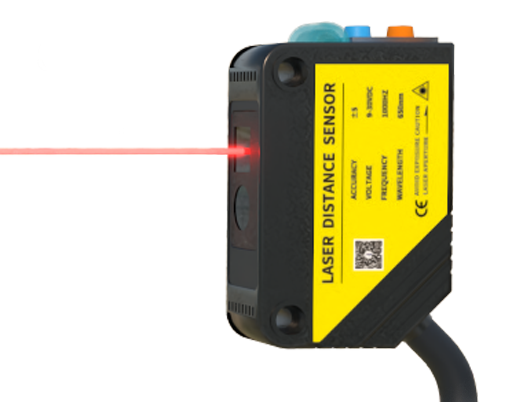
Recent technological advancements are pushing the boundaries of laser tension sensing. The integration of faster digital signal processors (DSPs) and machine learning algorithms allows for real-time tension analysis and predictive control, enabling proactive adjustments in production lines. Enhanced laser sources and high-speed CMOS detectors have improved measurement speed and resolution, allowing them to monitor rapidly moving or vibrating materials. Some modern systems now incorporate multiple laser points or linescan profiles to measure tension distribution across a wide web, providing a more comprehensive picture than a single-point measurement.
When selecting and implementing a laser tension sensor, several critical factors must be considered. The material's surface properties (reflectivity, color, texture) can affect laser signal strength; some sensors offer automatic gain control to compensate for these variations. The required measurement range, resolution, and response speed must match the process demands. Environmental conditions such as ambient light, dust, oil mist, or temperature fluctuations should be evaluated, with many industrial-grade sensors featuring robust housings and protective windows. Proper installation alignment is also crucial for accurate triangulation-based systems.
In conclusion, laser tension sensors represent a sophisticated fusion of optics, vibration analysis, and digital processing. Their non-contact nature provides a unique and often superior solution for precise tension measurement across a multitude of demanding industrial and research applications. As industries continue to strive for higher quality, efficiency, and process transparency, the role of advanced sensing technologies like laser tension sensors will only become more central, driving further innovation in their design and capability to meet the evolving challenges of modern manufacturing and materials science.