In industrial automation and control systems, proximity sensors are indispensable components for detecting the presence or absence of objects without physical contact. A critical, yet often nuanced, aspect of their application lies in correctly distinguishing between ferrous (iron-based) and non-ferrous (often plastic or aluminum) targets. This distinction is not merely academic; it directly impacts sensor selection, system reliability, and operational efficiency.
Proximity sensors primarily operate on two fundamental principles: inductive and capacitive. Inductive proximity sensors are the workhorses for detecting metallic objects. They generate an electromagnetic field. When a metallic target enters this field, eddy currents are induced within the target, causing a change in the sensor's oscillation amplitude. This change is detected and triggers the sensor's output switch. However, the sensor's sensitivity varies dramatically with the target material's properties.
Ferrous metals, such as mild steel, iron, and stainless steel (to a lesser, more variable degree), are highly permeable. This high magnetic permeability allows the electromagnetic field to penetrate deeply and induces strong eddy currents. Consequently, standard inductive sensors have their nominal sensing distance, or "Sn," rated specifically for a defined grade of mild steel (e.g., Fe360). For a given sensor, a ferrous target will typically be detected at or near this rated distance.
Non-ferrous metals, like aluminum, copper, brass, and austenitic stainless steels (e.g., 304, 316), present a different challenge. They have lower permeability but higher conductivity. The induced eddy currents are stronger due to this conductivity, but the field penetration differs. The effective sensing distance for these materials is significantly reduced. A common rule of thumb is that for aluminum, the sensing distance is approximately 40-50% of the rated Sn for mild steel. For copper, it can be as low as 30%. This reduction factor is crucial for mechanical design and positioning to avoid detection failures.
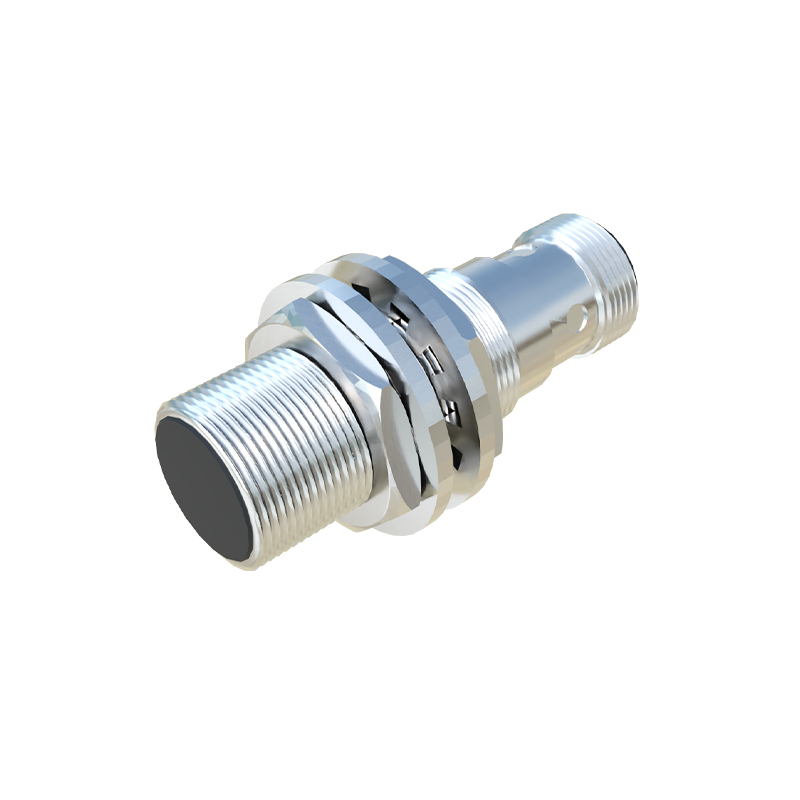
This brings us to the core differentiation: "ferrous" versus "non-ferrous" in sensor datasheets. A standard inductive sensor is optimized for ferrous targets. Using it to detect aluminum at the same mounting distance as steel will likely result in a missed detection. To address this, manufacturers offer "factor 1" sensors (for all metals) or specifically calibrated versions. A "factor 1" sensor has its Sn rated for aluminum, meaning its sensing distance for steel will be much greater, often 2-2.5 times the stated Sn. Understanding this specification is paramount.
For non-metallic targets, such as plastics, glass, wood, or liquids, inductive sensors are ineffective. This is where capacitive proximity sensors come into play. They generate an electrostatic field and detect changes in capacitance caused by any material that alters the dielectric constant of the field. Whether the target is plastic, paper, glue, or a conductive liquid, a capacitive sensor can detect it. Their sensing distance is influenced by the target material's density and dielectric constant. For instance, water or glue has a much higher dielectric constant than dry plastic, resulting in a longer effective sensing range.
In practical applications, the choice is dictated by the target. For reliably detecting steel parts on a conveyor, a standard inductive sensor is perfect. For monitoring the level of plastic pellets in a hopper or detecting a glue bead on a product, a capacitive sensor is essential. A common error is attempting to use an inductive sensor to detect a non-ferrous metal at a distance calculated for steel, leading to intermittent faults. Another is trying to sense a plastic bottle with an inductive sensor, which will never work.
Installation and environment also play roles. Inductive sensors are generally immune to dust, dirt, and non-metallic contaminants but can be influenced by adjacent metal (mounting in non-ferrous brackets requires increased clearance). Capacitive sensors can be influenced by humidity, dust buildup on the face, and stray capacitance from nearby objects, requiring careful tuning of their sensitivity potentiometer.
In summary, the dichotomy between "iron" and "plastic/glue" for proximity sensors is fundamentally a choice between inductive and capacitive technologies, with a critical sub-division within inductive sensing for ferrous versus non-ferrous metals. Successful implementation requires a clear understanding of the target material's electrical properties, consulting sensor reduction factors, and selecting the appropriate technology. This ensures robust detection, minimizes downtime, and maintains the integrity of the automated process. Always refer to the manufacturer's datasheet for specific sensing distances and correction factors for your application's target material.