In the realm of industrial automation and smart systems, proximity sensing technology is a cornerstone for enabling non-contact detection, enhancing safety, and improving operational efficiency. Among the various types of sensors available, capacitive proximity sensors, particularly those in the M5 form factor, have carved out a significant niche due to their unique capabilities. This article delves into the operational principles, key advantages, diverse applications, and critical selection criteria for M5 capacitive proximity sensors, providing a comprehensive guide for engineers and system integrators.
At its core, a capacitive proximity sensor operates by generating an electrostatic field. The M5 sensor, named for its 5mm diameter sensing face, emits a high-frequency oscillating field from its active surface. When a target object enters this field, it causes a change in the sensor's capacitance. The internal circuitry of the sensor detects this change, which triggers a switching output—typically a solid-state PNP or NPN signal. Unlike inductive sensors that only detect metals, the fundamental advantage of capacitive sensors lies in their ability to detect a vast range of materials, including liquids, powders, granules, plastics, glass, and wood. This makes the M5 capacitive sensor exceptionally versatile.
The compact M5 size is a major driver for its adoption. In modern machinery where space is at a premium, the small footprint of these sensors allows for installation in tight locations where larger sensors would be impractical. Despite their miniature size, they offer reliable sensing distances, usually up to 2-4mm for standard targets. This combination of small size and adequate range is ideal for applications like PCB handling, small-part detection in assembly lines, or level sensing in miniature containers.
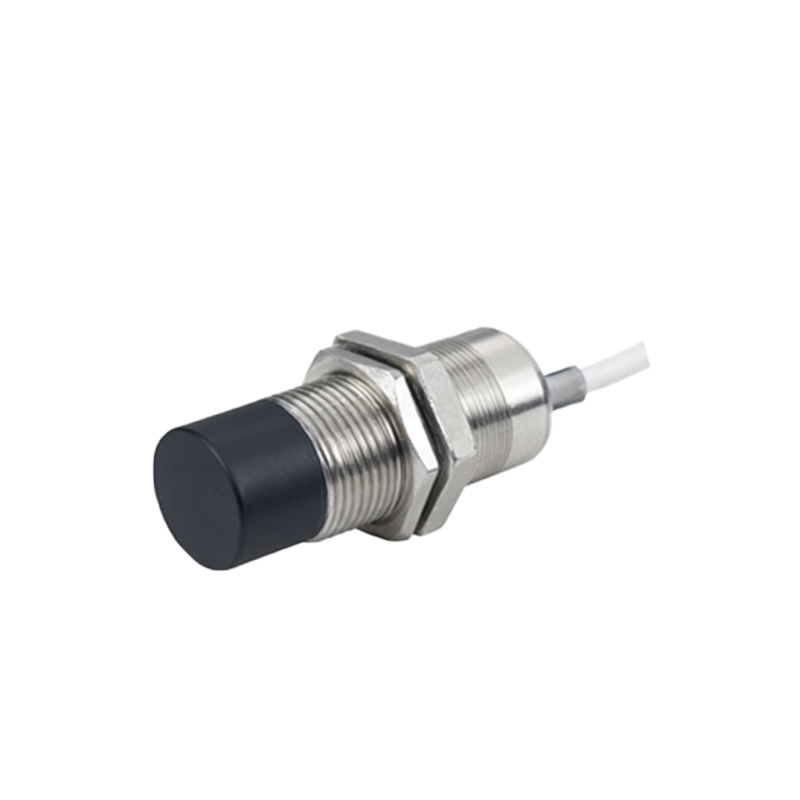
Key performance characteristics define the utility of M5 capacitive sensors. One critical feature is their adjustable sensitivity, often via a potentiometer on the sensor body. This allows engineers to fine-tune the sensing range and ignore interfering background materials, such as a container wall, to focus on the target material inside. This is paramount for applications like liquid level detection in non-metallic tanks or monitoring the fill level of plastic bottles. Furthermore, many M5 models feature built-in temperature and humidity compensation circuits, ensuring stable operation despite environmental fluctuations common in industrial settings. Their housing is typically made of corrosion-resistant materials like PBT or stainless steel, with high IP67 or IP69K ingress protection ratings, making them suitable for washdown environments in food & beverage or pharmaceutical industries.
The application spectrum for M5 capacitive proximity sensors is remarkably broad. In packaging machinery, they are used to detect the presence of labels, foil, or plastic film. In electronics manufacturing, they verify the placement of components on a board. A crucial application is in liquid and solid level control. They can reliably detect the presence or absence of adhesive, oil, water, or granular materials like sugar and flour through the walls of glass or plastic vessels, preventing overflows or run-dry conditions. Another growing area is in human-machine interface (HMI) and touch-sensitive controls, where their ability to detect a finger through a glass or plastic panel is utilized.
Selecting the right M5 capacitive sensor requires careful consideration of several parameters. First, identify the target material and its dielectric constant; materials with higher constants (like water) are easier to detect than those with lower constants (like certain plastics). The required sensing distance and the influence of the mounting environment (flush or non-flush) must be calculated. Electrical output type (e.g., 3-wire DC, NPN/PNP) must match the control system's input card. The operating voltage range (commonly 10-30V DC) and current rating are also vital. For harsh environments, specifications for housing material, temperature range, and IP rating are non-negotiable. Finally, consider special features like short-circuit protection, reverse polarity protection, and LED status indicators for easier diagnostics.
In conclusion, the M5 capacitive proximity sensor is a powerful and flexible component in the automation engineer's toolkit. Its ability to detect non-metallic objects through non-metallic barriers, combined with its rugged, compact design, solves a wide array of sensing challenges that optical or inductive sensors cannot address. By understanding its operating principle and meticulously matching its specifications to the application requirements, engineers can leverage this technology to build more robust, efficient, and intelligent automated systems. As industries continue to demand greater precision and material versatility, the role of the M5 capacitive sensor is poised to expand further.