Inductive proximity sensors represent a cornerstone of modern industrial automation, offering non-contact detection of metallic objects. Among the diverse range of models available, the FRM12P1701L stands out as a particularly robust and reliable solution for demanding applications. This article provides a detailed technical examination of the FRM12P1701L sensor, its operating principles, key specifications, and typical use cases in industrial environments.
The fundamental operating principle of the FRM12P1701L is based on electromagnetic induction. The sensor generates a high-frequency oscillating electromagnetic field via a coil wound around a ferrite core at its active face. When a metallic target enters this field, eddy currents are induced on the target's surface. These currents draw energy from the oscillator, resulting in a measurable amplitude reduction or frequency shift. The sensor's internal circuitry detects this change and triggers a solid-state switching output, typically in the form of a PNP (sourcing) or NPN (sinking) transistor. The "FRM12P1701L" designation often follows a manufacturer-specific coding system where "12" likely indicates the sensor's housing diameter (e.g., 12mm), "P" may denote the cylindrical threaded barrel form factor, "1701" could be a series or performance code, and "L" might specify a particular sensing distance, output type, or connection style.
Key technical specifications define the sensor's performance envelope. The rated sensing distance (Sn) is a critical parameter. For a standard 12mm diameter inductive sensor like the FRM12P1701L, this is typically 2mm or 4mm for mild steel, with a reduction factor applied for other metals (e.g., stainless steel, aluminum, copper). The sensor operates on a standard DC supply voltage, commonly in the range of 10-30V DC, ensuring compatibility with most industrial control systems. Its output is a 3-wire configuration, providing a switched signal to a PLC (Programmable Logic Controller) input module or other control device. The housing is invariably constructed from nickel-plated brass or high-grade stainless steel (e.g., V4A/AISI 316L), offering exceptional resistance to oils, coolants, and mechanical impact. The sensing face is often made of a specialized polymer (PBT or PPS) to allow the magnetic field to pass while protecting the internal coil. An important feature is its embedded protection against short-circuit, reverse polarity, and overload, enhancing system reliability. Many variants also include an LED status indicator for visual confirmation of operation and target detection.
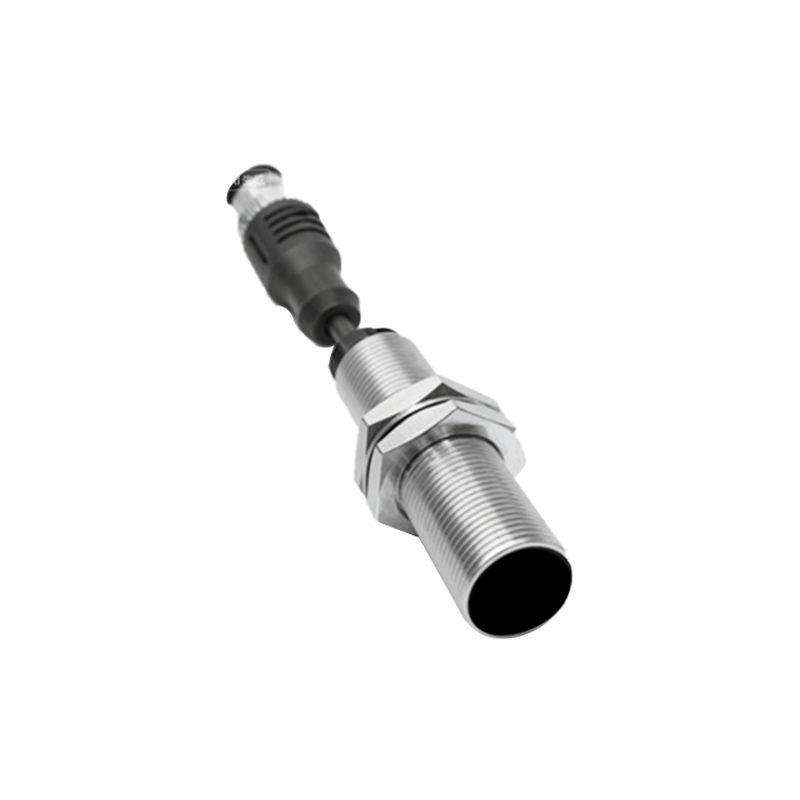
Installation and environmental considerations are paramount for optimal performance. The sensor must be mounted securely, with attention paid to the recommended flush-mounting or non-flush-mounting guidelines, as these affect the actual sensing range. Surrounding metals (the "metallic background") must be considered to prevent false triggering. The FRM12P1701L is designed to operate reliably across a wide temperature range, typically from -25°C to +70°C, making it suitable for use in unheated warehouses or near machinery generating significant heat. Its high protection rating, usually IP67 or IP69K, guarantees immunity to dust ingress and the ability to withstand high-pressure, high-temperature washdowns, a necessity in food & beverage or pharmaceutical manufacturing.
The industrial applications for the FRM12P1701L are vast due to its durability and precision. Common uses include position verification of metal parts on conveyor lines, end-of-stroke detection for cylinders and actuators, counting of metal components, monitoring of rotational speed via a gear tooth or key on a shaft, and checking for the presence of tools in CNC machining centers. Its small form factor allows for installation in tight spaces where larger sensors would not fit. In packaging machinery, it detects metallic elements on film or confirms the position of capping heads. In automotive assembly, it verifies the presence of nuts, bolts, or metal brackets. Its robustness makes it ideal for harsh environments like foundries or metal stamping plants.
When selecting an inductive proximity sensor like the FRM12P1701L, engineers must verify the exact specifications against the application requirements: the target material and size, required sensing distance, electrical interface (PNP/NPN, NO/NC), environmental conditions, and housing material. Proper selection ensures long-term, maintenance-free operation. In summary, the FRM12P1701L inductive proximity sensor exemplifies the fusion of robust mechanical design, reliable electronic switching, and application versatility. It is a fundamental component that enhances automation system efficiency, safety, and diagnostic capability, proving indispensable in countless industrial control scenarios.