In the realm of industrial condition monitoring and precision measurement, laser vibration sensors have emerged as a pivotal technology, offering non-contact, high-resolution vibration analysis. A fundamental characteristic defining their performance and suitability for various applications is their frequency response. This article delves into the intricacies of frequency response in laser vibration sensors, exploring its definition, determining factors, and implications for practical use in demanding industrial environments.
Frequency response, in the context of vibration sensors, refers to the relationship between the amplitude of the sensor's output signal and the frequency of the vibration being measured. It is typically represented as a graph showing the sensor's sensitivity (often in mV/(m/s²) or similar units) across a specified frequency range. For a laser vibration sensor, this response dictates the range of vibration frequencies it can accurately detect and measure. An ideal sensor would have a perfectly flat frequency response, meaning its sensitivity remains constant regardless of the input frequency. In reality, all sensors exhibit some variation.
The frequency response of a laser vibrometer is primarily governed by its internal components and measurement principle. Unlike contact sensors (e.g., piezoelectric accelerometers), laser sensors operate on the optical Doppler effect. A laser beam is directed at the target surface, and the vibration modulates the frequency of the reflected light. This shift is detected and converted into a velocity or displacement signal. The key elements influencing frequency response include:
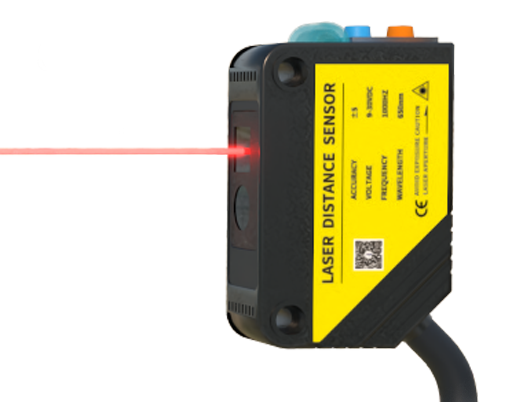
1. Photodetector and Electronics Bandwidth: The photodetector that converts the optical signal into an electrical current, along with the subsequent signal conditioning electronics (amplifiers, filters), has a finite bandwidth. This bandwidth sets an upper limit on the measurable frequency. High-frequency applications, such as analyzing ultrasonic vibrations in bearings or turbines, require detectors and electronics with very high bandwidths, often extending into the MHz range.
2. Laser Wavelength and Coherence: The properties of the laser source itself are critical. Shorter wavelength lasers generally allow for more precise measurements. The coherence length of the laser determines how well it can maintain interference over long path differences, which can affect measurements on surfaces with large stand-off distances or significant out-of-plane motion.
3. Signal Demodulation Technique: The method used to decode the Doppler frequency shift (e.g., heterodyne, homodyne, or digital interferometric techniques) has a direct impact on the frequency response and dynamic range. Modern digital interferometers offer superior linearity and a wide, configurable frequency response compared to older analog systems.

4. Environmental and Target Factors: While not intrinsic to the sensor, the target surface's reflectivity, roughness, and orientation can affect the signal-to-noise ratio (SNR). A poor SNR can effectively limit the usable frequency range, as high-frequency, low-amplitude signals may be lost in noise.
Understanding the specified frequency response is crucial for selecting the right sensor. A typical specification sheet will list a frequency range (e.g., 0.1 Hz to 1 MHz) and a tolerance (e.g., ±3 dB). The ±dB value indicates the allowable deviation from a reference sensitivity. For instance, at the lower and upper extremes of the range, the sensitivity might drop by 3 dB, meaning the output signal amplitude is about 70.7% of its nominal mid-band value. Engineers must ensure that the frequency content of the vibration they need to analyze falls well within the sensor's flat response region.
In industrial applications, this understanding drives critical decisions:
* Low-Frequency Monitoring (0.1 Hz - 100 Hz): Used for monitoring large structures like bridges, wind turbine towers, or slow-rotating machinery. Sensors for this range require high stability and sensitivity at very low frequencies, where other sensors like seismic accelerometers may struggle.
* Mid-Frequency Analysis (100 Hz - 20 kHz): This is the common range for general machinery health monitoring—pumps, motors, fans, and gearboxes. Laser sensors excel here by providing detailed spectral data without mass-loading delicate components.
* High-Frequency / Ultrasonic Analysis (20 kHz - 1 MHz+): Essential for detecting early-stage bearing defects, cavitation, or electrical partial discharge. Only specialized, high-bandwidth laser vibrometers can capture these signals, enabling predictive maintenance before catastrophic failure.
Calibration and verification of the frequency response are paramount for measurement integrity. This is typically performed by the manufacturer using traceable standards, such as a calibrated reference vibrator (shaker) that generates known frequencies and amplitudes. Users should periodically verify performance, especially after rough handling or use in extreme conditions.
In conclusion, the frequency response is not merely a datasheet parameter but a core determinant of a laser vibration sensor's capability. It is a synthesis of optical, electronic, and signal processing design. By carefully matching the sensor's frequency response characteristics—its range, flatness, and bandwidth—to the specific vibrational phenomena of interest, engineers can unlock precise, reliable insights into the dynamic behavior of machinery and structures, thereby enhancing safety, optimizing performance, and advancing the frontiers of predictive maintenance.