In the realm of industrial automation and control systems, proximity switch sensors are indispensable components for non-contact detection of objects. Among the various specifications and model codes, the designation "M40" frequently appears, particularly in the context of inductive proximity sensors. Understanding what "M40" signifies is crucial for engineers, technicians, and procurement specialists to ensure correct selection, installation, and integration into machinery and production lines.
Fundamentally, the "M40" in a proximity sensor model number typically refers to the sensor's housing diameter or thread size. Specifically, "M40" denotes a metric thread with a 40-millimeter diameter. This is a standardized industrial designation following the ISO metric thread standard. The "M" stands for "Metric," and the number "40" indicates the nominal major diameter of the thread in millimeters. Therefore, a sensor labeled as having an M40 housing features a cylindrical body with a 40mm diameter and a corresponding external metric thread along a portion of its length. This threaded design allows for straightforward and secure mounting into a pre-drilled and tapped hole of a matching size (M40x1.5 is a common pitch for such sensors) on a machine frame, bracket, or fixture.
The physical size implied by M40 has direct implications for the sensor's performance characteristics and application suitability. Generally, sensors with larger housing diameters, like M40, can accommodate larger sensing coils and electronic components. This often translates into a longer sensing range compared to sensors with smaller housings, such as M12, M18, or M30. For instance, a standard shielded (flush-mountable) inductive M40 proximity sensor might offer a sensing distance (Sn) of 40mm for a standard metal target, while an unshielded (non-flush) version could provide an even greater range. The robust construction of an M40 sensor also typically lends itself to higher mechanical strength and durability, making it suitable for harsh industrial environments with significant vibration, potential mechanical impact, or the presence of metallic dust and chips.
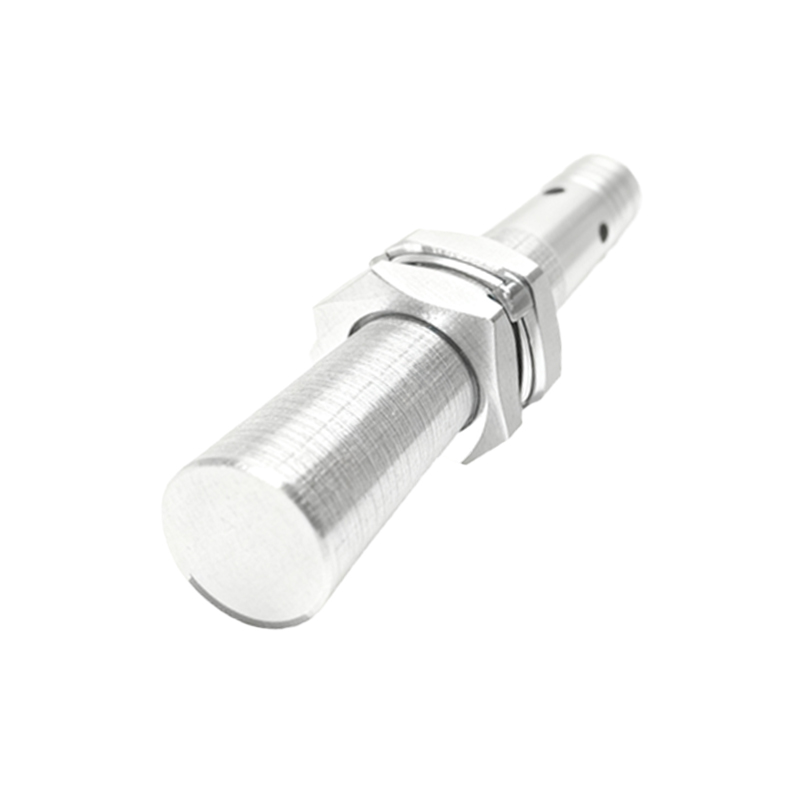
However, the "M40" designation primarily specifies the mechanical mounting interface, not the electrical characteristics or output type. An M40 proximity sensor can be found with various output configurations, including NPN (sinking), PNP (sourcing), Normally Open (NO), Normally Closed (NC), or analog (4-20mA, 0-10V) outputs. It can also be designed for different supply voltage ranges, such as 10-30V DC or 20-250V AC/DC. The sensing technology, while most commonly inductive for detecting metals, is not defined by M40. Although rare, capacitive M40 sensors for detecting non-metallic materials or ultrasonic variants might exist. Therefore, when selecting an M40 sensor, one must carefully review the complete datasheet specifications beyond just the housing size.
The application areas for M40 proximity sensors are vast within heavy industry and large-scale automation. Their long sensing range and sturdy build make them ideal for tasks such as position detection of large machine parts, pallets, or containers in material handling systems. They are commonly used in automotive manufacturing for checking the presence of engines, chassis, or large assemblies on conveyor lines. In metalworking, they monitor the position of heavy plates, coils, or robotic arms. Their size also allows for easier handling and wiring in control panels or on large machinery compared to very small sensors, though they require correspondingly larger mounting space.
When installing an M40 proximity sensor, precise mechanical preparation is key. The mounting hole must be drilled and tapped to the exact metric specification (e.g., M40x1.5). Incorrect tolerances can lead to difficult installation, thread damage, or insecure mounting. Adequate clearance around the sensing face is necessary, especially for unshielded sensors, to ensure the specified sensing range is achieved. The environmental rating (e.g., IP67, IP69K) should also be checked to confirm suitability for conditions involving coolants, oils, or high-pressure washdowns.
In summary, the term "M40" on a proximity switch sensor is a mechanical descriptor indicating a 40mm metric threaded housing. It points toward a sensor with a physically large form factor, generally associated with extended sensing ranges and high robustness. While it narrows down the mounting requirements, it does not define the sensor's electrical function, output type, or specific sensing technology. A comprehensive understanding of the M40 designation, coupled with a review of all other technical parameters, enables professionals to effectively leverage these powerful sensors for reliable object detection in demanding industrial applications, ensuring system reliability and operational efficiency.