Laser Range (LR) sensors, often referred to as laser distance sensors or laser rangefinders, represent a cornerstone technology in precision measurement and automation. Their operation is fundamentally based on the principle of Time-of-Flight (ToF) or phase-shift measurement, utilizing the constant speed of light to determine distance with remarkable accuracy.
At its core, an LR sensor emits a focused, coherent beam of laser light—typically from a laser diode—towards a target object. The light reflects off the object's surface and returns to a photodetector within the sensor. The key to distance calculation lies in analyzing this returned signal. In the direct Time-of-Flight method, the sensor precisely measures the elapsed time between the emission and reception of the laser pulse. Given that the speed of light (c) is a known constant (approximately 3×10^8 m/s), the distance (d) to the target is calculated using the simple formula: d = (c × t) / 2, where 't' is the measured time. The division by two accounts for the round-trip journey of the light pulse.
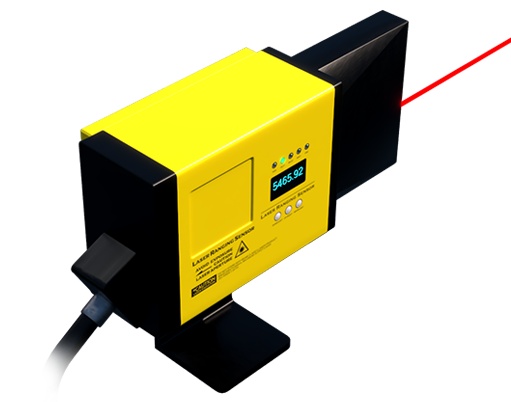
For even higher precision at shorter to medium ranges, many industrial LR sensors employ the phase-shift measurement technique. Here, the emitted laser beam is amplitude-modulated with a specific high-frequency signal. The reflected light returns with a phase shift relative to the emitted signal. The sensor's electronics measure this phase difference. Since the wavelength of the modulation frequency is known, the distance can be derived from the phase shift with sub-millimeter resolution. This method is exceptionally robust against ambient light interference.
The internal architecture of a typical industrial LR sensor is sophisticated. It houses the laser source, collimating optics to create a tight beam, a high-speed photodiode or avalanche photodiode (APD) for detection, and advanced signal processing circuitry. This circuitry employs filters and algorithms to distinguish the weak return signal from background noise, ensuring reliable operation in challenging industrial environments with dust, vibration, or varying surface reflectivities. Some sensors incorporate intelligent features like background suppression, which ignores objects beyond a set distance, or teach-in functions for easy configuration.
The applications of LR sensors are vast and critical across numerous sectors. In industrial automation, they are indispensable for precise positioning of robotic arms, conveyor belt monitoring, and controlling roll diameters in web processing. In logistics and warehousing, they measure parcel dimensions for automated sorting and optimize pallet stacking. The construction industry relies on them for surveying, alignment, and volume calculation. Furthermore, they are integral to autonomous guided vehicles (AGVs) for navigation and obstacle detection, and in process industries for monitoring fill levels in tanks or silos, even for aggressive or transparent liquids where other technologies fail.

When selecting an LR sensor, engineers must consider several key parameters: measuring range, accuracy (often specified as a fraction of the measured value, e.g., ±1 mm), repeatability, response time, laser class (for eye safety), and the type of output interface (analog 4-20 mA, voltage, or digital protocols like IO-Link, PROFINET). The choice of a visible red laser versus an invisible infrared laser also depends on the application, with red lasers aiding in alignment but potentially being more distracting.
In conclusion, Laser Range sensors provide a non-contact, high-speed, and exceptionally accurate solution for distance measurement. Their underlying principles of Time-of-Flight and phase-shift analysis, combined with robust industrial design, enable them to solve complex measurement tasks that are impractical for mechanical or ultrasonic sensors. As Industry 4.0 advances, the integration of LR sensors with networked systems and data analytics continues to drive efficiency, quality control, and innovation in smart manufacturing and beyond. Their role as the "eyes" of automated systems is only set to grow more pivotal.