In the realm of industrial automation and control, the ability to detect objects without physical contact is paramount. Among the various non-contact sensing technologies, the capacitive proximity sensor stands out for its versatility. Specifically, the four-wire capacitive proximity sensor represents a sophisticated and widely adopted configuration, offering distinct advantages in precision and functionality. This article delves into the operational principles, key characteristics, typical applications, and crucial selection criteria for these essential components.
At its core, a capacitive proximity sensor operates by generating an electrostatic field. The sensor's active face, or sensing area, forms one plate of a capacitor, with the target object acting as the other plate. When an object enters this electrostatic field, it alters the capacitance of the system. The sensor's internal oscillator circuit detects this change. Once the change exceeds a predetermined threshold—the sensing distance or sensitivity setting—the sensor's output state switches. The "four-wire" designation primarily refers to the power supply and output configuration. Typically, these sensors have two wires for the power supply (often DC voltage like 10-30V DC) and two wires for the output. The output section usually provides two distinct signals: one normally open (NO) and one normally closed (NC) contact. This dual complementary output is a hallmark of the four-wire design, providing maximum flexibility for interfacing with Programmable Logic Controllers (PLCs), relays, or other control system inputs. It allows engineers to choose the logic state that best suits their control circuit without requiring additional external components for inversion.
The advantages of the four-wire capacitive sensor are significant. Firstly, the independent NO and NC outputs simplify wiring and control logic design. Secondly, these sensors are renowned for their ability to detect a vast range of materials. Unlike inductive sensors that only detect metals, capacitive sensors can detect virtually any material that affects a dielectric field—metals, plastics, glass, wood, liquids, and even granular materials. This makes them indispensable for applications like liquid level detection in non-metallic tanks, presence detection of plastic bottles on a conveyor, or monitoring paper or wood stacks. They are also less susceptible to environmental factors like dust or non-conductive debris compared to some optical sensors, though conductive contaminants can influence performance. Modern four-wire capacitive sensors often feature adjustable sensitivity potentiometers. This allows fine-tuning of the sensing distance to ignore unwanted backgrounds (like a container wall) or to reliably detect specific materials with different dielectric constants.
Typical industrial applications are diverse. In packaging machinery, they detect the presence of plastic or cardboard containers. In the food and beverage industry, they monitor liquid levels in transparent or opaque plastic tanks. In woodworking, they sense the proximity of wood panels. In assembly lines, they verify the presence of non-metallic components. A critical application is in bulk material handling, where they can detect the fill level of powders or granules in silos. The robust construction of industrial-grade models, often with IP67 or IP69K ratings, ensures reliable operation in harsh, washdown environments.
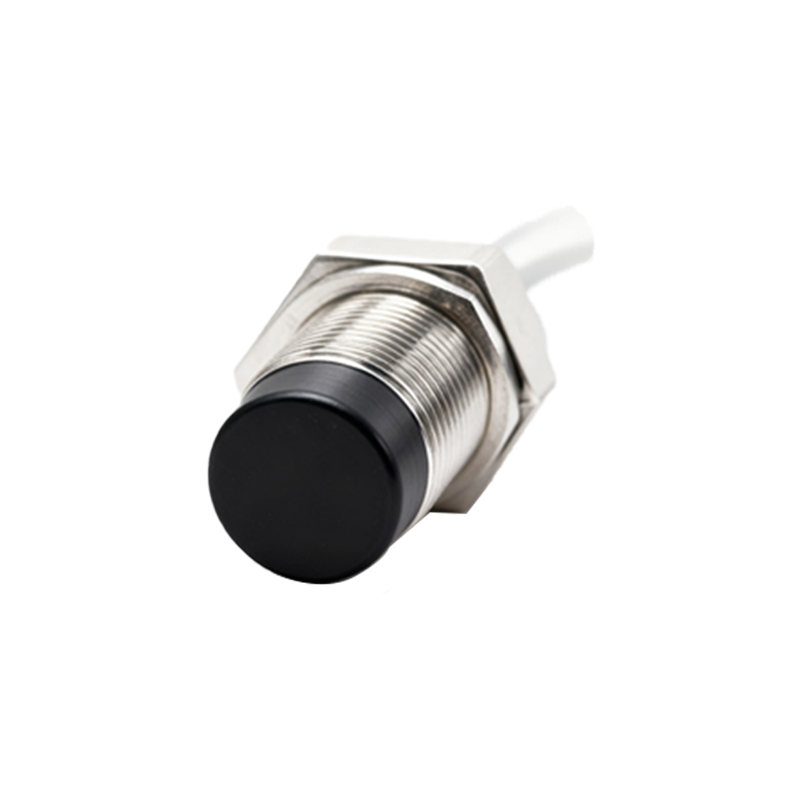
Selecting the right four-wire capacitive proximity sensor requires careful consideration of several parameters. The operating voltage range must match the plant's DC supply. The output type (typically transistor-based PNP or NPN for DC models) must be compatible with the controller's input card. The sensing distance, specified for a standard target (often mild steel or water), must be sufficient for the application, with a derating factor applied for materials with lower dielectric constants. Housing material (e.g., stainless steel, PBT plastic) is chosen based on the chemical and physical environment. Temperature range and electrical protection features like short-circuit, reverse polarity, and overload protection are also vital for long-term reliability. Finally, the physical form factor (barrel-style, rectangular) must suit the mounting constraints.
In conclusion, the four-wire capacitive proximity sensor is a powerful and flexible tool in an engineer's arsenal. Its material-agnostic detection capability, coupled with the convenience of dual complementary outputs, makes it a preferred solution for complex detection tasks across countless industries. By understanding its operating principle and meticulously matching its specifications to the application requirements, automation professionals can ensure robust, reliable, and efficient system performance, enhancing both productivity and process control.