Proximity sensors are indispensable components in modern industrial automation, providing non-contact detection of metallic and non-metallic objects. Proper wiring is critical to ensure reliable operation, safety, and longevity of these sensors. This article presents practical wiring examples for common types of proximity sensors, including inductive, capacitive, and ultrasonic models, tailored for typical industrial scenarios.
Inductive proximity sensors are widely used for detecting metallic objects. A standard three-wire DC inductive sensor typically includes brown (positive), blue (negative), and black (output) wires. In a standard NPN configuration, the brown wire connects to the positive DC supply (typically +24V DC), the blue wire to the common ground (0V), and the black wire to the load (e.g., a PLC input module). The load is then connected between the black wire and the positive supply. For PNP configurations, the black output wire switches the positive voltage; thus, the load is connected between the black wire and ground. Shielded cables are recommended for long runs in electrically noisy environments to prevent false triggering.
Capacitive proximity sensors can detect both metallic and non-metallic materials, such as plastics, liquids, or wood. Wiring is similar to inductive sensors, but attention must be paid to grounding and sensitivity adjustments. For a three-wire DC capacitive sensor, connect the brown wire to +24V DC, blue to 0V, and black to the load. Ensure the sensor body is properly grounded via the mounting hardware or a dedicated ground wire to stabilize the electrostatic field. Avoid mounting these sensors near moving metal parts or conductive dust, as this can cause interference. Adjust the sensitivity potentiometer so that the sensor detects the target material without being triggered by background objects.
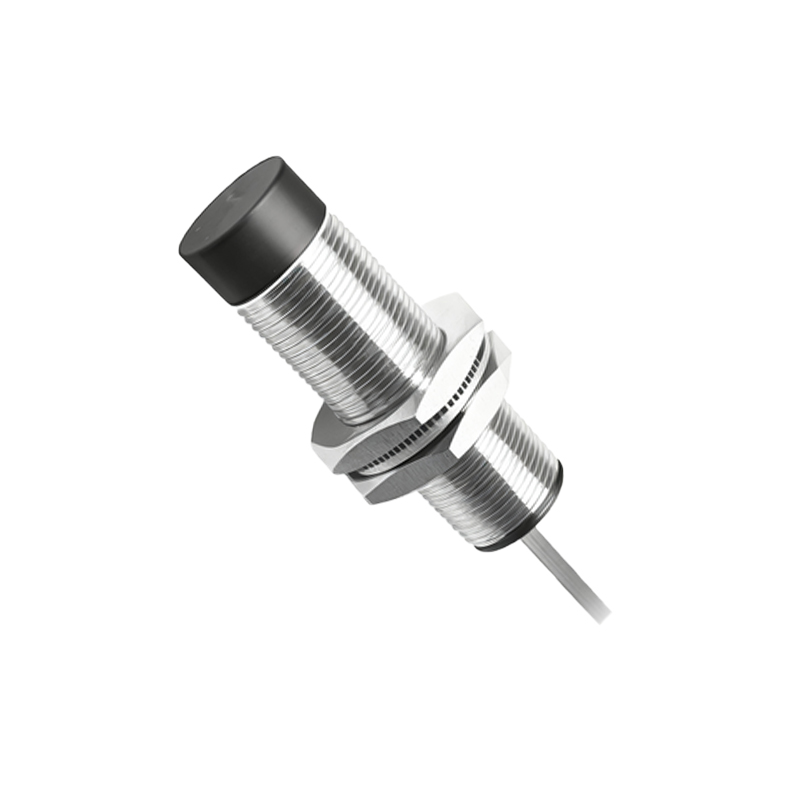
Two-wire AC proximity sensors simplify wiring by operating directly on AC voltage (e.g., 120V AC). Connect one wire to the live AC terminal and the other to the load, which is then connected to the neutral line. Note that two-wire sensors have a residual leakage current even when off, which may require a bypass resistor in parallel with the load to prevent ghost voltage issues. Always verify the sensor’s voltage rating matches the supply to avoid damage.
For hazardous locations or high-noise environments, consider using intrinsically safe or shielded versions. Intrinsically safe sensors require barriers or isolators to limit energy, with wiring following strict guidelines to prevent ignition risks. Shielded sensors use a metal casing or additional wire (usually yellow/green) for grounding, which must be connected to a solid earth ground to drain electromagnetic interference.
Ultrasonic proximity sensors, used for distance measurement or level detection, often feature four wires: power (+), power (-), output, and a shield. Pair them with compatible controllers, and ensure the sensing face is clear of obstructions like dust or foam, which can attenuate sound waves. Use twisted-pair cables for power and output lines to reduce noise coupling.
In complex setups, such as daisy-chaining multiple sensors or integrating with PLC systems, always refer to the manufacturer’s datasheet. Key steps include: verifying voltage compatibility, using correct wire gauges (e.g., 18 AWG for most low-power sensors), implementing proper grounding, and adding surge protectors for outdoor installations. Test the circuit with a multimeter to confirm voltage levels and output switching before full deployment.
Common pitfalls include reverse polarity, inadequate grounding, and ignoring environmental factors like temperature or humidity. For instance, high humidity can affect capacitive sensors, while metal chips may adhere to inductive sensors, causing false signals. Regular maintenance, such as cleaning sensing faces and checking connections, enhances reliability.
By following these wiring examples and best practices, engineers can optimize proximity sensor performance, minimize downtime, and ensure safe operation across diverse industrial applications, from packaging lines to robotic assembly cells.