In the realm of precision measurement and industrial automation, laser displacement sensors stand as a cornerstone technology. Among the various configurations, the oblique incidence method presents a unique and powerful solution for specific measurement challenges. This article delves into the operational principles, key advantages, typical applications, and critical selection factors for oblique incidence laser displacement sensors, providing a comprehensive guide for engineers and technical decision-makers.
The fundamental principle of an oblique incidence laser displacement sensor involves projecting a focused laser beam onto the target surface at a known, fixed angle—typically between 30 to 60 degrees—rather than perpendicularly. The diffusely reflected light from the measurement point is then received by a position-sensitive detector (PSD) or a CMOS/CCD array within the sensor head. As the target's surface height changes, the position of the reflected light spot shifts on the detector. Using trigonometric calculations based on the fixed projection angle and the measured spot displacement, the sensor's internal processor accurately calculates the change in the target's height or distance. This triangulation method is highly robust and capable of achieving sub-micron resolution.
A primary advantage of the oblique incidence configuration is its exceptional suitability for measuring shiny, mirror-like, or transparent surfaces. Perpendicular incidence sensors often suffer from specular reflection, where the laser beam reflects directly away from the receiver, causing signal loss. By using an oblique angle, the sensor captures the diffuse reflection component, ensuring a stable and reliable signal even on polished metals, glass, or liquid surfaces. Furthermore, this setup allows for the measurement of steps, edges, and profiles that might obstruct a perpendicular beam path. It enables measurements in confined spaces or on specific points of a complex component that are not accessible from a direct top-down approach.
The application spectrum for oblique incidence laser sensors is vast and critical across multiple industries. In semiconductor manufacturing, they are indispensable for wafer warpage measurement, lead frame coplanarity inspection, and precise solder paste height profiling. The automotive sector relies on them for measuring paint thickness on car bodies, inspecting sealant bead dimensions, and verifying the flatness of machined engine components. In electronics assembly, they ensure the precise height of components post-reflow and check connector pin positions. Additionally, they play a vital role in measuring the thickness of transparent films, monitoring the surface quality of rolled metals, and performing 3D profile scanning of objects where shadowing is a concern with other methods.
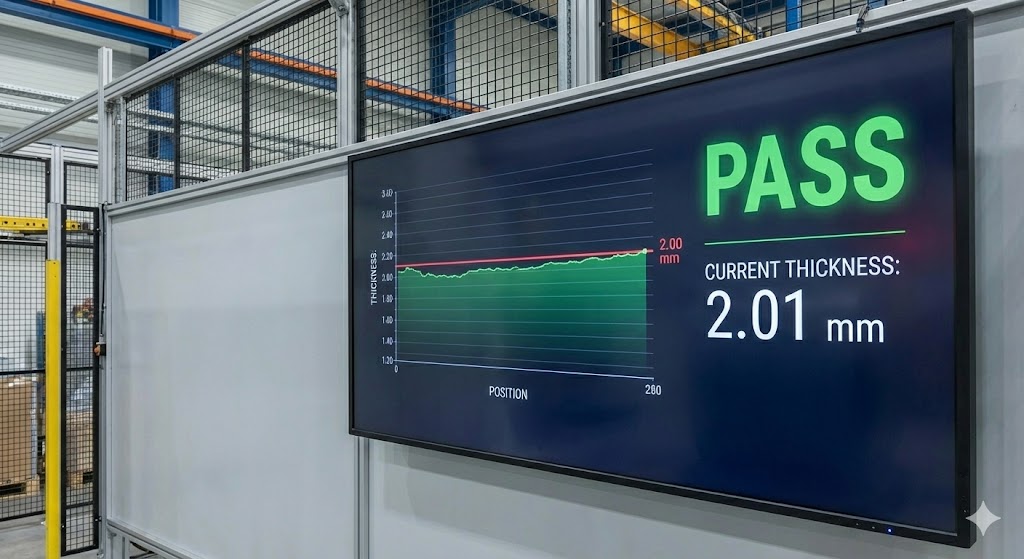
Selecting the appropriate oblique incidence laser displacement sensor requires careful consideration of several technical parameters. First, the measurement range and stand-off distance must be chosen based on the physical constraints of the application. A longer stand-off might be necessary for hot targets or to avoid contamination. Second, the spot size is crucial; a smaller spot enables higher resolution and the ability to measure finer details or steep edges. Third, the linearity and repeatability specifications determine the sensor's accuracy and consistency over time and temperature variations. Environmental robustness, indicated by Ingress Protection (IP) ratings and resistance to vibrations, is essential for harsh industrial environments. Finally, the output interface (analog, digital, Ethernet, etc.) and compatibility with existing control systems must be evaluated.

Integration of these sensors into a production line often involves mounting them on adjustable brackets or robotic arms to maintain the precise incident angle. Calibration using a known reference target is a mandatory step to ensure accuracy. Users must also be mindful of the effective measurement direction, which is perpendicular to the target surface, not along the laser beam. Changes in the target's material or color can affect the intensity of the reflected light but modern sensors with automatic gain control (AGC) can compensate for these variations to a significant degree, maintaining measurement stability.
In conclusion, oblique incidence laser displacement sensors offer a specialized and highly effective solution for non-contact measurement tasks involving reflective surfaces, complex geometries, and challenging access. Their operation based on the triangulation principle provides high precision and reliability. By thoroughly understanding their working methodology, strengths, and the key parameters for selection, engineering professionals can effectively leverage this technology to enhance quality control, enable process automation, and drive innovation in manufacturing and research applications. As demands for higher precision and more versatile metrology grow, the role of these sophisticated sensors will continue to expand.
