Laser light sensors represent a critical advancement in industrial automation and precision measurement technologies. These devices operate based on the fundamental principles of optical triangulation, time-of-flight (ToF), or interferometry, depending on their specific application. At their core, laser light sensors emit a focused beam of coherent light—typically from a laser diode—toward a target object. The interaction between the laser beam and the object's surface generates reflections or scattering, which are then captured by a photodetector within the sensor. By analyzing characteristics such as the angle of reflected light, intensity variations, or phase shifts, the sensor calculates precise measurements of distance, position, thickness, or presence detection.
In optical triangulation-based sensors, the emitted laser beam forms a spot on the target surface. The reflected light is focused onto a position-sensitive detector (PSD) or a charge-coupled device (CCD). As the distance to the target changes, the position of the reflected spot shifts on the detector. Using geometric triangulation formulas, the sensor's embedded processor converts this positional data into accurate distance measurements. This method is highly effective for short to medium-range applications, such as in assembly line inspection or robotic guidance systems, where sub-millimeter accuracy is required.

Time-of-flight (ToF) laser sensors, on the other hand, measure distance by calculating the time it takes for a laser pulse to travel to the target and back. These sensors emit short pulses of infrared or visible laser light and use high-speed timers to detect the round-trip duration. Since the speed of light is constant, the distance can be derived precisely with the formula: distance = (speed of light × time) / 2. ToF sensors are ideal for long-range measurements, such as in warehouse automation or vehicle detection, offering robustness against environmental factors like ambient light interference.

Interferometric laser sensors utilize the wave nature of light to achieve nanometer-level precision. They work by splitting a laser beam into a reference path and a measurement path. The beam reflected from the target recombines with the reference beam, creating an interference pattern. Changes in the target's position alter the phase of the reflected light, causing shifts in the interference fringes. By analyzing these shifts, the sensor can detect minute displacements, making it invaluable in semiconductor manufacturing or precision metrology.
Key components of laser light sensors include the laser source, optics (lenses and mirrors), photodetectors, and signal processing units. The laser source must provide stable, monochromatic light with low divergence to ensure consistent performance. Optics are designed to focus the beam and collect reflected light efficiently, while photodetectors—such as photodiodes or avalanche photodiodes—convert optical signals into electrical ones. Advanced signal processing algorithms filter noise, compensate for environmental variations, and enhance measurement reliability.
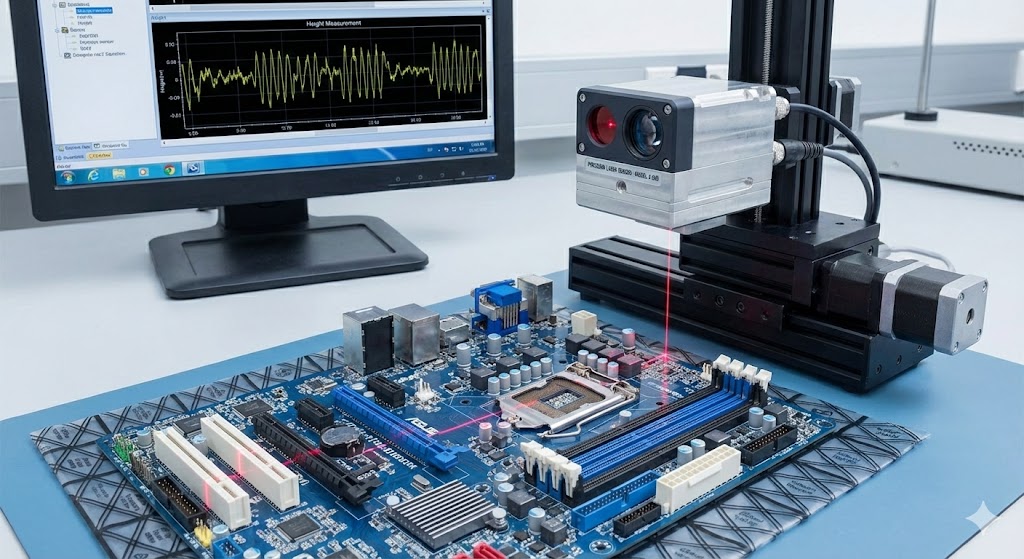
Industrial applications of laser light sensors are vast and diverse. In automotive manufacturing, they are used for weld seam tracking, gap measurement, and part alignment. In electronics, they assist in PCB inspection and component placement. Environmental monitoring leverages laser sensors for detecting particulate matter or gas concentrations via light absorption techniques. Their non-contact nature minimizes wear and tear, allowing for high-speed, repeatable operations in harsh conditions like high temperatures or dusty environments.
Despite their advantages, laser light sensors face challenges such as sensitivity to surface properties (e.g., reflectivity and color), which can affect accuracy. Calibration and regular maintenance are essential to mitigate drift over time. Emerging trends include the integration of artificial intelligence for adaptive sensing and the development of miniaturized sensors for IoT devices. As industries push toward greater automation and precision, laser light sensors will continue to evolve, offering enhanced capabilities in smart factories and beyond.