In the realm of industrial automation, robotics, and advanced electronics, the demand for high-precision, compact, and reliable distance measurement solutions has never been greater. Micro laser distance sensors have emerged as a pivotal technology, offering unparalleled accuracy in a minuscule form factor. These sensors operate on the principle of time-of-flight (ToF) or phase-shift measurement, where a laser diode emits a focused beam toward a target. The sensor then calculates the distance by measuring the time delay or phase difference between the emitted and reflected light signals. This method allows for non-contact measurement with resolutions often reaching the sub-millimeter range, even at distances of several meters.
The core advantages of micro laser sensors lie in their miniaturization and performance. Traditional large-scale laser rangefinders are being rapidly supplanted by these micro versions in applications where space is at a premium. For instance, in collaborative robotics (cobots), these sensors are integrated into grippers or arms to provide real-time feedback for object detection, positioning, and obstacle avoidance. Their small size and low power consumption make them ideal for battery-operated or portable devices. Furthermore, the laser spot is exceptionally small and precise, enabling measurements on very small targets or within confined spaces where other optical sensors might fail.
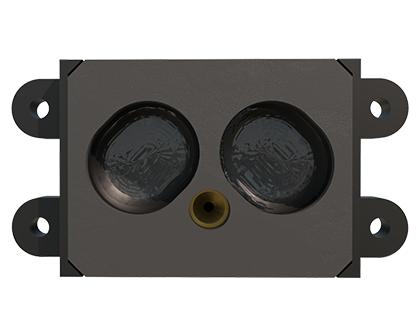
Another significant application is in consumer electronics, particularly in smartphones and tablets for autofocus enhancement and augmented reality (AR) features. The sensor's ability to quickly and accurately map surfaces in three dimensions is crucial for depth-sensing cameras. In industrial quality control, micro laser sensors are deployed on production lines to verify dimensions, detect presence or absence of components, and measure thickness or warpage with high repeatability. Their immunity to ambient light interference and ability to work on various surface materials—from glossy metals to dark, non-reflective plastics—adds to their versatility.
However, selecting the right micro laser sensor requires careful consideration of several parameters. Measurement range, accuracy, repeatability, response time, and the required interface (e.g., analog voltage, digital I/O, or serial communication like RS-485 or IO-Link) must align with the application's needs. Environmental factors such as temperature fluctuations, dust, and vibrations also play a critical role; many industrial-grade models feature robust housings (often IP67 rated) and built-in temperature compensation to ensure stable operation in harsh conditions.

The integration of these sensors into larger systems is facilitated by smart features like programmable measurement windows, multi-point averaging, and onboard data processing. This reduces the load on the central controller and simplifies system design. Looking ahead, advancements in laser diode efficiency, signal processing algorithms, and packaging technology will continue to drive down costs while enhancing performance. Emerging trends include the integration of micro laser sensors with AI for predictive maintenance and adaptive control systems, opening new frontiers in automation.

In conclusion, micro laser distance sensors represent a critical enabler for precision in the modern technological landscape. Their compact design, high accuracy, and adaptability make them indispensable across diverse sectors, from manufacturing and logistics to consumer tech and research. As industries push toward greater automation and intelligence, the role of these sophisticated yet tiny measurement tools will only expand, solidifying their position as a cornerstone of contemporary electro-optical engineering.