In the realm of industrial automation, the reliable detection of objects is paramount. Among the various sensing technologies available, 3-wire DC proximity sensors, particularly those rated for 36 watts, stand out for their robustness and versatility. This article delves into the technical specifications, wiring configurations, operational principles, and key application considerations for these essential components.
A 3-wire proximity sensor is an active electronic device designed to detect the presence or absence of a metallic target without physical contact. The "3-wire" designation refers to its connection scheme: typically, one wire for DC power supply positive (brown), one for DC power supply negative or common (blue), and one for the switched output signal (black for NPN, black for PNP). The "36-watt" rating is a critical parameter, often related to the sensor's maximum switching capacity or its power consumption under specific conditions. It is crucial to interpret this value correctly by consulting the datasheet. In many contexts, this rating pertains to the maximum load the sensor's output can handle, which is calculated using the formula P = V I. For a standard 24V DC sensor, a 36W rating suggests a maximum output current of approximately 1.5 Amps (36W / 24V = 1.5A). This makes it suitable for directly switching small relays, solenoids, or PLC input modules.
The core technology behind these sensors is based on electromagnetic induction. The sensor contains an oscillator circuit that generates a high-frequency electromagnetic field at its sensing face. When a metallic object (ferrous or non-ferrous, depending on the sensor type) enters this field, eddy currents are induced in the target. This causes a change in the oscillation amplitude or frequency within the sensor. An evaluation circuit detects this change and triggers a solid-state switch (usually a transistor) in the output stage. For a 3-wire configuration, this output is either sinking (NPN) or sourcing (PNP). An NPN sensor switches the negative (common) line to the load, while a PNP sensor switches the positive line. Correct selection based on the control system's input logic is essential to ensure proper operation.
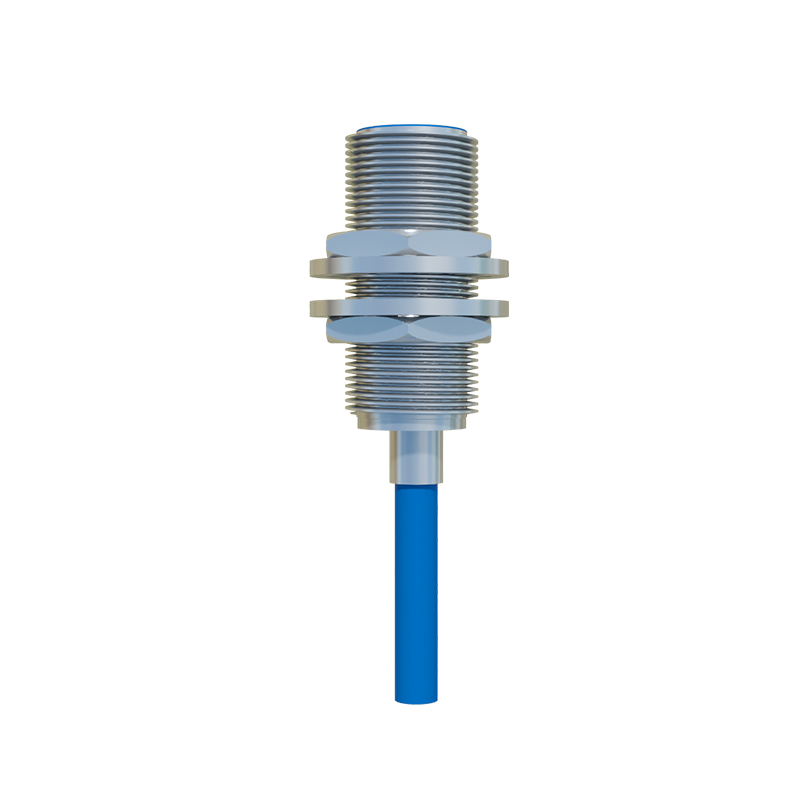
Wiring a 3-wire 36W sensor is straightforward but requires attention to detail. First, ensure the power supply voltage matches the sensor's operating range, commonly 10-30V DC. Connect the brown wire to the positive terminal and the blue wire to the negative terminal of the power supply. The output wire (black) is connected to the load. The other terminal of the load is then connected to the opposite power supply rail: to positive for an NPN sensor, or to negative for a PNP sensor. Always incorporate a protective fuse in the supply line and consider using shielded cables in electrically noisy environments to prevent false triggering. The 36-watt capacity allows for some flexibility but avoid continuous operation at the absolute maximum current to ensure longevity and reliability.
Key advantages of using a 3-wire 36-watt proximity sensor include their fast response times, enabling high-speed counting and positioning tasks. Their solid-state design ensures a long operational life with no moving parts to wear out. They are resistant to environmental contaminants like dust, oil, and moisture, especially those with high IP (Ingress Protection) ratings like IP67. The 36W output rating provides a good balance, offering enough power to drive many industrial loads directly without requiring an intermediary amplifier, thus simplifying control panel design.
When selecting and applying these sensors, several factors must be considered. Sensing distance, or the nominal range at which a standard target can be reliably detected, is a primary specification. Always account for a safety margin; do not operate at the absolute maximum range. The target material and size also affect performance; sensors are typically calibrated for mild steel. For other metals, a correction factor must be applied. Mounting is another critical aspect; flush-mountable sensors can be installed without lateral clearance, while non-flush types require space around the sensing face. For the 36W rating, ensure the inrush current of the connected load (like a solenoid) does not exceed the sensor's peak current capability. Thermal management is also important, as operating near the maximum power dissipation may generate heat.
In conclusion, the 3-wire 36-watt DC proximity sensor is a workhorse in modern industrial systems. Its combination of a simple interface, respectable switching capacity, and non-contact sensing principle makes it indispensable for tasks ranging from simple part detection on a conveyor to complex positional feedback in machinery. A thorough understanding of its electrical characteristics, proper wiring, and application limits is key to leveraging its full potential for creating reliable, efficient, and safe automated processes. Always prioritize consulting the manufacturer's specific datasheet for the exact model in use to