Capacitive proximity sensors are versatile and reliable devices used for non-contact detection of both metallic and non-metallic objects. Their operation hinges on a fundamental principle of physics: the ability to store an electrical charge. Unlike inductive sensors, which only detect metals, capacitive sensors can sense a wide variety of materials, including liquids, plastics, wood, and glass, making them indispensable in numerous industrial and consumer applications.
At the core of a capacitive sensor lies a simple capacitor. In its basic form, a capacitor consists of two conductive plates separated by an insulating material, known as a dielectric. When a voltage is applied, an electric field develops between the plates, and the capacitor stores electrical energy. The sensor itself functions as one plate of this capacitor. The target object, when it enters the sensing field, acts as the second plate. The air (or other medium) between them serves as the dielectric.
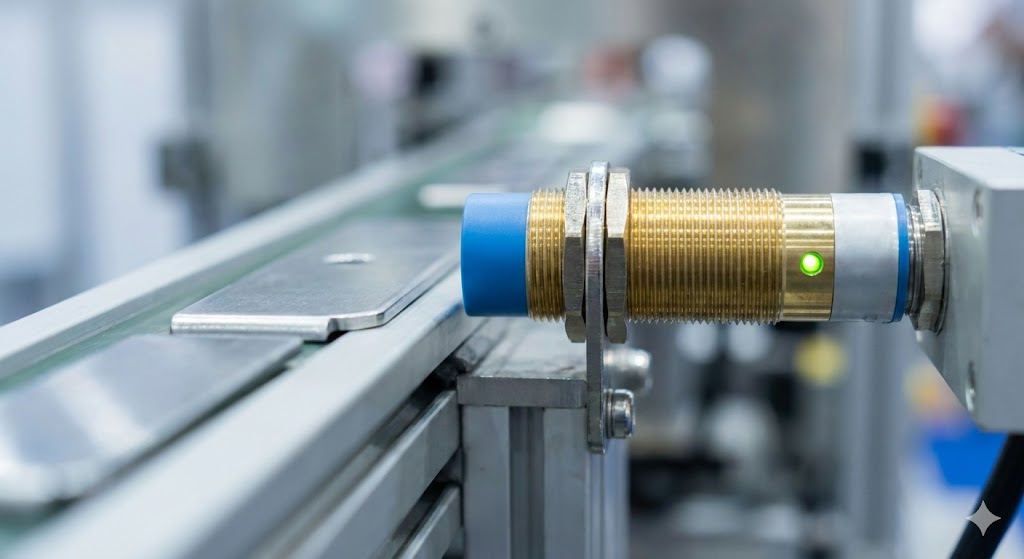
The key parameter is capacitance. Capacitance (C) is determined by three factors: the surface area of the plates (A), the distance between them (d), and the dielectric constant (ε) of the insulating material. The relationship is given by the formula C = ε A / d. A capacitive proximity sensor is designed to detect changes in this capacitance.
The sensor's active face contains an oscillator circuit that generates an electrostatic field. When no target is present, the oscillator is inactive or operates at a specific baseline amplitude. As a target object approaches the sensor's face, it intrudes into this electrostatic field. The target object, regardless of its conductivity, alters the dielectric properties of the space between the sensor plate and the ground. Even non-conductive materials have a dielectric constant higher than air.
This change modifies the capacitance of the system. With a conductive target, it effectively becomes the second plate, increasing the surface area and thus the capacitance. With a non-conductive target, the material's higher dielectric constant replaces the air dielectric, which also increases the capacitance. This increase in capacitance is detected by the sensor's internal circuitry.
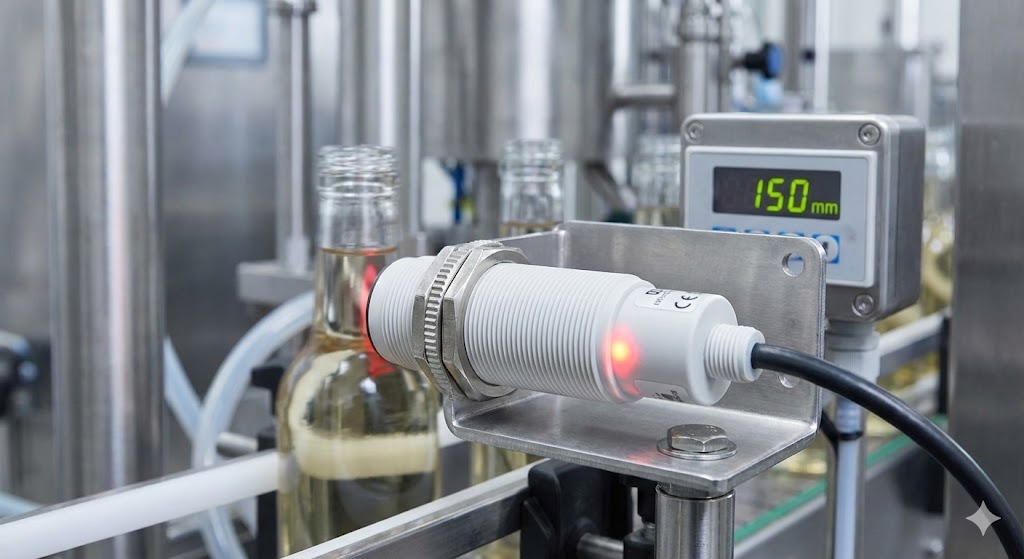
The oscillator's amplitude increases in response to the rising capacitance. A threshold circuit continuously monitors this amplitude. Once the amplitude reaches a pre-set threshold level—corresponding to a specific sensing distance—the sensor's output state switches. This switch can control a relay, transistor, or other output device to signal the presence of the object. When the target moves away, the capacitance decreases, the oscillator amplitude drops below the threshold, and the output returns to its original state.
Several factors influence the sensing performance. The sensing distance is nominal and can be affected by the target's characteristics. Larger target sizes generally increase the effective sensing area, allowing for longer detection ranges. The material composition is critical. Conductive materials like metals are detected at the rated sensing distance. Non-conductive materials are detected at a reduced range, which depends on their dielectric constant. For instance, water (with a very high dielectric constant) can be sensed from a greater distance than a plastic like PVC.
Environmental conditions must also be considered. Factors like humidity, dust, or contaminants on the sensor face can alter the dielectric constant of the ambient environment, potentially causing false triggers. Many industrial sensors feature a sensitivity adjustment potentiometer to compensate for such conditions and to fine-tune the sensor for specific materials or to ignore background interference.
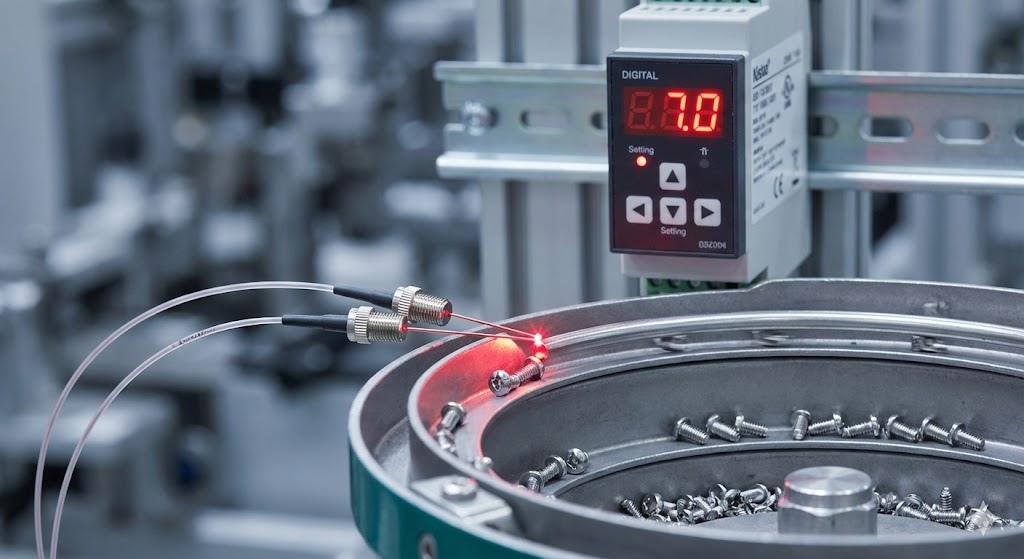
Capacitive sensors come in various housing styles (cylindrical, rectangular) and output types (NPN, PNP, analog, IO-Link). Shielded versions have a grounded ring around the active face, focusing the field forward and making them suitable for flush mounting in metal. Unshielded versions have a larger, more extended field, useful for detecting materials with low dielectric constants.
The applications for capacitive proximity sensors are vast. In packaging, they detect the presence of liquid in bottles or the level of powder in a container. In woodworking, they sense wood or composite boards. In the automotive industry, they are used for fluid level monitoring. They are also common in consumer electronics, such as touch-sensitive buttons and liquid level indicators in appliances.
In summary, the capacitive proximity sensor operates by generating an electrostatic field and detecting changes in capacitance caused by the intrusion of a target object into that field. Its ability to sense almost any material, coupled with its non-contact nature and robustness, makes it a fundamental component in modern automation and sensing technology. Understanding the interplay between the target's dielectric properties, distance, and the sensor's electrical characteristics is key to selecting and applying these sensors effectively.