In the rapidly evolving landscape of industrial automation and precision metrology, the demand for high-speed, non-contact measurement solutions has never been greater. High-frequency laser displacement sensors have emerged as a cornerstone technology, enabling real-time monitoring and control with micron-level accuracy at sampling rates reaching into the hundreds of kilohertz. This article delves into the operational principles, key application areas, and critical selection parameters for these advanced sensing devices.
At its core, a high-frequency laser displacement sensor operates on the principle of optical triangulation or, in more advanced models, confocal or interferometric methods. The triangulation method is most common for high-speed applications. A focused laser beam is projected onto the target surface. The reflected light is detected by a position-sensitive element, such as a CMOS or CCD array. Any change in the distance to the target causes a shift in the position of the reflected light spot on the detector. This positional shift is processed at extremely high speeds by dedicated electronics to calculate the precise displacement value. The "high-frequency" designation refers specifically to the sensor's ability to perform this capture-and-calculate cycle at very high rates, often from 50 kHz to over 500 kHz. This capability is crucial for capturing dynamic events, vibrations, or measurements on fast-moving production lines without aliasing or loss of data fidelity.
The advantages of utilizing high-frequency laser displacement sensors are manifold. First and foremost is speed, allowing for 100% inspection in manufacturing processes previously limited to statistical sampling. Secondly, their non-contact nature eliminates the risk of damaging delicate surfaces or being worn out themselves, ensuring long-term stability and repeatability. Furthermore, they offer exceptional resolution, often down to sub-micron levels, which is essential for quality control in industries like semiconductor manufacturing, precision machining, and electronics assembly.
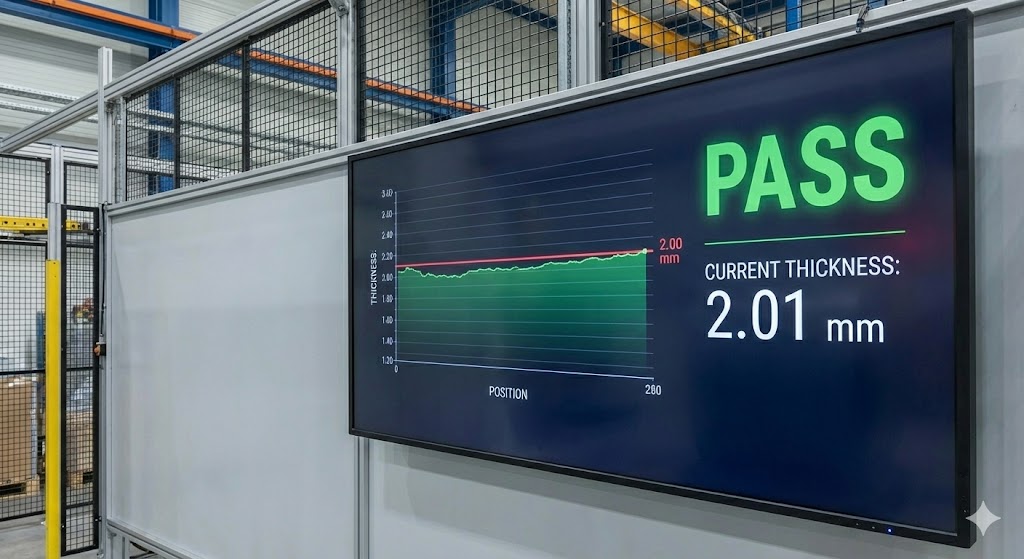
Key application sectors heavily rely on this technology. In the automotive industry, they are deployed for real-time inspection of brake disc thickness variation, piston movement analysis, and vibration measurement on engine test stands. In the production of lithium-ion batteries, they measure electrode coating thickness and foil flatness at web speeds exceeding 100 m/min. In the realm of microelectronics, these sensors control wire bonding processes and inspect solder paste height on PCBs. Additionally, they are indispensable in research and development for analyzing material properties, studying fast mechanical deformations, and monitoring high-frequency oscillations.
Selecting the appropriate high-frequency laser displacement sensor requires careful consideration of several interdependent parameters beyond just the sampling rate. The measurement range, spot size, and stand-off distance must be matched to the target's size and accessibility. The type of target surface significantly impacts performance; polished metals may require sensors with specialized algorithms to handle specular reflection, while dark or absorbent materials might need a higher-power laser. Environmental factors are critical; industrial environments may necessitate sensors with high IP ratings for dust and water resistance, robust housing against vibration, and temperature compensation for thermal drift. The output interface (e.g., analog voltage, digital Ethernet, or high-speed serial) must be compatible with the data acquisition system's bandwidth. Finally, the software ecosystem provided by the manufacturer for setup, data visualization, and analysis can greatly influence the ease of integration and time-to-value.

In conclusion, high-frequency laser displacement sensors represent a critical enabling technology for modern precision manufacturing and advanced research. By providing unparalleled speed and accuracy in a non-contact package, they solve complex measurement challenges that were once insurmountable. As production speeds continue to increase and tolerance windows shrink, the role of these sensors will only become more pivotal. Engineers and system integrators must thoroughly understand both the capabilities of the sensors and the specifics of their application to fully leverage the power of high-frequency displacement measurement, thereby driving improvements in quality, efficiency, and innovation across countless industries.