In the realm of industrial automation, the reliable detection of metallic objects without physical contact is a fundamental requirement. Among the myriad of solutions available, the LJ12A3-4-Z inductive proximity sensor stands out as a robust and widely adopted component. This article delves into the technical specifications, operational principles, and practical application considerations for this specific sensor model, providing a comprehensive guide for engineers and technicians.
The LJ12A3-4-Z is a cylindrical, shielded inductive proximity sensor. The "LJ" designation typically refers to a standard series, "12" indicates a 12mm diameter barrel, "A3" often specifies the sensing distance (3mm in this case), and "4-Z" commonly denotes the output configuration and connection type—in this instance, a 3-wire DC type (NPN normally open output) with a cable lead. Its primary function is to detect the presence of ferrous and non-ferrous metals, such as steel, aluminum, brass, and copper, though with varying sensing distances due to material-specific reduction factors.
At its core, the sensor operates on the principle of electromagnetic induction. Inside the sensor's face, an oscillator generates a high-frequency alternating magnetic field. When a metallic target enters this field, eddy currents are induced on the target's surface. These eddy currents draw energy from the oscillator, causing a reduction in its amplitude. This change is detected by a threshold circuit, which subsequently triggers a solid-state switch (the output transistor) to change state. For the LJ12A3-4-Z with NPN output, this means the output line switches to a low-voltage state (sinks current) when a target is detected within its nominal sensing range.
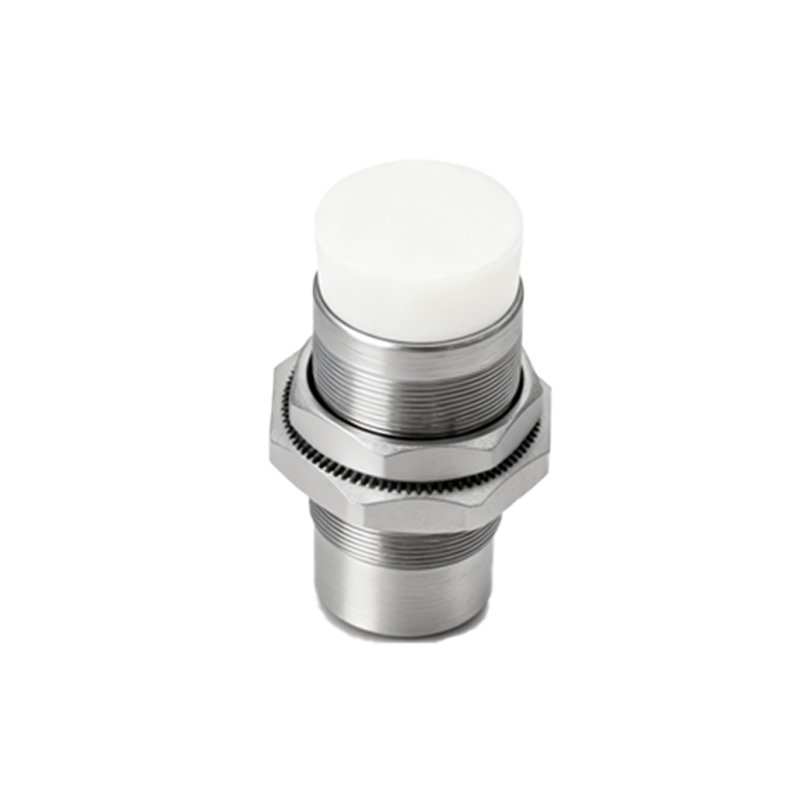
Key technical parameters define its performance envelope. The rated sensing distance (Sn) is 3mm ±10%. It is crucial to note that this is defined for a standard target of mild steel (Fe 360) with dimensions equal to the sensor's face. For non-ferrous metals, the effective sensing distance is reduced; for instance, aluminum might be detected at approximately 40-50% of Sn. The sensor features a hysteresis of typically 3-15% of Sn to prevent output chatter when a target is at the exact detection boundary. The operating voltage range is typically 6-36V DC, making it compatible with common industrial control voltages like 12V or 24V DC. The output current is up to 300mA, sufficient to drive relays, PLC inputs, or small solenoids directly. Its response frequency can reach up to 1kHz, allowing for the detection of rapidly moving parts. The housing is usually constructed from nickel-plated brass or stainless steel, offering good resistance to industrial environments, with a protection rating of IP67, ensuring defense against dust and temporary immersion.
Installation and wiring are straightforward but require attention to detail. Being a shielded (flush-mountable) type, the LJ12A3-4-Z can be installed flush in a metal bracket without affecting its sensing characteristics, a significant advantage in space-constrained applications. The standard three-wire configuration includes Brown (V+), Blue (0V/GND), and Black (Output). For proper operation with an NPN output, the load (e.g., a PLC input) is connected between the Black wire and the positive supply (Brown). Always consult the manufacturer's datasheet for the definitive wiring diagram. Key installation considerations include maintaining a minimum non-metallic clearance around the sensing face and avoiding parallel mounting of multiple sensors too closely to prevent mutual interference.
Typical applications for the LJ12A3-4-Z are extensive across automation. It is perfectly suited for position sensing of machine tool slides, end-of-travel limit detection, counting metal parts on conveyors, verifying the presence of a metal component in an assembly fixture, and detecting the position of a piston in a pneumatic cylinder (using a metallic trigger). Its compact size, reliability, and non-contact nature make it indispensable for repetitive tasks where mechanical limit switches would suffer from wear.
For optimal performance and longevity, adherence to operating limits is paramount. Avoid exposing the sensor to excessive temperatures beyond its specified range (commonly -25°C to +70°C). Ensure the target material and size are appropriate for the required sensing distance. When detecting non-standard materials, always conduct real-world tests to verify the actual sensing point. Proper electrical protection, such as fusing and transient suppression, should be considered in electrically noisy environments to prevent damage from voltage spikes or incorrect wiring.
In summary, the LJ12A3-4-Z inductive proximity sensor represents a mature, reliable technology for metallic object detection. Its standardized design, solid performance characteristics, and ease of integration have cemented its place as a workhorse component in countless industrial control systems. A thorough understanding of its