In the realm of industrial automation and control systems, the reliability and precision of sensing technology are paramount. Among the various types of sensors, inductive proximity switches stand out as a fundamental and widely adopted solution for non-contact detection of metallic objects. This article delves into the operational principles, key characteristics, selection criteria, and application best practices for these robust electronic devices.
At its core, an inductive proximity sensor operates on the principle of electromagnetic induction. The sensor generates an oscillating electromagnetic field from its active face, typically via a coil wound around a ferrite core. When a metallic target enters this field, eddy currents are induced on the surface of the target. These eddy currents draw energy from the oscillator circuit, causing a change in its amplitude. This amplitude reduction is detected by a threshold circuit, which subsequently triggers a solid-state output switch—either PNP (sourcing) or NPN (sinking)—to change state, signaling the presence of the object. It is crucial to note that these sensors are designed specifically for detecting ferrous and non-ferrous metals, with varying sensing distances depending on the target material.
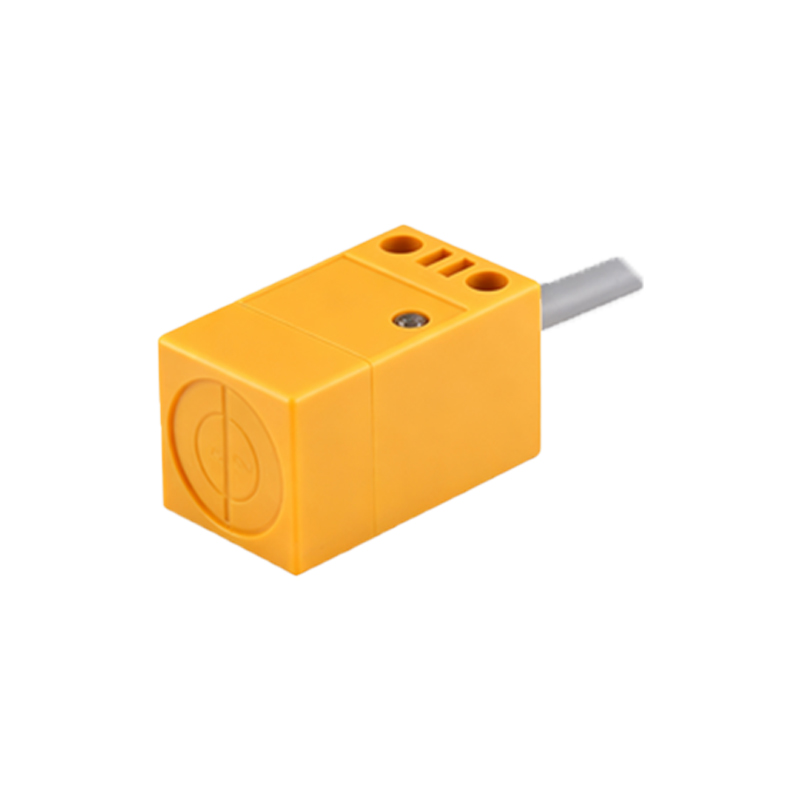
The defining performance metric for any proximity switch is its nominal sensing distance (Sn), as defined by international standards like IEC 60947-5-2. This is the theoretical operating distance under standardized conditions. In practice, engineers must account for factors such as temperature fluctuations, supply voltage tolerance, and target material, which influence the effective operating distance. A key design feature is the built-in hysteresis, which prevents output chattering when a target is at the edge of the sensing range. This ensures a clean, stable switching signal even in environments with vibration.
Selecting the appropriate inductive proximity sensor requires careful consideration of several parameters. First, the housing style must be chosen based on the installation environment: cylindrical threaded barrels (e.g., M8, M12, M18, M30) are common for general-purpose mounting, while rectangular or block-style housings offer alternative form factors. The sensing range must be matched to the application; standard-range sensors suffice for most tasks, while specialized models offer extended or reduced ranges. The output configuration is another critical choice. Two-wire AC/DC, three-wire DC (PNP or NNP), and four-wire (dual-output) models are available. Three-wire DC sensors are predominant in modern PLC-based systems due to their compatibility and ease of wiring. The output type can be normally open (NO), normally closed (NC), or programmable. Furthermore, the protection rating, denoted by IP (Ingress Protection) codes like IP67 or IP69K, indicates the sensor's resilience against dust and water ingress, which is vital for harsh industrial environments such as washdown areas in food processing or outdoor machinery.
Application versatility is a hallmark of inductive proximity switches. They are ubiquitously employed for position detection—confirming whether a cylinder is fully extended or retracted, verifying the presence of a part on a conveyor, or counting metallic objects. In machine safety, they can serve as interlock monitors on guard doors. Their non-contact nature eliminates mechanical wear, granting them a significantly longer operational lifespan compared to mechanical limit switches. This makes them ideal for high-cycle applications. For challenging environments, all-welded stainless steel housings and specialized coatings are available to resist corrosion from coolants, oils, or chemicals.
Installation and commissioning demand attention to detail. Engineers must ensure adequate clearance around the sensor's active face—both laterally and axially—to prevent false triggering from the mounting bracket or adjacent metal structures, a parameter specified as "non-flush" or "flush-mountable." Proper shielding and cable routing are necessary in electrically noisy environments to prevent electromagnetic interference (EMI) from causing erratic behavior. Regular maintenance, though minimal, should include periodic cleaning of the sensing face to remove debris like metal chips or grease that could attenuate the sensing field.
In conclusion, inductive proximity switches are indispensable components in the industrial engineer's toolkit. Their robust construction, non-contact operation, and high reliability make them the go-to choice for millions of detection tasks worldwide. A thorough understanding of their technology and a methodical approach to selection and installation are key to leveraging their full potential, thereby enhancing system uptime, safety, and overall manufacturing efficiency. As Industry 4.0 advances, these sensors continue to evolve, integrating IO-Link communication for diagnostics and parameterization, further solidifying their role in the connected, data-driven factory of the future.