In the realm of industrial automation and control systems, proximity sensors play a pivotal role in detecting the presence or absence of objects without physical contact. Among the various types available, the 3-wire proximity sensor stands out due to its widespread application and reliable performance. This article delves into the structural composition of a typical 3-wire proximity sensor, explaining its key components and how they function together to ensure accurate sensing.
A 3-wire proximity sensor primarily consists of three main sections: the sensing element, the oscillator and demodulator circuit, and the output switching circuit. Each of these sections is crucial for the sensor's operation. The sensing element, usually located at the front end of the sensor, is responsible for generating an electromagnetic field. This field is typically produced by a coil wound around a ferrite core. When a metallic object enters this field, eddy currents are induced in the object, leading to a change in the oscillation amplitude within the sensor.
The oscillator circuit, integrated into the sensor's internal electronics, generates a high-frequency alternating current that powers the sensing coil. This circuit maintains a constant oscillation as long as no target object is detected. Upon detection, the eddy currents cause a damping effect on the oscillation, which is then picked up by the demodulator. The demodulator converts this change into a direct current signal that can be processed further. This signal conditioning is vital for ensuring that the sensor responds only to valid targets while ignoring environmental noise or interference.
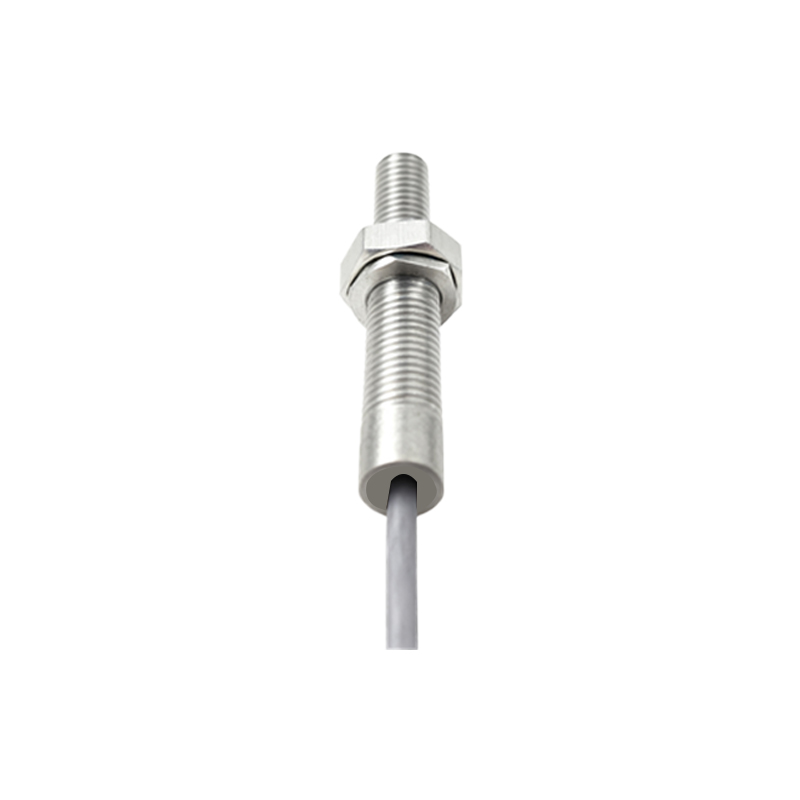
Following the demodulation stage, the signal is fed into the output switching circuit. In a 3-wire configuration, the sensor has three distinct wires: one for power supply (typically labeled V+ or brown wire), one for ground (often blue wire), and one for the output signal (usually black wire). The output circuit can be either NPN (sinking) or PNP (sourcing), depending on the design. This circuit activates a solid-state switch, such as a transistor, to control an external load like a relay, PLC input, or indicator light. The choice between NPN and PNP depends on the electrical requirements of the control system, with PNP being common in positive-logic applications and NPN in negative-logic setups.
The housing of a 3-wire proximity sensor is another critical aspect of its structure. Made from materials like nickel-plated brass, stainless steel, or plastic polymers, the housing provides mechanical protection and environmental sealing. Many sensors are rated IP67 or higher, making them resistant to dust, moisture, and chemical exposure. The shape and size of the housing—whether cylindrical, rectangular, or ring-shaped—are tailored to specific installation needs, such as flush or non-flush mounting in machinery.
Internally, the components are mounted on a printed circuit board (PCB) that ensures stable electrical connections. Advanced sensors may include additional features like short-circuit protection, reverse polarity protection, and LED indicators for status monitoring. These enhancements improve durability and ease of maintenance in harsh industrial environments.
Understanding the structure of a 3-wire proximity sensor is essential for proper selection, installation, and troubleshooting. By recognizing how the sensing element, oscillator, demodulator, and output circuit interact, engineers can optimize sensor performance for applications ranging from conveyor systems and robotic arms to safety interlocks and packaging machines. Regular inspection of the housing and electrical connections further ensures long-term reliability, minimizing downtime in automated processes.
In summary, the 3-wire proximity sensor's design integrates electromagnetic principles with robust electronics to deliver non-contact detection. Its structured approach—combining a sensing coil, signal processing circuits, and a protected output—makes it a versatile tool in modern industry. As technology evolves, innovations in materials and miniaturization continue to enhance its capabilities, but the fundamental three-wire architecture remains a cornerstone of efficient automation.