In the realm of industrial automation and control systems, proximity sensors are indispensable components. These non-contact devices detect the presence or absence of an object within a defined sensing range without any physical contact. Their ability to operate reliably in harsh environments, provide high-speed response, and offer long service life makes them a cornerstone of modern manufacturing, robotics, and machinery safety. This article delves into the primary types of proximity sensors, their operating principles, common applications, and key considerations for selection.
The fundamental working principle of most proximity sensors involves generating an electromagnetic field or a beam of radiation. When a target object enters this field, it causes a change in the field's properties or the signal's return path. This change is detected and converted into an electrical output signal, typically a switch closure or an analog value. The nature of the generated field defines the sensor type and its suitability for different materials.
Inductive Proximity Sensors are among the most common types. They generate an oscillating electromagnetic field. When a metallic object (ferrous or non-ferrous) enters this field, it induces eddy currents within the target, which dampens the oscillation. The sensor detects this damping and triggers an output. Inductive sensors are ideal for detecting metals only. They are robust, resistant to dust, oil, and coolant, making them perfect for machine tools, automotive assembly lines, and metal detection tasks. Their sensing range is relatively short, typically up to 60 mm, depending on the target metal and sensor size.
Capacitive Proximity Sensors can detect both metallic and non-metallic materials, including liquids, plastics, glass, wood, and granules. They operate by generating an electrostatic field. Any object with a dielectric constant different from air will alter the capacitance of the sensing circuit when it approaches the active face. This change is measured to produce an output. Capacitive sensors are widely used in level detection for tanks (liquids or powders), material handling for non-metals, and presence detection of packaging materials. They can also sense through certain non-metallic walls, enabling sealed container monitoring.
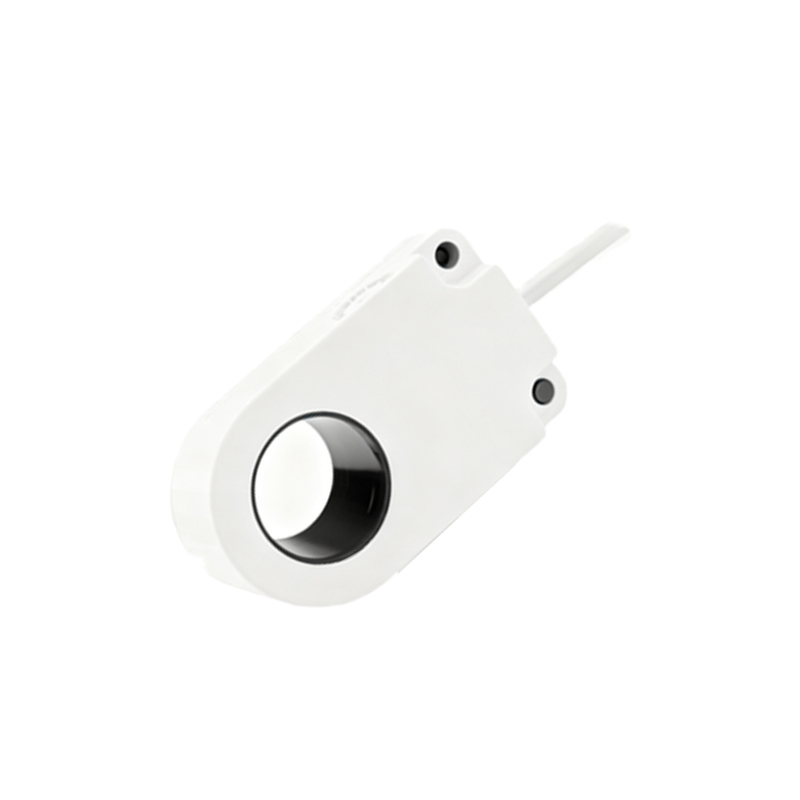
Ultrasonic Proximity Sensors use sound waves beyond the human hearing range. They emit high-frequency ultrasonic pulses and measure the time taken for the echo to return from a target object. This time-of-flight principle allows them to measure distance (analog output) as well as detect presence (switching output). Unlike inductive and capacitive types, ultrasonic sensors are excellent for detecting objects regardless of color, transparency, or material, as long as the surface can reflect sound. Common applications include pallet detection, loop control, liquid level sensing, and collision avoidance in automated guided vehicles (AGVs). Environmental factors like temperature, humidity, and air turbulence can affect their accuracy.
Photoelectric Sensors, while sometimes categorized separately, function as proximity devices in their diffuse (reflective) mode. They consist of an emitter (usually an LED producing visible red, infrared, or laser light) and a receiver. In the diffuse mode, the sensor detects light reflected directly from the target object. The presence of the object within the sensing range causes a sufficient amount of light to return to the receiver, triggering the output. They offer the longest sensing ranges among standard proximity types and can detect virtually any material. They are sensitive to color, reflectivity, and surface texture. Applications are vast, including object counting on conveyors, bottle detection in packaging, and registration control.
Magnetic Proximity Sensors (Reed Switches or Hall Effect sensors) detect the presence of a permanent magnet. When the magnet approaches, it either closes a reed contact (reed switch) or causes a voltage change in a semiconductor (Hall effect sensor). These sensors are simple, cost-effective, and used where only a magnetic field needs to be detected, such as in cylinder position sensing (with a magnet embedded in the piston), door/window position sensing in safety systems, and speed detection.
Selecting the right proximity sensor requires a careful analysis of the application parameters. Key factors include:
1. Target Material: Metal detection points to inductive sensors. For non-metals, capacitive or ultrasonic are choices.
2. Sensing Distance: Required range dictates sensor size and technology.
3. Output Type: Discrete (PNP/NPN) or analog (4-20 mA, 0-10V).
4. Environmental Conditions: Exposure to washdown, chemicals, extreme temperatures, or heavy vibration demands specific housing ratings (e.g., IP67, IP69K).
5. Installation and Size: Space constraints may limit sensor dimensions.
6. Response Speed and Switching Frequency: Critical for high-speed production lines.
7. Cost: Inductive sensors are generally the most economical for metal sensing.
In conclusion, the diversity of proximity sensor