In the world of industrial automation and control systems, proximity sensors are ubiquitous. Their primary function is to detect the presence or absence of an object without physical contact. A common question among engineers, technicians, and system designers is: Can proximity sensors detect non-metallic objects? The answer is not a simple yes or no; it depends fundamentally on the type of proximity sensor technology employed. This article delves into the operating principles of the main proximity sensor types and clarifies their capabilities regarding non-metallic material detection.
The most prevalent type is the Inductive Proximity Sensor. These sensors generate an electromagnetic field. When a metallic object enters this field, eddy currents are induced in the object, causing a change in the sensor's oscillation amplitude or frequency. This change is detected and triggers the sensor's output switch. The key limitation here is that inductive sensors are specifically designed to detect conductive metals, primarily ferrous metals like steel and iron, and to a lesser extent, non-ferrous metals like aluminum or copper. They are generally incapable of detecting non-metallic materials such as plastic, wood, glass, ceramic, or liquids, as these materials do not conduct electricity and thus do not affect the electromagnetic field sufficiently. Therefore, for detecting non-metals, an inductive sensor is not the correct choice.
For non-metallic object detection, the Capacitive Proximity Sensor is the go-to solution. Unlike inductive sensors, capacitive sensors can detect both metallic and non-metallic objects. They operate by generating an electrostatic field. Any object that enters this field alters the sensor's capacitance. Since all materials have a dielectric constant (a measure of how well a material can store electrical energy in an electric field), they will affect the capacitance to some degree. This includes solids like plastic, wood, paper, glass, and ceramics, as well as liquids and granular materials. The sensitivity of a capacitive sensor can often be adjusted via a potentiometer to ignore certain materials (like a container wall) and detect the target material (like a liquid level inside). This makes them incredibly versatile for applications involving bottles, cardboard boxes, wood panels, or detecting fill levels in non-metallic tanks.
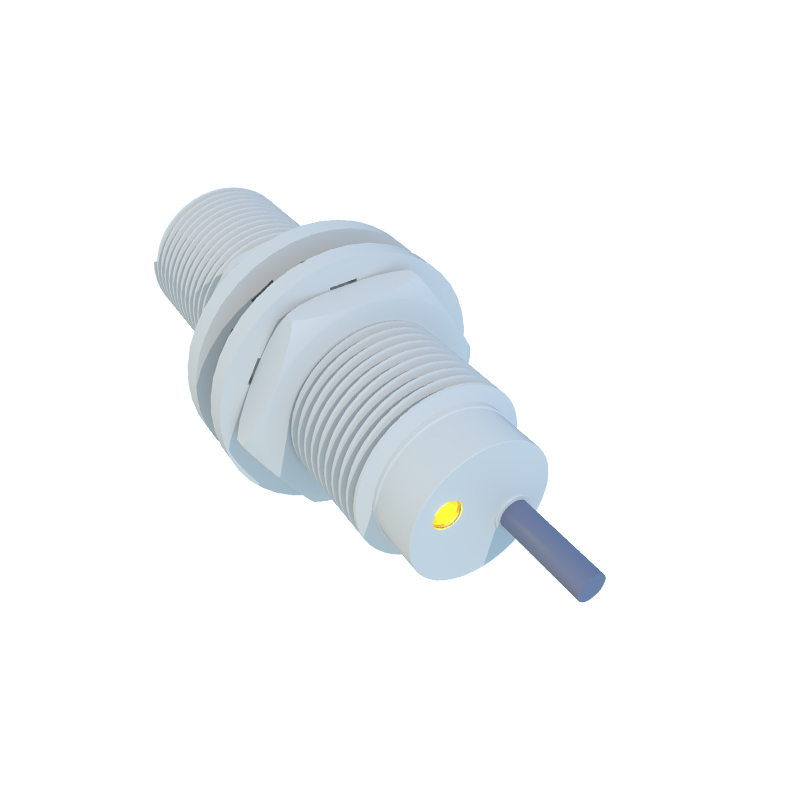
Another powerful technology for non-metallic detection is the Ultrasonic Proximity Sensor. These sensors work on the principle of echolocation. They emit high-frequency sound waves and measure the time it takes for the echo to return after bouncing off an object. Since they rely on sound reflection, the material's conductivity or dielectric properties are irrelevant. Ultrasonic sensors can reliably detect virtually any solid or liquid object, regardless of its material composition—be it metal, plastic, wood, or even transparent glass. They are excellent for applications requiring longer sensing ranges, level detection in bulk solids, or detecting transparent objects that might challenge optical sensors.
Photoelectric Sensors also play a crucial role in non-metallic detection. They use a light beam (visible red, infrared, or laser) and detect changes in the received light intensity. Objects interrupt or reflect this beam. Photoelectric sensors are material-agnostic; they can detect any object that is opaque or reflective enough to affect the light beam. This makes them perfect for detecting plastics, films, labels, and even clear glass bottles in packaging and bottling lines. Different modes (through-beam, retro-reflective, diffuse reflective) offer solutions for various non-metallic detection challenges.
In summary, the detection of non-metallic objects is entirely feasible with the appropriate sensor technology. Inductive proximity sensors are unsuitable for this task. Instead, engineers must select from capacitive, ultrasonic, or photoelectric sensors based on the specific application requirements:
Capacitive Sensors: Ideal for detecting most solids, liquids, and granules at short to medium ranges, especially when material composition varies.
Ultrasonic Sensors: Best for longer ranges, level sensing, or detecting objects with complex surfaces, unaffected by color or transparency.
Photoelectric Sensors: Optimal for high-speed detection, precise positioning, and applications involving transparent or highly reflective non-metals.
Understanding these fundamental differences is critical for designing efficient, reliable, and cost-effective automated systems. Always consult the sensor datasheet and consider factors like sensing distance, target size, environmental conditions (dust, moisture), and the specific dielectric or acoustic properties of the non-metallic material in question.