In the realm of industrial automation, the reliable detection of metallic objects is a fundamental requirement. Among the myriad of sensing solutions available, the E2B-M18 inductive proximity sensor stands out as a workhorse, renowned for its robustness, precision, and versatility. This article delves into the technical specifications, operational principles, and key application considerations for this widely adopted sensor.
The "E2B-M18" designation follows a common industry nomenclature. Typically, 'E2B' refers to the specific series or family from a manufacturer like Omron, a leading producer of such sensors. 'M18' specifies the sensor's threaded barrel housing diameter, which is 18 millimeters. This standardized size allows for easy installation in a vast array of mounting fixtures and brackets commonly found on machinery.
At its core, the E2B-M18 is an inductive proximity sensor. It operates on the principle of electromagnetic induction. The sensor contains an oscillator circuit that generates a high-frequency electromagnetic field at its active face (the sensing surface). When a metallic object (the target) enters this field, eddy currents are induced on the surface of the metal. This causes a change in the oscillation amplitude within the sensor's circuit. An integrated evaluation circuit detects this change and triggers a solid-state output switch (typically NPN or PNP transistor output). This switching action sends a signal to a programmable logic controller (PLC) or other control device, indicating the presence or absence of the target.
Key technical parameters define the performance of an E2B-M18 sensor. The sensing distance is a critical specification. For a standard M18 inductive sensor, this is often 5mm or 8mm, but it can vary. It is crucial to note that this is the nominal sensing distance for a standard target (usually a square of mild steel, 1mm thick). The actual sensing range can be affected by the target material's properties; for instance, non-ferrous metals like aluminum or copper have a reduced effective sensing distance. The sensor's housing is usually constructed from nickel-plated brass or stainless steel, offering excellent resistance to oils, coolants, and physical impact. Most models are rated IP67 or higher, making them dust-tight and capable of withstanding temporary immersion, suitable for harsh industrial environments.

Output configuration is another vital selection criterion. E2B-M18 sensors are available in two primary output types: NPN (sinking) and PNP (sourcing). The choice depends on the electrical requirements of the control system's input module. Furthermore, they come in normally open (NO) or normally closed (NC) contact logic. A 3-wire design (Brown for +V, Blue for 0V, Black for output signal) is standard, though 2-wire AC/DC versions also exist. Operating voltage ranges are typically 10-30V DC for 3-wire models.
The application scope for the E2B-M18 sensor is extensive. Common uses include:
Position Detection: Verifying the presence of a metal part at a specific station on an assembly line.
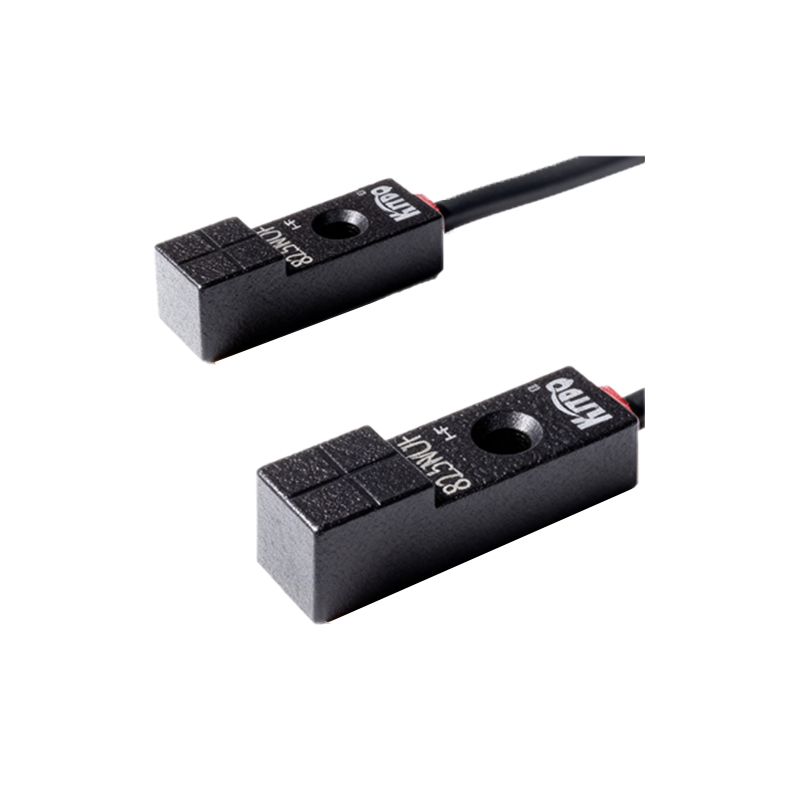
End-of-Travel Sensing: Detecting the limit position of a pneumatic cylinder with a metal piston rod or a magnetic collar.
Counting and Sorting: Counting metal objects on a conveyor belt or sorting based on metallic presence.
Rotor Position Sensing in Motors: Detecting gear teeth or keyways for speed monitoring.
Machine Safety: As part of non-contact interlock systems, though not for primary safety functions without appropriate safety ratings.
When installing an E2B-M18 sensor, several best practices ensure optimal performance. First, ensure the target approaches the sensor head axially for maximum sensing distance. Side-approach can reduce effectiveness. Second, maintain adequate clearance from surrounding metal objects (the "flush-mountable" feature of many models mitigates this). Third, always refer to the manufacturer's datasheet for wiring diagrams and ensure correct polarity to prevent damage. Regular maintenance involves simply wiping the sensing face clean of any debris, grease, or metal chips that could interfere with the electromagnetic field.
In conclusion, the E2B-M18 inductive proximity sensor is a quintessential component in modern industrial control systems. Its non-contact operation, high switching frequency, immunity to environmental contaminants, and mechanical durability make it an indispensable tool for engineers and technicians. Understanding its operating principles, specifications, and application nuances is key to designing reliable, efficient, and maintenance-friendly automation solutions. Whether on a packaging machine, a CNC lathe, or a robotic cell, the humble E2B-M18 continues to be a silent, sentinel of precision in the automated world.