In the realm of industrial automation and precision measurement, laser sensors have emerged as indispensable tools, offering unparalleled accuracy, speed, and reliability. Their ability to detect objects, measure distances, and inspect surfaces has revolutionized processes across manufacturing, robotics, logistics, and beyond. This article delves into the fundamental principles of how laser sensors detect, explores their diverse applications, and provides insights into their critical role in modern industry.
At its core, a laser sensor operates by emitting a focused beam of coherent light—typically from a laser diode—towards a target. This light interacts with the target's surface. The sensor then captures the reflected or scattered light using a photodetector or a specialized receiver like a CCD or CMOS array. The key to detection lies in analyzing this returned light signal. Different detection methods are employed based on the required measurement:
1. Triangulation Method: This is a common principle for precise distance and displacement measurement. The laser emitter, the point of reflection on the target, and the position-sensitive detector (PSD) form a triangle. As the target's distance changes, the position of the reflected light spot on the PSD shifts. By calculating this shift, the sensor determines the exact distance with micron-level accuracy. This method is ideal for measuring height, thickness, and profile.
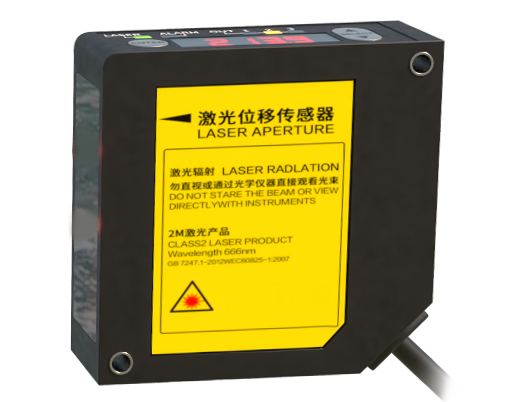
2. Time-of-Flight (ToF) Principle: Used for longer-range measurements, ToF sensors calculate distance by measuring the time it takes for a laser pulse to travel to the target and back. Since the speed of light is constant, the elapsed time is directly proportional to the distance. This technology is widely used in applications like level monitoring in silos, vehicle detection, and mobile robot navigation.
3. Confocal Measurement: This advanced technique uses chromatic aberration. A white light or multi-wavelength laser is focused through a lens. Different wavelengths converge at different focal points. Only the wavelength that is perfectly focused on the target surface is reflected back optimally into the spectrometer. By analyzing this dominant wavelength, the sensor determines the distance with extreme precision, even on transparent or highly reflective surfaces.
4. Laser Light Section Method: For 2D profile or 3D contour scanning, a laser line is projected onto an object instead of a single point. A camera captures the deformation of this line. By analyzing the line's shape in the camera image, the sensor can reconstruct the object's profile, detecting defects, measuring dimensions, or guiding robotic arms.

The detection capability is further enhanced by evaluating the intensity of the returned light. A significant change in intensity can simply indicate the presence or absence of an object (through-beam or retro-reflective sensors). More sophisticated sensors analyze light intensity patterns for tasks like contrast detection (e.g., reading marks on packaging) or recognizing specific surface characteristics.
Industry Applications and Advantages
The practical applications of laser detection are vast. In automotive manufacturing, laser sensors perform 100% inline inspection of weld seams, measure critical gaps and flushness on car bodies, and guide robots for precise part placement. In electronics, they measure component lead coplanarity, inspect solder paste height on PCBs, and ensure precise wafer alignment.
Logistics and packaging benefit from laser sensors that detect labels, count objects on high-speed conveyors, and measure box dimensions for automated sorting and cubing. In metal processing, they monitor sheet flatness, control roll gaps, and measure diameter in wire drawing processes.
The advantages driving their adoption are clear. They offer non-contact measurement, eliminating wear and damage to both the sensor and the target. Their high speed allows for inspection at production line rates. Sub-micron resolution enables quality control in the most demanding sectors. Furthermore, many laser sensors are robust, designed to withstand harsh industrial environments with dust, vibration, and varying temperatures.
Considerations for Implementation
Selecting the right laser sensor requires careful analysis. Key factors include the required measurement range, resolution, target material (color, reflectivity, transparency), environmental conditions, and necessary response time. For instance, a dark, matte surface absorbs more light, potentially requiring a sensor with higher output power or a different detection principle compared to a shiny metal surface.
Integration with control systems is typically straightforward via standard industrial interfaces like IO-Link, analog outputs, or Ethernet protocols. Regular maintenance involves keeping the lens clean and verifying calibration to ensure long-term accuracy.
In conclusion, laser sensors detect by masterfully leveraging the properties of light—its speed, coherence, and interaction with matter. Through principles like triangulation and time-of-flight, they transform physical properties into precise, actionable data. As Industry 4.0 and smart manufacturing advance, the role of laser sensors as the "eyes" of automated systems will only grow more critical, enabling higher efficiency, superior quality, and unprecedented levels of process control. Their continued evolution promises even greater capabilities, solidifying their status as a cornerstone technology in the electrical and automation engineering landscape.