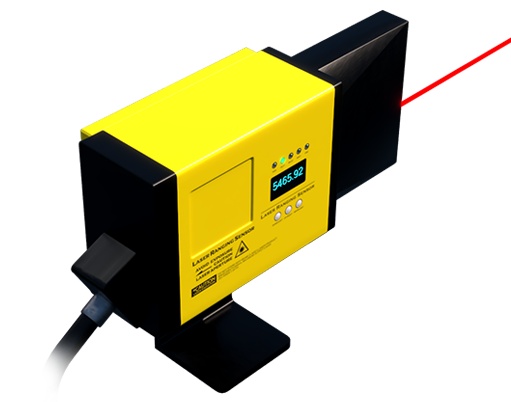
Laser displacement sensor technology has become a cornerstone of precision measurement and automation across numerous industrial sectors. These sensors operate on the principle of triangulation or time-of-flight, emitting a laser beam onto a target surface and analyzing the reflected light to determine distance with exceptional accuracy. The core components typically include a laser diode, a receiving lens, and a position-sensitive detector (PSD) or CMOS/CCD array. Modern iterations offer resolutions down to the sub-micron level and sampling rates exceeding 100 kHz, enabling real-time monitoring of even the most dynamic processes.
The advantages of laser displacement sensors are manifold. Their non-contact nature eliminates the risk of damaging delicate surfaces and avoids wear on the sensor itself, ensuring long-term stability and reliability. They are largely immune to the material properties of the target, such as color or reflectivity, thanks to advanced algorithms and automatic gain control features. This makes them versatile tools for measuring a wide array of objects, from highly reflective metals to dark, absorbent materials. Furthermore, their compact design and robust housings allow for easy integration into harsh industrial environments, resisting vibrations, dust, and temperature fluctuations.
In practical application, these sensors are indispensable. In automotive manufacturing, they precisely measure body panel gaps and flushness, ensuring quality and fit. Within the electronics industry, they verify the coplanarity of semiconductor packages and the thickness of wafer substrates. Robotics heavily relies on laser displacement for precise positioning and contour following. In the realm of quality control, they perform online inspection of product dimensions, detecting warpage, thickness variations, and surface defects at high production speeds. Emerging applications also include monitoring structural deformations in civil engineering and guiding autonomous vehicles with LiDAR systems, a sophisticated form of laser rangefinding.
When selecting a laser displacement sensor, engineers must consider several key parameters. The measuring range defines the minimum and maximum distances over which the sensor can operate accurately. Spot size is critical for measuring small features or uneven surfaces. Linearity indicates the deviation from a perfect straight-line response across the measuring range. Environmental factors like ambient light, temperature, and the presence of contaminants must also be accounted for, often necessitating sensors with specific IP ratings and protective features.
The future trajectory of this technology points toward even greater miniaturization, higher speeds, and enhanced intelligence. The integration of embedded processors and AI-driven software is enabling sensors not only to capture data but also to perform preliminary analysis and make adaptive decisions on the fly. Multi-point and profile sensors, which project a laser line rather than a single point, are gaining traction for capturing complete 3D contours in a single scan. As Industry 4.0 and smart factories evolve, laser displacement sensors will continue to be vital data acquisition nodes, feeding critical dimensional information into digital twin models and closed-loop control systems, thereby driving unprecedented levels of efficiency, quality, and automation.